Why Some Businesses Dominate Local Search (And How You Can Compete)
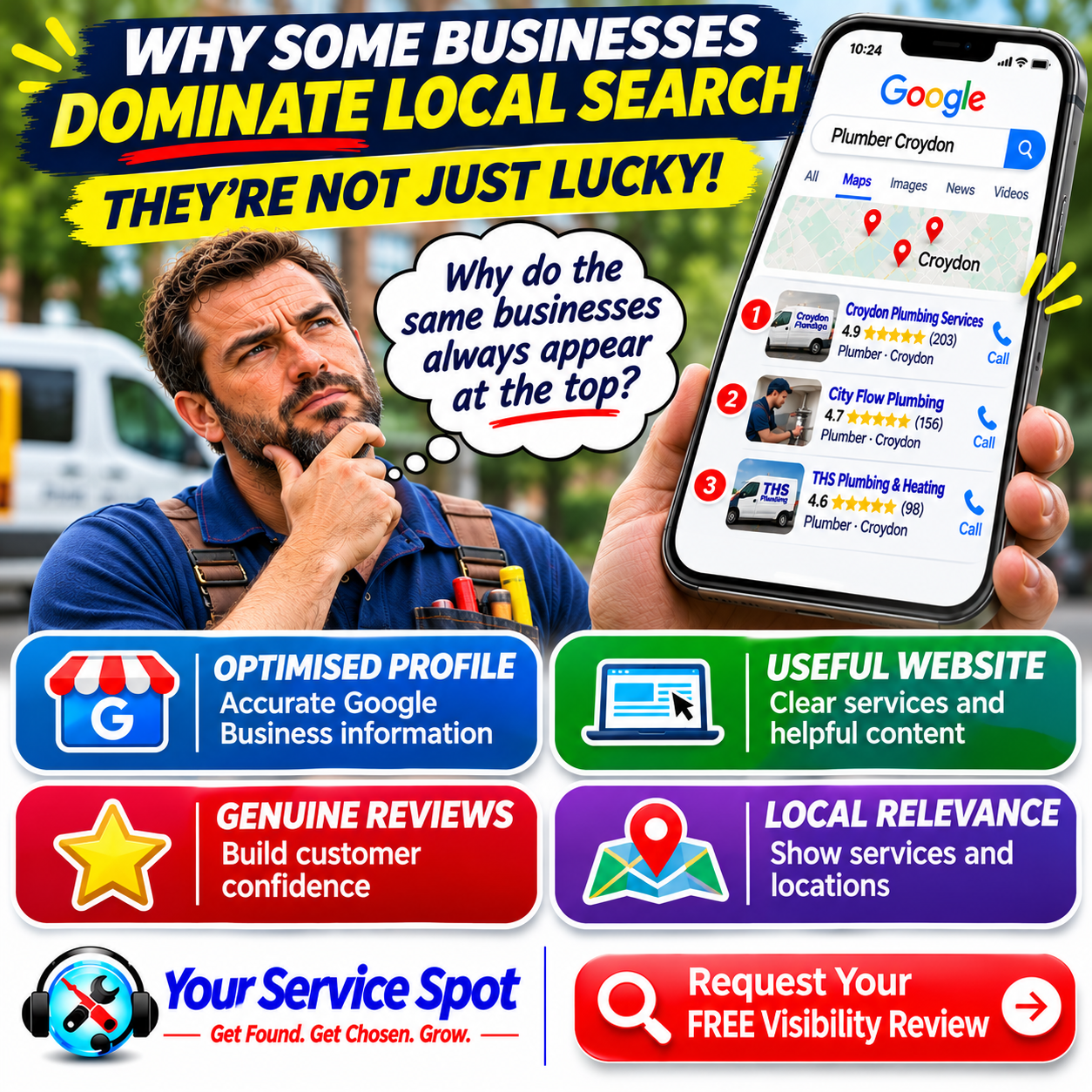
Have you ever searched Google for a local service and noticed the same businesses appearing again and again?
Perhaps you’re looking for a plumber in Croydon, an emergency drainage company in Brighton or a pool maintenance provider in Houston.
Certain businesses seem to appear everywhere:
- They’re prominent in Google Maps.
- Their websites appear near the top of organic search results.
- They have strong customer reviews.
- And when potential customers search for relevant services, those businesses seem to get all the attention.
Meanwhile, your business might provide an equally good service but struggle to get noticed.
So why do some businesses dominate local search while others remain almost invisible?
The answer usually involves a combination of factors.
Strong local search rankings can reflect relevant business information, website content, location, online reputation and other signals that help Google determine which results to display.
The good news is that many aspects of your Google visibility can be improved.
In this guide, we’ll explain what makes some businesses more visible in local search, how Google’s ranking systems work and what practical steps you can take to compete more effectively.
-
What Does It Mean to Dominate Local Search?
A business with strong local search visibility may appear prominently across several relevant Google searches.
For example, a plumbing company might be visible when customers search for:
- Plumber Croydon
- Emergency plumber Croydon
- Boiler repair near me
- Bathroom installation South London
- Local plumbing services
That visibility might include Google Maps listings, Google’s Local 3-Pack and organic website results.
However, these are different search features.
Google Maps and local business listings help customers discover businesses associated with particular locations.
Organic website results help customers find relevant pages, services and information.
A business may perform strongly in one area without being equally visible in the other.
And local rankings can change depending on the searcher’s location, the wording of the search and other factors.
Why Does Local Search Visibility Matter?
Consider someone who needs an emergency plumber.
They’re unlikely to spend hours researching every plumbing company in their area.
They may look at the first few relevant results, compare reviews and contact a business that appears suitable.
If your company isn’t visible during that process, you could miss an opportunity to win the enquiry.
The objective isn’t simply to appear on Google. It’s to be discovered by customers who are actively looking for your services.
What Google visibility actually means.
-
How Google Determines Local Search Rankings
Before investigating why competitors dominate local search, it’s useful to understand how Google evaluates local business results.
Google identifies three main local ranking factors:
Relevance, distance and prominence.
These factors help determine which businesses appear for particular local searches.
Relevance: How Closely Does Your Business Match the Search?
Relevance describes how well a business matches what someone is searching for.
Imagine someone searches for:
“Emergency drain unblocking Brighton”
A drainage company that clearly identifies emergency drain unblocking as one of its services may be a more relevant match than a business whose information only mentions general property maintenance.
Relevant information can include business categories, services and other details Google understands about the company.
How to improve relevance:
- Choose accurate Google Business Profile categories.
- Clearly describe your services.
- Complete relevant business information.
- Create useful website pages.
- Answer common customer questions.
Avoid selecting unrelated categories or adding services you don’t provide simply to attract additional searches.
Distance: How Close Is Your Business to the Customer?
Distance considers how far a business is from the location associated with a search.
For example, someone searching for an electrician in Purley may see different results from someone searching in central Croydon.
This is one reason local search rankings can vary across a relatively small geographical area.
What you can do:
Ensure your genuine business location and service areas are accurately represented.
However, adding more towns to your Google Business Profile doesn’t automatically improve your rankings in those locations.
Distance isn’t something an SEO agency can simply optimise away.
Prominence: How Established Is Your Business Online?
Prominence relates to how well-known or established a business is.
Google considers information about businesses from across the web.
This can include links, reviews and other relevant signals.
Google also states that more reviews and positive ratings can help local rankings.
How to strengthen prominence:
- Encourage genuine customer reviews.
- Build a credible online reputation.
- Earn relevant links and mentions.
- Maintain accurate business information.
- Demonstrate genuine experience and expertise.
However, having more reviews than a competitor doesn’t guarantee a higher ranking.
Strong local search rankings depend on several factors working together.
-
Successful Businesses Take Their Google Business Profile Seriously
Your Google Business Profile is an important part of your local online presence.
It helps customers find useful information about your business through Google Search and Maps.
Yet many business owners create a profile and rarely review it.
Meanwhile, more visible competitors may maintain more complete and accurate information.
What Should Your Google Business Profile Include?
Accurate business categories
Choose the category that best represents your main business activity.
Add relevant secondary categories where appropriate.
Clear service information
Explain the services you genuinely provide.
Correct contact details
Make it easy for customers to reach you.
Accurate opening hours
Include special hours when necessary.
Relevant photographs
Use genuine images that help customers understand your business.
Customer reviews
Encourage authentic feedback and respond professionally.
Useful business information
Complete the fields relevant to your business.
A well-maintained profile helps customers make informed decisions.
It also provides Google with information about your business.
However, posting frequently or uploading large numbers of photographs doesn’t automatically guarantee better local rankings.
Common Google Business Profile Problems
Some businesses struggle because their profiles contain:
- Incorrect primary categories
- Missing service information
- Outdated opening hours
- Inaccurate contact details
- Unnecessary or misleading information
- Duplicate or problematic listings
Correcting these issues can be a sensible starting point.
-
Their Websites Clearly Explain What They Do
Consider two roofing companies.
Business A says:
“We provide professional solutions with exceptional customer service.”
Business B says:
“We provide emergency roof repairs, flat roof replacement and roof inspections throughout Croydon and South London.”
Which description gives customers more useful information?
Business B immediately explains its services and location.
This clarity also helps search engines understand the website.
What Makes a Website Relevant to Local Searches?
A useful local business website should clearly explain:
- What the company does
- Which services it provides
- Where it operates
- Who its customers are
- What problems it solves
- How customers can make an enquiry
Your homepage should communicate your main services quickly.
Individual service pages can provide more detailed information.
For example, a drainage company might have separate pages covering emergency drain unblocking, CCTV drain surveys and drain repairs.
Each page should offer genuine value.
Avoid creating dozens of repetitive pages simply to target slightly different keywords.
Why Clear Website Content Matters
Relevant content helps potential customers understand whether your business can meet their needs.
It also provides useful information for Google to discover and interpret.
-
They Invest in Local SEO Rather Than Relying on Luck
Businesses that consistently perform well in local search may have invested in improving their online presence over time.
This can include website improvements, Google Business Profile optimisation, useful content and reputation management.
Local SEO helps businesses become more relevant and discoverable for searches associated with particular services and locations.
Important Local SEO Activities
Service page optimisation
Clearly explain the services customers are searching for.
Location relevance
Describe genuine service coverage and provide useful local information.
Website accessibility
Ensure search engines can discover important pages.
Business information accuracy
Maintain correct details across relevant platforms.
Online reputation
Encourage genuine reviews and build credibility.
Content development
Answer questions customers ask before choosing a provider.
These activities can reinforce one another.
But local SEO isn’t a one-time task.
Business information changes, competitors improve their websites and customer search behaviour evolves.
Does Every Business Need an Ongoing SEO Strategy?
The appropriate level of activity depends on the business, competition and available resources.
A small company operating in a relatively specialised market may have different needs from a business competing for emergency services across a major city.
The important thing is to identify worthwhile improvements and measure their results.
-
They Build Trust Through Genuine Customer Reviews
Imagine you’re choosing between two local electricians.
One has a detailed website and numerous genuine customer reviews.
The other has very little information about previous customer experiences.
Which would give you greater confidence?
Reviews can help customers evaluate a business before making contact.
And reviews can also contribute to Google’s local ranking prominence.
What Makes a Strong Review Profile?
It’s worth considering:
- Overall customer satisfaction
- The number of genuine reviews
- The information customers share
- How the business responds
- Whether feedback reflects its current services
A business with a consistent review process may develop a more useful body of customer feedback over time.
However, review count alone doesn’t determine local search rankings.
How to Encourage More Reviews
Develop a simple process for requesting honest feedback after completing work.
Provide customers with a convenient review link.
Respond professionally to positive and negative comments.
Avoid buying reviews, offering incentives for positive ratings or selectively requesting reviews only from happy customers.
A genuine reputation is more valuable than an artificially inflated rating.
-
They Create Useful Content for Their Service Areas
Location-specific content can help customers understand where a business operates.
For example, a pool maintenance company serving several Houston neighbourhoods might provide useful information about its services in Bellaire, West University and Memorial.
Similarly, a drainage company serving Brighton and surrounding areas may explain its service coverage.
What Makes a Useful Location Page?
A good location page can include:
- Services genuinely available in the area
- Relevant local information
- Clear service coverage
- Appropriate examples of completed work
- Customer questions
- Contact details
Avoid simply copying the same content and replacing one town name with another.
And don’t invent business addresses or local offices.
Do Location Pages Improve Google Maps Rankings?
Not automatically.
Location pages can help organic website relevance, but Google Maps rankings also depend on distance and other factors.
A business doesn’t become physically closer to a searcher simply because it publishes a location page.
-
They Have a Stronger Online Reputation Beyond Google
Your online reputation isn’t limited to your Google Business Profile.
Potential customers may discover information about your business through other websites.
These might include:
- Relevant industry directories
- Professional associations
- Local business organisations
- Supplier websites
- Customer review platforms
- Local news publications
Accurate information and legitimate mentions can contribute to a credible online presence.
Quality Matters More Than Quantity
A genuine listing with a relevant professional association may be more useful than dozens of low-quality directory entries.
Likewise, an authentic article about a company’s community involvement may help establish recognition.
Avoid purchasing artificial links or participating in schemes designed to manipulate search rankings.
Focus on genuine relationships, useful information and credible sources.
-
Their Websites Provide a Better Customer Experience
Search visibility is valuable, but customers still need to feel confident using your website.
A slow, confusing or difficult-to-navigate website can discourage enquiries.
Important Website Improvements
Mobile usability
Customers should be able to browse your website comfortably on a smartphone.
Clear navigation
Make your main services easy to find.
Page performance
Avoid unnecessary delays and technical problems.
Useful content
Explain your services in straightforward language.
Prominent contact options
Make it easy to call, email or complete an enquiry form.
Trust signals
Show genuine reviews, qualifications and examples of your work where appropriate.
Google uses various signals when evaluating websites, but there isn’t a simple rule that the fastest or most attractive website ranks first.
Nevertheless, improving usability can make your website more helpful to potential customers.
-
They Understand That Local Rankings Change by Location
Here’s something many business owners overlook.
Google Maps results aren’t necessarily the same for everyone.
Imagine two customers searching for:
“Plumber near me”
One is in central Croydon.
The other is in Purley.
They may see different businesses because their locations differ.
Search wording and other factors can also affect the results.
Why This Matters
If you search Google from your office and don’t appear in the top three, that doesn’t automatically mean your business is invisible everywhere.
Likewise, appearing first from your own location doesn’t guarantee first place across your entire service area.
How to Check Local Search Rankings Properly
- Test several relevant searches.
- Record the date and location.
- Compare Google Maps and organic results separately.
- Review Google Search Console information.
- Consider specialist local ranking tools when you need more detailed geographical comparisons.
- Incognito browsing can reduce some personalisation, but it doesn’t remove geographical influences.
Avoid making major SEO decisions based on one search result.
-
How to Analyse Businesses That Dominate Your Local Market
Rather than guessing why competitors are more visible, conduct a structured comparison.
Identify three businesses that repeatedly appear for your most valuable searches.
Then compare the following areas:
| Area | Your business | Competitor | What to investigate |
| Google Business Profile | Current information | Their information | Categories and completeness |
| Customer reviews | Rating and count | Rating and count | Review process |
| Service pages | Existing pages | Existing pages | Content gaps |
| Location coverage | Clearly explained? | Clearly explained? | Local relevance |
| Website usability | Current experience | Their experience | Technical improvements |
| Online reputation | Relevant mentions | Relevant mentions | Credibility |
| Search visibility | Recorded searches | Recorded searches | Ranking patterns |
This comparison can reveal opportunities.
- Perhaps your competitors have clearer service pages.
- Maybe your Google Business Profile contains incomplete information.
- Or their online reputation may be better established.
However, don’t assume every difference explains a ranking gap.
Google’s systems consider multiple signals, and competitors’ actual enquiry volumes generally aren’t publicly available.
The purpose of competitor analysis is to identify practical improvements, not guess Google’s exact algorithm.
-
Ten Practical Steps to Improve Your Local Search Rankings
If you want to strengthen your Google visibility, start with these actions.
Step 1: Review Your Google Business Profile
Check your primary category, services, contact details and opening hours.
Correct inaccuracies.
Step 2: Identify Your Most Valuable Searches
Focus on the services and locations most relevant to your business.
Avoid chasing irrelevant keywords simply because they attract search volume.
Step 3: Improve Your Homepage
Clearly explain what you do, who you help and where you operate.
Step 4: Strengthen Important Service Pages
Provide useful information about your main services.
Answer common customer questions.
Step 5: Review Your Service Areas
Make your genuine coverage clear.
Create useful location content where appropriate.
Step 6: Develop a Consistent Review Process
Encourage authentic customer feedback.
Respond professionally.
Step 7: Improve Website Usability
Check mobile navigation, page performance and contact options.
Step 8: Strengthen Your Online Reputation
Maintain accurate business information and earn relevant mentions.
Step 9: Monitor Competitor Visibility
Track several relevant searches and locations over time.
Step 10: Measure Enquiries, Not Just Rankings
Monitor calls, contact forms and qualified leads.
Improved rankings are useful, but attracting more suitable customers is the real objective.
Local SEO checklist for small businesses.
-
Can You Pay Google to Dominate Local Search?
Google Ads can help businesses appear in paid advertising placements.
However, advertising and organic local rankings are different.
Google states that businesses cannot request or pay for better local rankings.
Paying for Google Ads doesn’t improve your organic position in Google Maps or the Local 3-Pack.
Advertising can provide additional exposure, but it doesn’t replace a sound local SEO strategy.
Be cautious of anyone promising guaranteed first-place organic rankings.
-
How Long Does It Take to Improve Google Visibility?
There isn’t a universal timeframe.
Some improvements can be completed quickly.
For example:
- Correcting inaccurate business information
- Improving service descriptions
- Fixing broken website pages
- Updating contact details
Other improvements take longer.
Developing useful content, strengthening your reputation and building a credible online presence are ongoing activities.
Results depend on your starting position, competition, search demand and how Google responds to changes.
You may improve visibility for certain services before seeing progress elsewhere.
A realistic local SEO strategy focuses on consistent improvements rather than guaranteed rankings by a particular date.
-
What About AI Search Visibility?
Traditional Google Search and Maps remain important discovery channels.
However, customers can also research local businesses using AI-powered platforms such as ChatGPT, Google Gemini and Perplexity.
Instead of typing:
“Emergency plumber Croydon”
A customer might ask:
“Can you recommend a reliable emergency plumber in Croydon who has good reviews?”
AI-powered systems may use available information to generate responses and, depending on the platform, mention relevant businesses.
Can Strong Local SEO Help AI Search Visibility?
Some improvements overlap.
Clear service information, useful content, accurate business details and a credible reputation can support both traditional search and AI-powered discovery.
However, strong Google rankings don’t guarantee AI recommendations.
Different platforms may access different sources and generate different responses.
For small businesses, AI search visibility is another opportunity worth monitoring alongside traditional SEO.
-
Dominating Local Search Isn’t the Final Goal
Imagine your business finally appears prominently in Google Maps:
- A customer discovers your listing.
- They visit your website.
- But your services aren’t clearly explained.
- Your reviews don’t inspire confidence.
- And your contact details are difficult to find.
That potential customer may still choose a competitor.
Being found is only the beginning.
At Your Service Spot, we focus on the complete customer journey.
GET FOUND
Help potential customers discover your business.
BUILD TRUST
Demonstrate your experience, credibility and reputation.
GET CHOSEN
Give customers reasons to consider your services.
GENERATE ENQUIRIES
Make it easy for interested customers to get in touch.
A strong online presence should support the entire process.
How to convert website visitors into leads.
-
Why Are Your Competitors More Visible Than You?
If the same businesses repeatedly appear above yours, there may be worthwhile opportunities to investigate:
- Perhaps your Google Business Profile needs attention.
- Maybe your website doesn’t clearly explain your services.
- Your competitors might have stronger reputations or more relevant content.
- Or their locations may give them an advantage for particular searches.
Without examining the evidence, it’s difficult to know.
That’s where a structured visibility assessment can help.
Request Your FREE Visibility Review
At Your Service Spot, we help local businesses identify opportunities to improve Google visibility, strengthen local SEO and attract more enquiries.
Our approach considers:
- Google Business Profile information
- Local search visibility
- Website content and usability
- Customer reviews and online reputation
- Relevant competitor activity
- Opportunities for improvement
We’ll help you understand where your business stands and which practical improvements may be worth prioritising.
Ready to discover why your competitors keep getting found?
Frequently Asked Questions About Local Search Rankings
-
What are local search rankings?
Local search rankings describe how prominently businesses or websites appear for searches associated with particular locations. These can include Google Maps listings, the Local 3-Pack and organic website results.
-
Why do some businesses dominate local search?
Some businesses have stronger relevance, more complete information, useful website content, established reputations or advantageous locations. The reasons vary by search and ranking system.
-
What are Google’s three main local ranking factors?
Google identifies relevance, distance and prominence as its main local ranking factors.
-
How can I improve my local search rankings?
Review your Google Business Profile, improve service pages, maintain accurate information, encourage genuine reviews and strengthen your website’s usefulness. Monitor relevant searches to identify progress.
-
Does Google Business Profile optimisation improve rankings?
Accurate, complete information can help Google understand your business and match it with relevant searches. However, optimisation doesn’t guarantee a particular ranking.
-
Do more Google reviews mean better local rankings?
Google states that review count and positive ratings can help local rankings. However, review numbers alone don’t determine ranking positions.
-
Why does a competitor with fewer reviews rank above me?
The competitor may be more relevant to the search, closer to the customer or stronger in other ranking signals.
-
Does my website affect Google Maps visibility?
Your website can provide useful information about your services and business. However, Maps rankings depend on several factors, including relevance, distance and prominence.
-
Can location pages improve local SEO?
Useful location pages can support website relevance for genuine service areas. They don’t automatically improve Google Maps rankings.
-
Why do Google Maps results change depending on where I search?
Distance is an important local ranking factor. Different locations can produce different business results.
-
Does posting regularly on Google Business Profile improve rankings?
Google Business Profile posts can help communicate updates to customers, but Google doesn’t guarantee ranking improvements from posting frequency.
-
How important is website speed for local SEO?
Website performance contributes to usability and can be relevant to search performance. However, speed alone doesn’t determine local rankings.
-
Can I pay Google to improve my organic local ranking?
No. Google Ads provides paid advertising opportunities, but paying for advertising doesn’t improve organic Google Maps rankings.
-
How long does local SEO take to work?
There is no guaranteed timeframe. Results depend on competition, your starting position, the changes made and how Google’s systems respond.
-
Is local SEO worthwhile for small businesses?
It can be valuable for businesses whose customers search online for local services. The return depends on demand, competition, investment and conversion performance.
-
How do I find out why competitors rank above me?
Compare Google Business Profiles, website content, reviews, location relevance, technical performance and online reputation. Use several searches and locations rather than relying on one result.
-
Can a small business compete with larger companies in local search?
Yes. Smaller businesses can compete for relevant searches, particularly when their services, locations and customer needs are clearly represented. Results aren’t guaranteed.
-
Does ranking first on Google guarantee more customers?
No. Rankings can improve visibility, but customers still need to trust your business and find it easy to enquire.
-
Does local SEO help AI search visibility?
Some foundations overlap, including clear services, useful content, accurate information and credible reputation. However, Google rankings don’t guarantee AI recommendations.
-
Can an SEO agency guarantee first place on Google?
No credible agency should guarantee a particular organic ranking. Results depend on Google’s systems, competition, location and other factors.