Local SEO Checklist for Small Businesses: A Step-by-Step Guide
If you run a local business, being good at what you do isn’t enough if potential customers can’t find you.
When someone needs a plumber, dentist, accountant, cleaning company, restaurant or other local service, one of their first steps is often to search online.
The question is: will they find your business or one of your competitors?
This local SEO checklist will help you review the most important parts of your online presence and identify opportunities to improve your visibility in Google Search and Google Maps.
You don’t need to complete everything overnight. Local SEO is usually most effective when the fundamentals are put in place and then improved consistently over time.
Let’s get started.
-
Claim and Complete Your Google Business Profile
Your Google Business Profile is one of the most important components of local SEO.
Start by checking that you have access to your profile and that the information accurately represents your business.
Review:
- Business name
- Primary business category
- Additional relevant categories
- Address or service area
- Telephone number
- Website
- Opening hours
- Services
- Business description
- Photographs
Don’t simply complete the profile once and forget about it.
Keep information accurate whenever your services, opening hours or other business details change.
Local SEO Checklist Tip
Pay particular attention to your primary category. It should accurately describe the main service your business provides rather than simply choosing a category because you think it might attract more searches.
-
Check How Your Business Appears on Google
One of the simplest steps in this local SEO guide is also one many businesses overlook.
Search for your own services.
Don’t only search for your business name. A customer who doesn’t already know you won’t do that.
Try searches such as:
[service] + [location]
For example:
- plumber Croydon
- dentist South London
- drain unblocking Brighton
- electrician near me
Look at which businesses appear prominently.
Then ask:
- Does my business appear?
- Which competitors appear instead?
- What do their online presence and Google Business Profiles look like compared with mine?
This gives you a much more realistic picture of your local visibility.
-
Make Sure Your Website Clearly Explains What You Do
Google shouldn’t have to guess what services your business provides.
Neither should your customers.
Your website should clearly communicate:
What you do. Where you do it. Why someone should choose you. What they should do next.
Important services should usually have useful, dedicated content rather than being hidden in a long list on the homepage.
For example, a drainage company might need pages covering drain unblocking, CCTV drain surveys, emergency drainage and drain repairs.
These pages give search engines more context while giving potential customers the information they need before making an enquiry.
-
Optimise Your Website for Your Locations
If you serve particular towns, cities or neighbourhoods, make that clear on your website.
Location-specific pages can be useful when they contain genuinely relevant information for customers in those areas.
Avoid creating dozens of virtually identical pages where only the town name changes.
Instead, build useful pages that explain:
- Services available in the location
- Areas covered
- Relevant local information
- Why customers should choose you
- Frequently asked questions
- How to contact you
Your objective should always be to create something useful for the person who lands on the page.
-
Check Your Business Information Is Consistent
Consistency matters.
Check how your business details appear across your website, Google Business Profile, social media accounts and other important online listings.
Pay particular attention to your:
Business name, address, telephone number and website.
Old telephone numbers, previous addresses, incorrect opening hours or inconsistent business names can create unnecessary confusion for customers.
Make correcting inaccurate information part of your local SEO checklist.
-
Build a Strong Google Review Profile
Reviews can influence whether somebody chooses your business after finding it.
Consider two similar businesses appearing next to each other in Google.
One has a handful of old reviews.
The other has a steady stream of recent reviews from satisfied customers and thoughtful responses from the business.
Which would give you more confidence?
Encourage genuine customers to leave honest Google reviews and make the process easy for them.
Don’t treat reviews as a one-off campaign. Ideally, review generation should become part of your normal customer follow-up process.
And remember to respond to your reviews.
-
Add Genuine, High-Quality Photos
Photos help potential customers understand who they’re dealing with.
Depending on your business, useful images might include:
- Completed work
- Your premises
- Team members
- Vehicles
- Equipment
- Products
- Before-and-after examples
Authentic photographs can be particularly valuable for local service businesses because they provide visible evidence that you’re a real business doing real work.
Keep adding new images rather than relying entirely on photos uploaded several years ago.
-
Create Content Around Questions Customers Actually Ask
Your website shouldn’t only contain sales pages.
Think about the questions customers regularly ask you.
Those questions can become useful articles and guides.
A pool service company, for example, might answer questions about cloudy pool water, pool maintenance after heavy rain or how frequently a pool should be serviced.
A drainage company could explain what causes recurring blocked drains or when a CCTV drain survey is worthwhile.
Useful content can help you reach people earlier in their buying journey while demonstrating expertise.
-
Link Related Pages Together
Internal linking helps visitors discover relevant information elsewhere on your website and helps search engines understand the relationship between your pages.
For example, a blog post about a common customer problem could naturally link to the service that solves it.
A service page could link to the areas where that service is available.
Your links should be helpful and relevant rather than added purely for SEO.
-
Make Sure Your Website Works Properly on Mobile
Local searches frequently happen when people are away from a desktop computer.
Someone looking for an emergency service may be standing outside their house with nothing but a phone.
Your website therefore needs to be easy to use on a small screen.
Check that:
- Text is readable
- Navigation is simple
- Buttons are easy to tap
- Contact details are obvious
- Forms are straightforward
- Pages load reasonably quickly
Most importantly, don’t make potential customers work hard to figure out how to contact you.
-
Give Visitors a Clear Next Step
Traffic alone doesn’t grow a business.
Customers do.
Every important page should make the next step obvious.
Depending on the business, that could be:
- Call Now
- Request a Quote
- Book an Appointment
- Get Directions
- Send an Enquiry
A visitor shouldn’t reach the end of a page and wonder what they’re supposed to do next.
Local SEO gets more valuable when visibility turns into enquiries.
-
Monitor Your Local Search Visibility
Don’t assume your SEO is working simply because you’ve made some changes.
Measure it.
Monitor indicators such as:
- Visibility for important searches
- Google Business Profile interactions
- Website traffic
- Calls and enquiries
- Review growth
- Organic leads
- Which pages attract visitors
The ultimate objective isn’t simply achieving rankings.
It’s generating more opportunities for your business.
Your Quick Local SEO Checklist
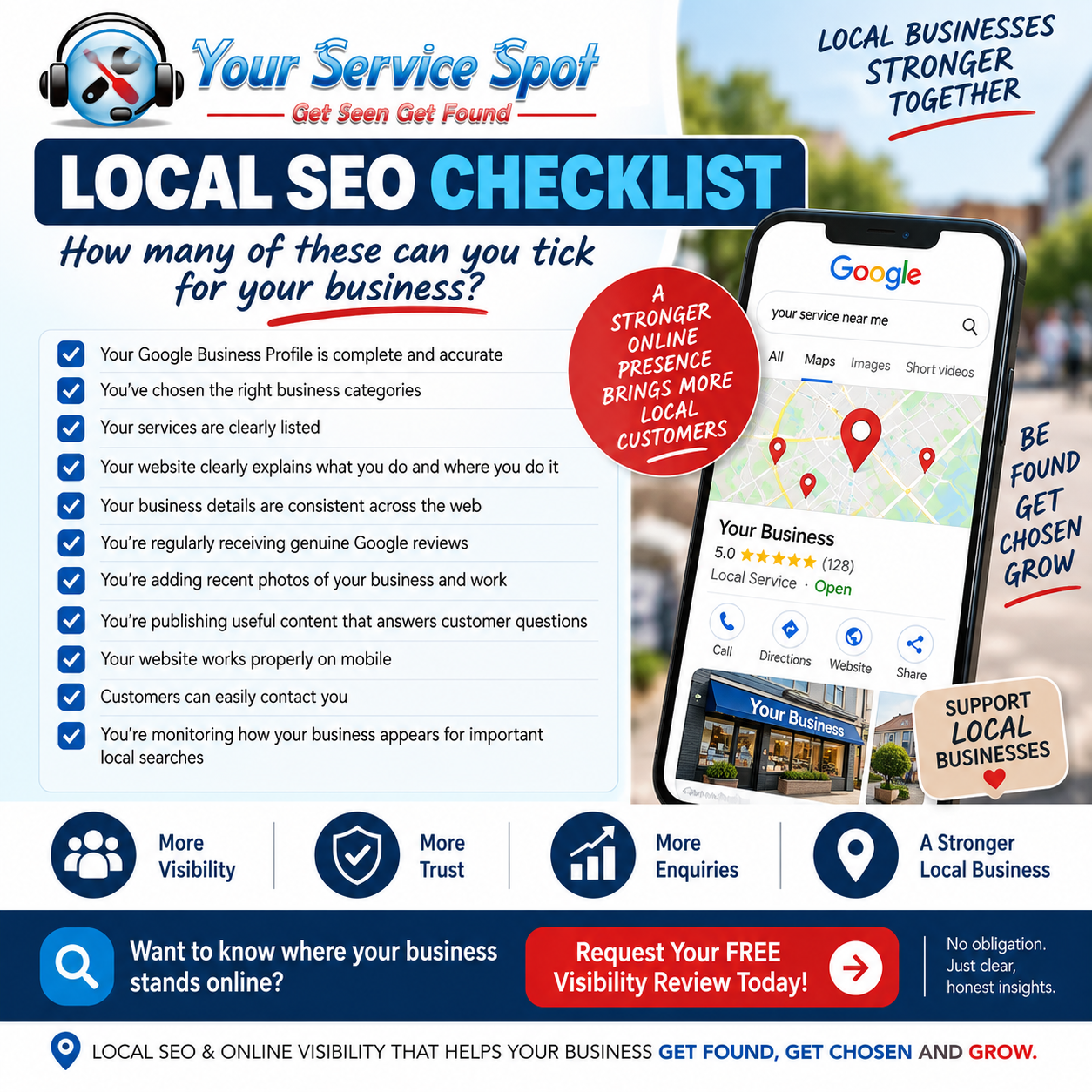
How many of these can you confidently tick today?
☐ Google Business Profile complete and accurate
☐ Correct primary and secondary categories
☐ Services clearly listed
☐ Website explains what you do and where
☐ Important services have useful content
☐ Relevant locations are properly covered
☐ Business details are consistent online
☐ New Google reviews are being generated
☐ Reviews receive appropriate responses
☐ Recent, genuine photographs are being added
☐ Helpful local/service content is published
☐ Related website pages are internally linked
☐ Website works well on mobile
☐ Calls to action are clear
☐ Local visibility and enquiries are monitored
If you’ve found several boxes you can’t tick, that’s useful information.
You’ve just identified potential opportunities to improve your local visibility.
Local SEO Isn’t About One Magic Trick
One of the biggest misconceptions about local SEO is that changing one keyword, adding a few Google posts or publishing one new webpage will suddenly transform a business’s rankings.
In reality, effective local SEO involves multiple signals working together.
Your Google Business Profile, website, services, content, reviews, reputation and overall online presence all contribute to how easily customers can discover and evaluate your business.
And competitors aren’t standing still either.
That’s why local SEO should be viewed as an ongoing process of improving, measuring and refining.
How Your Service Spot Can Help
Working through a local SEO checklist yourself is an excellent starting point.
But sometimes it’s difficult to see your own business through the eyes of Google—or a potential customer.
That’s where we can help.
At Your Service Spot, we look at how your business appears online, identify potential visibility gaps and show you where improvements could be made.
How Visible Is Your Business Right Now?
Request your FREE Visibility Review and find out where your business could be missing opportunities.
Get Found. Get Chosen. Grow.
Frequently Asked Questions About Local SEO
What is a local SEO checklist?
A local SEO checklist is a structured way to review the factors that can affect how easily a local business is discovered online. It can include your Google Business Profile, website, reviews, services, location information, content and overall online presence.
What are the most important parts of local SEO?
There isn’t one single factor that determines local visibility. Important areas include an accurate Google Business Profile, a relevant and useful website, customer reviews, consistent business information and strong service and location content.
How do I know whether my local SEO is working?
Look beyond rankings alone. Monitor whether your business is becoming more visible for commercially important searches and whether that visibility is generating website visits, calls, enquiries and customers.
How long does local SEO take?
There is no universal timeframe. Results can depend on your market, competition, location, website, existing visibility and the amount of work required. Local SEO is generally better approached as a continuing process rather than a quick fix.
Do small businesses really need local SEO?
If customers search online for the products or services you provide, local SEO can be valuable. It helps make your business easier to discover when potential customers are actively looking for businesses like yours.
Can I do local SEO myself?
Yes. Business owners can handle many basics themselves, including keeping business information accurate, asking customers for reviews, adding photographs and publishing useful content. More competitive markets may require deeper research, optimisation and ongoing monitoring.
Is Google Business Profile enough for local SEO?
Usually not. Your Google Business Profile is important, but your website, reviews, business information, content and broader online presence can all contribute to your local visibility and customers’ decision-making.