Why Every Local Business Needs Location Pages
Your business may serve customers across five, ten or even twenty different towns and neighbourhoods.
But here’s an important question:
Does your website make that clear?
Many local businesses have a single sentence on their homepage saying something like:
“We serve Croydon, Purley, Coulsdon, Sutton and surrounding areas.”
That tells visitors where you work.
But if you want potential customers to discover your business when they search for a particular service in one of those locations, you may need to do more.
That’s where well-planned location pages can become an important part of your local SEO strategy.
Rather than simply listing the places you cover, location pages allow you to create genuinely useful content about the services you provide in each important area.
The difference is simple:
It’s one thing to serve an area.
It’s another to be found there.
What Are Location Pages?
Location pages are dedicated website pages designed to provide relevant information about the services a business offers in a particular geographic area.
For example, a drainage company serving several areas might create pages such as:
- Drain Unblocking Brighton
- Drain Unblocking Hove
- Drain Unblocking Worthing
A pool company could have:
- Pool Service River Oaks Houston
- Pool Service Houston Heights
- Pool Service Memorial Houston
And YSS itself might have:
- Local SEO Croydon
- Local SEO Purley
- Local SEO Coulsdon
The purpose isn’t simply to insert a location into a page title.
A good location page should answer an important question for the visitor:
“Can this business provide the service I need in my area?”
Why Location Pages Matter for Local SEO
Think about how people actually search.
They don’t always search for:
“plumber”
They might search for:
“plumber Croydon”
Instead of:
“pool cleaning”
they might search for:
“pool service River Oaks Houston”
And instead of:
“drain unblocking”
they might search for:
“drain unblocking Brighton”
These searches combine two important pieces of information:
SERVICE + LOCATION
A relevant location page gives your website an opportunity to provide a useful answer to that particular search.
Google recommends creating helpful, reliable, people-first content rather than pages designed primarily to manipulate search rankings.
That distinction is particularly important with location pages.
-
Location Pages Make Your Service Areas Clear
Imagine you run a business based in Croydon but also regularly serve customers in Purley, Coulsdon, Sanderstead, Caterham and Sutton.
A potential customer in Caterham finds your website.
Their first question may be:
“Do they actually come to Caterham?”
A dedicated Caterham page can answer that immediately.
It can explain:
- Which services you provide there
- The types of customers you help
- How someone in the area can contact you
- Relevant information about your service
- What happens after they enquire
You’re removing uncertainty.
And removing uncertainty can make it easier for a potential customer to take the next step.
-
Location Pages Can Target More Specific Searches
Your homepage has a lot of work to do.
It needs to explain who you are, what you provide, why customers should trust you and how they can contact you.
It cannot necessarily be the most relevant page for every service and every location you target.
Dedicated location pages allow you to create pages around more specific search intent.
For example:
Pool Service Houston
is broader than:
Pool Service River Oaks Houston
Likewise:
Local SEO London
is much broader than:
This doesn’t mean creating a page for every street, postcode and village within 100 miles.
It means identifying the locations that genuinely matter commercially and creating useful pages around them.
-
Location Pages Give Customers a More Relevant Landing Page
SEO isn’t simply about rankings.
Imagine somebody searches:
“emergency drain unblocking Brighton”
Which experience is more useful?
Option A: They land on a generic homepage and need to work out whether the company serves Brighton and provides emergency drain unblocking.
Option B: They land on a relevant page that immediately confirms the company provides drain-unblocking services in Brighton and explains how to get help.
Option B removes friction.
This connects directly with something we’ve discussed elsewhere on the YSS blog:
Getting found is only the beginning.
Once someone arrives, your website needs to convince them that they’ve found the right business and make the next step easy.
-
Location Pages Can Support Your Wider Website Structure
Good location pages shouldn’t exist as isolated pages floating somewhere on your website.
They should form part of a logical structure.
For example:
Homepage
↓
Services
↓
Service Areas
↓
Croydon | Purley | Coulsdon | Sutton
You can then create appropriate internal links between related services, locations and useful articles.
This helps visitors navigate your website and helps search engines understand how your content relates which is a good local SEO strategy.
Google recommends using crawlable links and descriptive anchor text to help both people and Google understand linked pages and how they relate to the rest of a site.
-
Location Pages Can Help Turn Visibility Into Enquiries
A location page shouldn’t simply exist to rank.
It should also help generate business and turn visibility into enquiries.
That means each important page needs a clear conversion path.
Consider including:
📞 A prominent telephone number
📝 A simple enquiry form
🎯 A clear call to action
⭐ Genuine customer reviews or testimonials
🔧 Relevant services
📍 Clear geographic information
❓ Useful FAQs
📷 Appropriate genuine photographs
A visitor shouldn’t reach the bottom of your location page and wonder:
“What am I supposed to do now?”
Tell them.
Call us. Request a quote. Book an appointment. Ask for an assessment.
For YSS, that next step might be:
Request your FREE Visibility Review.
The Big Location Page Mistake: Copy, Paste, Change the Town
This deserves particular attention.
Suppose a business wants to target 20 towns.
It creates one location page.
Then it duplicates that page 19 times and simply changes:
Croydon → Purley → Sutton → Caterham…
That’s not the strategy we’re recommending.
Changing the town name doesn’t magically make a page useful.
Google’s spam policies specifically identify creating substantially similar pages targeted at regions or cities that funnel users toward the same destination as a potential form of doorway abuse.
So, the objective shouldn’t be:
“How many location pages can we create?”
It should be:
“How many genuinely useful location pages can we justify?”
What Should a Good Location Page Include?
There isn’t a single template that every business should follow, but a strong page might include:
A Clear Location-Specific Heading
For example:
Pool Service River Oaks Houston | Professional Pool Care
rather than:
Welcome to Our River Oaks Page
Tell the visitor immediately what the page is about.
An Introduction Written for That Audience
Confirm the service and location naturally.
Avoid awkward keyword stuffing such as:
“If you need a Croydon plumber in Croydon for Croydon plumbing services, our Croydon plumbers…”
Write for humans.
Relevant Services
Explain which services customers in that location can access.
Where appropriate, link to the main service pages for more detailed information.
Genuine Local Relevance
Where you have meaningful local knowledge, use it.
That could include relevant neighbourhoods, service considerations, examples of work or other genuinely useful information.
Don’t invent local details simply to make a page look different.
Trust Signals
Include appropriate evidence such as:
- Customer reviews
- Testimonials
- Case studies
- Accreditations
- Experience
- Real photographs
Customers need a reason to choose you, not merely confirmation that you know the name of their town.
Frequently Asked Questions
Location-specific FAQs can answer genuine customer concerns.
For example:
- Do you provide pool service throughout River Oaks?
- How quickly can you reach customers in Brighton?
- Do you provide local SEO services for businesses throughout Croydon?
Only include questions that are genuinely relevant to the business and location.
A Strong Call to Action
Finally, make the next step obvious:
- Need help? Call today.
- Request a quote.
- Book an appointment.
- Request your FREE Visibility Review.
A location page should be able to contribute to enquiries, not merely impressions.
How Many Location Pages Should You Create?
There isn’t a magic number.
Don’t create 50 pages simply because your business is technically willing to travel to 50 places.
Prioritise locations based on factors such as:
- Areas you genuinely serve
- Commercial importance
- Existing customers
- Services you want to grow
- Search demand
- Competition
- Geographic practicality
- Your ability to create useful content
You might initially identify your five or six most important locations and build from there.
Quality before quantity.
Then monitor what happens.
Location Pages Aren’t a Substitute for Your Google Business Profile
Your website and Google Business Profile should work together, but they aren’t interchangeable.
Your Business Profile helps your business appear across Google Search and Maps, while your website provides the space to explain your services, locations, expertise and reasons to choose you in far greater detail.
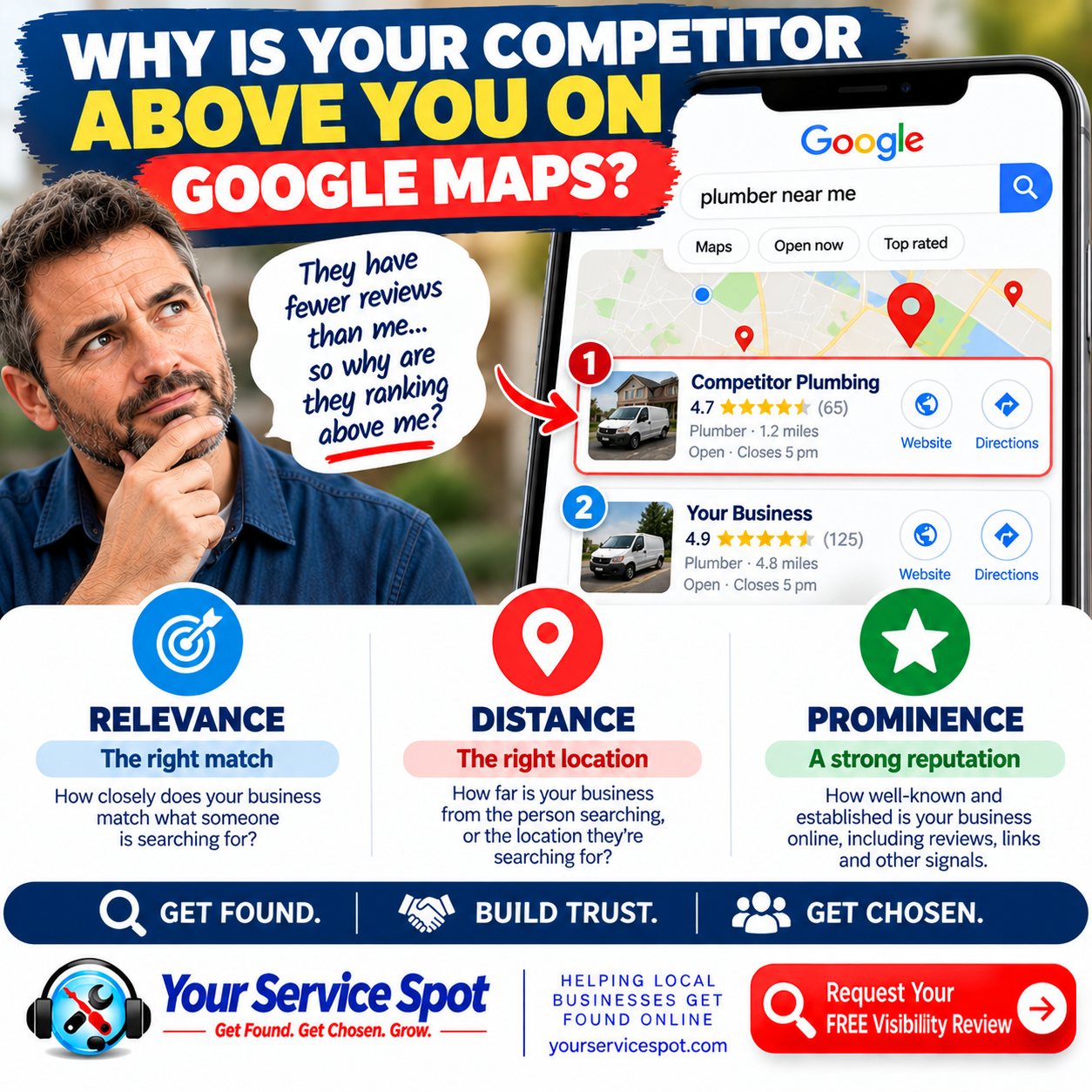
Google says local results are primarily based on relevance, distance and prominence.
A location page cannot change where your business is physically located or guarantee inclusion in a particular local pack.
That’s an important distinction.
Location pages are part of a broader local SEO strategy — not a way of manufacturing dozens of imaginary business locations.
Don’t Create Fake Locations
If you serve an area but don’t have premises there, don’t pretend that you do.
A service-area business can legitimately explain on its website that it provides services in multiple locations.
That’s very different from inventing addresses or creating the impression that the business has offices where none exist.
Your location pages should accurately represent the business.
Serve the location? Talk about serving it.
Have genuine premises there? Say so.
Don’t have an office there? Don’t imply that you do.
Trust matters to customers and search engines alike.
Location Pages Need Internal Links
Creating a location page and leaving it buried deep within the website isn’t ideal.
Relevant pages should be incorporated naturally into your internal linking structure.
For example, your main Service Areas page could link to individual locations.
Individual location pages could link to relevant service pages.
Relevant blog articles could link to location pages.
And where useful, location pages could link to nearby or related content.
This creates a network rather than a collection of isolated pages.
Should Every Local Business Have Location Pages?
Not necessarily.
A restaurant with one physical location and no meaningful reason to target surrounding towns probably doesn’t need 20 pages for neighbouring areas.
A service-area business covering multiple towns may benefit considerably more.
The key question is:
Do customers genuinely search for the services you provide in multiple locations that matter to your business?
If they do, location pages are worth investigating.
Location Pages: Think Customers First, SEO Second
It’s tempting to view location pages as an SEO technique.
A better way to think about them is as useful landing pages for customers in the areas you serve.
Ask:
- Would this page still be useful if Google didn’t exist?
- Does it explain the service?
- Does it reassure the customer you cover their location?
- Does it answer useful questions?
- Does it establish trust?
- Does it provide a clear next step?
If the answer is yes, you’re creating something worthwhile.
And if it’s also properly optimised for search, it can become a valuable part of your local SEO strategy.
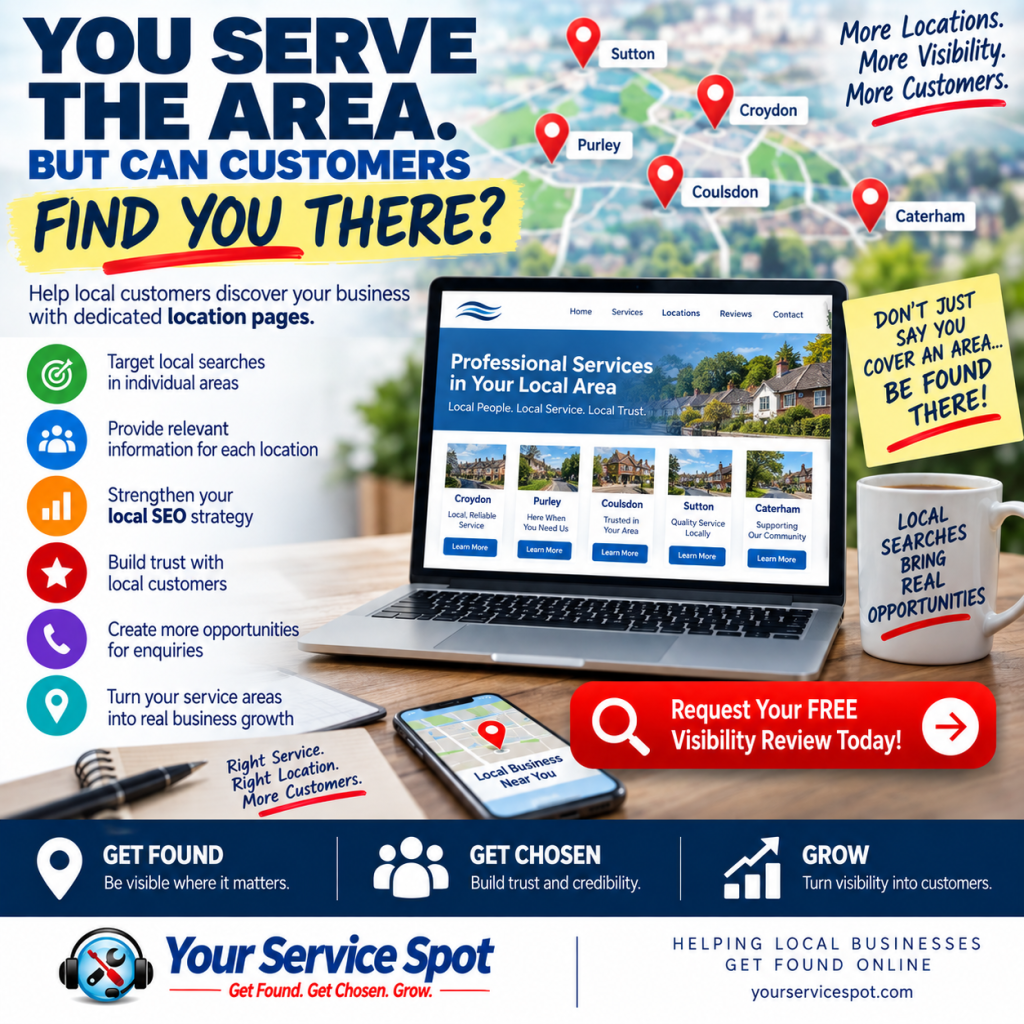
You May Serve the Area — But Can Customers Find You There?
This is the question local businesses need to ask.
Simply being willing to travel to a town doesn’t mean potential customers there know your business exists.
Well-planned location pages can help build a clearer connection between:
WHAT YOU DO + WHERE YOU DO IT + WHY CUSTOMERS SHOULD CHOOSE YOU
At Your Service Spot, we help businesses build local visibility strategies around the way their customers actually search.
Are Your Most Important Locations Properly Represented on Your Website?
Request your FREE Visibility Review and discover where your business could be missing local search opportunities.
Get Found. Get Chosen. Grow.
Frequently Asked Questions About Location Pages
What are location pages?
Location pages are website pages that provide useful information about the services a business offers in a particular town, city, neighbourhood or service area. They can help customers understand where a business operates while supporting a broader local SEO strategy.
Do location pages help local SEO?
Well-designed location pages can help search engines and potential customers understand the geographic relevance of your website content. However, they don’t guarantee rankings and cannot overcome every local ranking factor, such as the searcher’s distance from a business.
Should I create a location page for every town I serve?
Not automatically. Focus first on commercially important areas you genuinely serve and where you can create useful content. Creating hundreds of thin or near-identical pages simply to target place names is not a good strategy.
Can I use the same content on every location page?
You shouldn’t simply duplicate a page repeatedly and replace the location name. Each page should provide genuine value appropriate to the service and location rather than existing solely to target a keyword.
What should a location page include?
A strong page may include a clear service-and-location heading, relevant services, useful local information, trust signals, FAQs, internal links and a clear call to action.
Do I need an office in every location I target?
No. Service-area businesses can legitimately create useful website content about areas they genuinely serve. However, you shouldn’t invent offices or imply you have physical premises in locations where you don’t.
How many location pages should a local business have?
There’s no universal number. It depends on your service area, commercial priorities, search opportunities and ability to create genuinely useful pages. Starting with your most important locations is usually more sensible than creating dozens at once.
What’s the difference between a location page and a service page?
A service page primarily explains what you provide. A location page focuses on providing that service or group of services within a particular geographic area. Strong local business websites often use both.