Why Your Competitors Keep Outranking You on Google (And What You Can Do About It)
You’ve spent years building your business.
You provide excellent service, have satisfied customers and work hard to maintain your reputation.
But when you search Google for the services you offer, something frustrating happens.
Your competitors appear above you. Again.
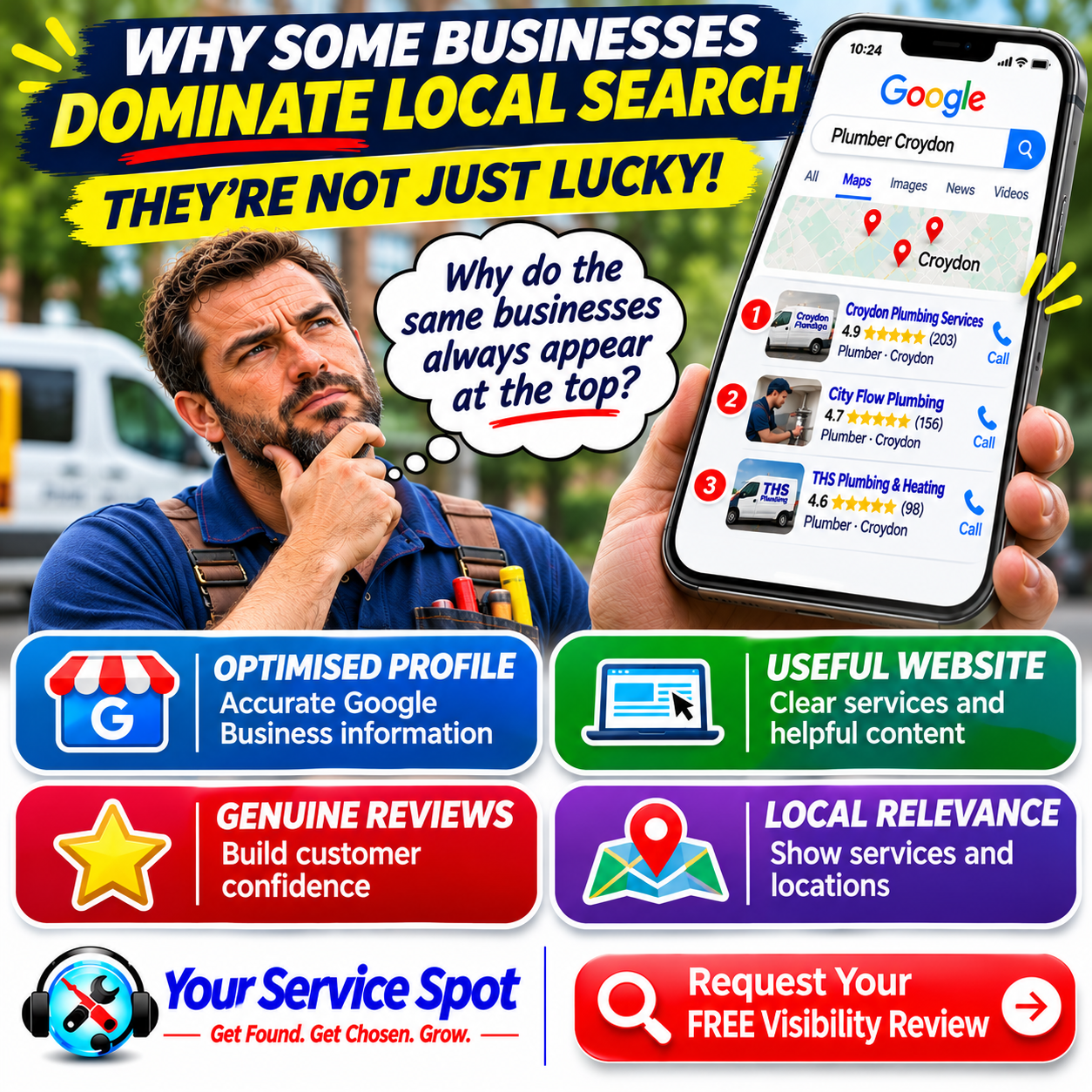
Perhaps they’re featured in Google’s Local 3-Pack.
Maybe their websites consistently appear ahead of yours.
Or perhaps they dominate Google Maps searches in the areas where you want to attract customers.
Naturally, you’re wondering:
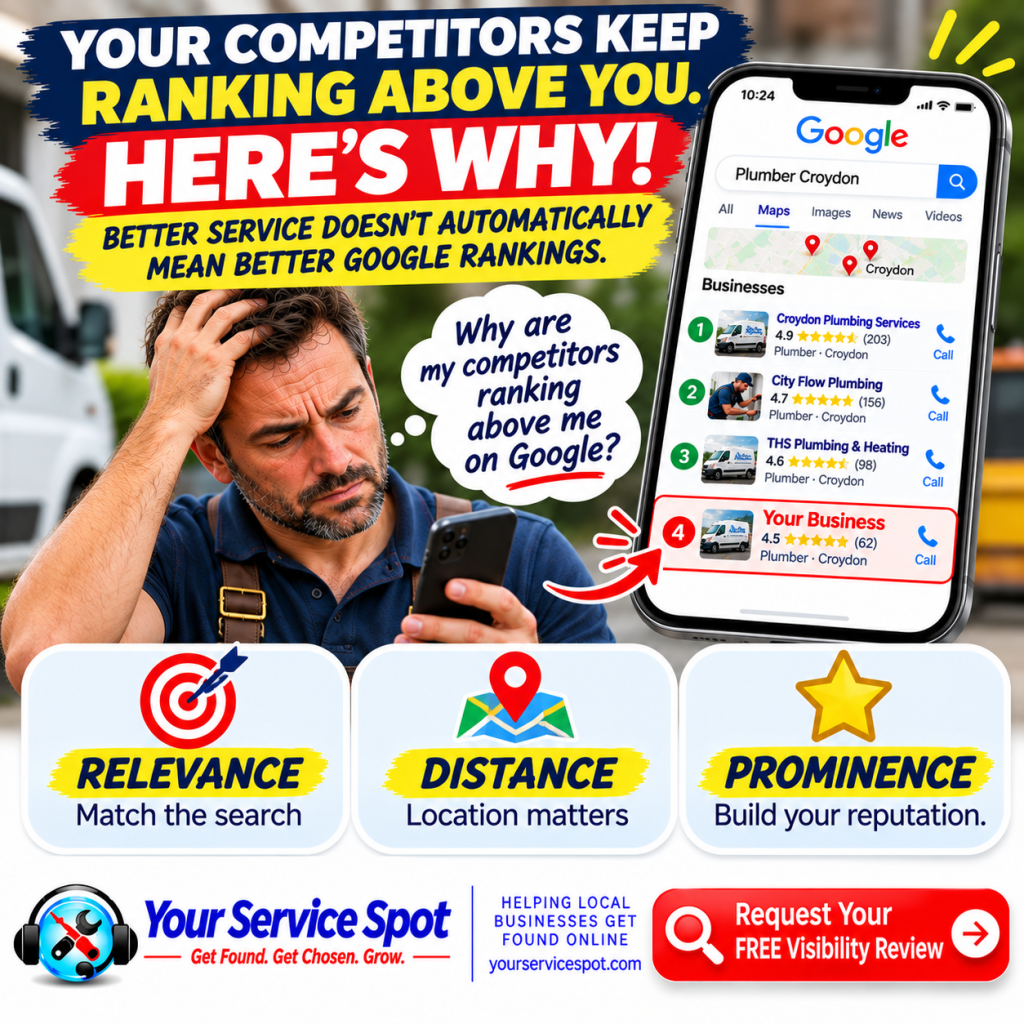
Why do my competitors keep outranking me on Google?
And more importantly, what can I do to outrank competitors and attract more local customers?
Here’s something worth understanding.
Google doesn’t simply rank businesses according to who provides the best service.
Its search systems evaluate many signals to determine which results are most relevant and useful for a particular search.
For local businesses, this means that excellent service alone doesn’t guarantee strong Google visibility.
The good news is that there are practical steps you can take.
In this guide, we’ll explain why competitors may be ranking above you, how Google’s local ranking systems work and how effective local SEO can help strengthen your online presence.
-
Why Do Competitors Rank Higher on Google?
Imagine two plumbing companies operating in Croydon.
- Both have experienced staff.
- Both provide reliable service.
- Both have satisfied customers.
But when someone searches for “emergency plumber Croydon”, one company appears prominently while the other is difficult to find.
Why?
Several factors may contribute.
The more visible business might have:
- A more complete Google Business Profile
- More relevant service information
- A website that clearly targets emergency plumbing
- A stronger online reputation
- More useful local content
- Better technical website performance
- A location closer to the person searching
However, you can’t determine the exact reason simply by looking at the results.
Google uses different systems for organic website rankings and local business listings.
The first step towards improving your rankings is understanding where your competitors are outperforming you.
Why your competitors are getting more calls from Google.
-
How Google Decides Which Local Businesses Rank First
For Google Maps and local business results, Google identifies three main ranking factors.
Understanding them can help explain why competitors appear above you.
Relevance: Does Your Business Match the Search?
Relevance describes how closely a business matches what someone is searching for.
Imagine someone searching for:
“Emergency drain unblocking Brighton”
A company whose Google Business Profile and website clearly explain its emergency drainage services may provide a more relevant match than one offering only general plumbing services.
What you can improve:
- Choose accurate Google Business Profile categories.
- Clearly describe your services.
- Create useful service pages.
- Explain the problems you solve.
- Keep your business information complete and accurate.
Avoid adding irrelevant categories or services simply to target more searches.
Distance: Where Is the Customer Searching From?
Distance considers how far a business is from the location associated with a search.
For example, someone searching for “electrician near me” in Purley may see different results from someone making the same search in central Croydon.
This explains why Google Maps rankings can vary significantly across a town.
What you can improve:
Make your genuine service areas clear and ensure your business location information is accurate.
However, adding more service areas to your Google Business Profile doesn’t automatically improve your rankings in those locations.
You cannot control where every potential customer is searching from.
Prominence: How Established Is Your Business Online?
Prominence relates to how well-known or established a business is.
Google considers information about businesses from across the web.
This can include links, reviews and other relevant signals.
Google also states that more reviews and positive ratings can help local rankings.
What you can improve:
- Encourage genuine customer reviews.
- Maintain accurate business information.
- Build relevant links and mentions.
- Demonstrate your experience.
- Strengthen your online reputation.
But don’t assume that the business with the most reviews will always rank first.
Google’s local ranking factors are relevance, distance and prominence. There is no guaranteed shortcut to the top three.
-
Your Competitors May Have Better-Optimised Google Business Profiles
Your Google Business Profile is an important part of your local online presence.
It helps customers discover information about your business through Google Search and Maps.
However, many businesses create a profile and rarely review it.
Meanwhile, competitors may have more complete and accurate information.
What Should You Check?
Primary business category
Does your main category accurately describe your principal business activity?
Additional categories
Are relevant secondary activities represented appropriately?
Services
Have you included accurate descriptions of the services you offer?
Opening hours
Are your normal and special opening hours correct?
Contact information
Can customers easily reach you?
Photographs
Do your images accurately represent your business and services?
Customer reviews
Are you encouraging genuine feedback and responding professionally?
A complete profile can help Google understand your business and make your listing more useful to customers.
However, publishing frequent Google Business Profile posts or uploading more photographs doesn’t automatically guarantee higher rankings.
Google Business Profile mistakes that cost businesses customers.
-
Your Competitors’ Websites May Explain Their Services More Clearly
Consider two roofing company websites.
Business A says:
“We provide quality solutions and outstanding customer service.”
Business B says:
“We provide emergency roof repairs, flat roof replacement and roof inspections throughout Croydon and South London.”
Business B immediately communicates more useful information.
It explains what the company does and where it operates.
That clarity helps customers and search engines understand the business.
How to Improve Your Website
Start by reviewing your homepage.
Does it clearly explain:
- Your main services?
- Your location?
- The areas you serve?
- The customers you help?
- Why someone should consider your business?
- How to contact you?
Then review your individual service pages.
A business offering several important services should provide enough information for customers to understand each one.
For example, a drainage company might have separate useful pages for emergency drain unblocking, CCTV drain surveys and drain repairs.
Each page should answer genuine customer questions.
Avoid creating large numbers of thin or repetitive pages simply to target keywords.
Why your homepage isn’t ranking.
-
Your Competitors May Have Stronger Local SEO
Local SEO helps businesses improve their visibility in searches associated with particular locations.
For example:
“Plumber Croydon”
“Emergency electrician Brighton”
“Pool cleaning Bellaire Houston”
A business with a stronger local SEO foundation may be easier to discover for relevant searches.
What Does Effective Local SEO Include?
Relevant website content
Clearly explaining services and locations.
Accurate business information
Maintaining consistent details across relevant online platforms.
Useful location pages
Providing genuine information for customers in areas you serve.
Google Business Profile optimisation
Keeping categories, services and other details accurate.
Online reputation
Encouraging authentic reviews and building customer trust.
Technical website improvements
Making important pages accessible and usable.
Local SEO is an ongoing process.
It isn’t a single setting that can be switched on to guarantee rankings.
What local SEO means for small businesses.
-
Your Competitors May Have More Relevant Customer Reviews
Customer reviews influence purchasing decisions.
They can also contribute to Google’s local ranking prominence.
Imagine two businesses.
Business A
4.9-star rating with 15 reviews.
Business B
4.8-star rating with 180 reviews.
Which business will rank higher?
You can’t determine that from ratings and review counts alone.
Google considers other factors, including relevance and distance.
However, a substantial body of genuine customer feedback can help potential customers feel more confident.
How to Strengthen Your Review Profile
- Develop a consistent process for requesting reviews from customers.
- Make it easy for them to leave honest feedback.
- Respond professionally to positive and negative reviews.
- And avoid purchasing reviews or offering incentives in exchange for favourable ratings.
It’s also worth monitoring whether you’re continuing to receive customer feedback.
Recent reviews can help reassure potential customers that your business remains active and provides a good service.
But don’t assume Google applies a specific ranking bonus simply because a review is recent.
Why recent Google reviews matter.
-
Your Competitors May Have Better Location Pages
If your business serves several towns or neighbourhoods, location-specific content may help customers understand your coverage.
For example, a plumbing company serving Croydon, Purley and South Norwood might provide useful information about its services in each area.
However, location pages should offer genuine value.
A page that simply replaces “Croydon” with “Purley” throughout otherwise identical content is unlikely to provide a particularly useful experience.
What Makes a Good Location Page?
Include:
- The services genuinely available in that area
- Relevant local information
- Clear service coverage
- Appropriate examples of work
- Helpful customer questions
- Contact information
Don’t invent local offices or addresses.
And don’t assume that publishing a location page guarantees a Google Maps ranking in that town.
Why every local business needs location pages.
-
Your Competitors’ Websites May Be Easier to Use
Google rankings aren’t determined solely by website design or speed.
However, technical accessibility and usability matter.
A website with broken pages, indexing problems or content that search engines cannot access may struggle to perform well.
A slow or confusing website can also discourage potential customers.
What Should You Investigate?
Mobile usability
Can customers navigate your website comfortably on their phones?
Page performance
Do important pages load efficiently?
Indexing
Can Google discover and index your main pages?
Broken links
Are visitors encountering missing pages?
Navigation
Can customers quickly find your services?
Contact options
Is it easy to call or submit an enquiry?
Improving these areas can support both search performance and customer experience.
How to improve website performance.
-
Your Competitors May Have a Stronger Online Reputation
Google’s understanding of a business isn’t limited to its website.
Relevant information may also exist on other websites.
For example:
- Industry directories
- Professional associations
- Local business organisations
- Relevant news websites
- Supplier or partner websites
- Customer review platforms
These sources can help establish a business’s online presence.
But quality matters more than collecting large numbers of irrelevant directory listings.
Focus on accurate, legitimate and relevant mentions.
Avoid buying low-quality links or participating in link schemes.
A Practical Example
Imagine a local electrician who belongs to a recognised professional organisation.
If the organisation provides a legitimate public member listing, that may offer useful information for customers and search engines.
Similarly, a genuine local news article about a business’s community work may help build recognition.
The objective is to develop a credible online presence, not manufacture artificial popularity.
-
You’re Comparing Rankings Without Considering Search Location
Here’s a common mistake:
- A business owner searches Google from their office.
- Their competitor appears above them.
- They assume that competitor ranks higher everywhere.
- But local search results can change depending on location.
- Someone searching from a different neighbourhood may see a different order.
- The exact wording of the search also matters.
For example:
“Plumber Croydon”
“Emergency plumber near me”
“Boiler repair Purley”
These searches don’t necessarily produce the same results.
How to Investigate Properly
- Test several relevant service searches.
- Record the location and date.
- Compare Google Maps and organic website results separately.
- Use Google Search Console to examine website search performance.
- Consider specialist local ranking tools when you need more detailed geographical comparisons.
- Incognito browsing can reduce some personalisation, but it doesn’t eliminate location effects or produce a perfectly neutral ranking.
Don’t base your entire local SEO strategy on one Google search.
-
How to Analyse Competitors Who Keep Outranking You
Rather than guessing, carry out a structured competitor visibility assessment.
Start with three businesses that regularly appear for your most valuable searches.
Compare These Areas
| Area | Your business | Competitor | Opportunity |
| Google Business Profile | Complete / Incomplete | Complete / Incomplete | Improve missing details |
| Primary category | Your category | Their category | Check relevance |
| Customer reviews | Count and rating | Count and rating | Strengthen review process |
| Service pages | Existing pages | Existing pages | Improve useful content |
| Location coverage | Clearly explained? | Clearly explained? | Clarify service areas |
| Website usability | Issues identified | Issues identified | Fix technical problems |
| Online reputation | Relevant mentions | Relevant mentions | Build credibility |
| Customer enquiries | Current baseline | Usually unknown | Track your results |
This comparison can reveal practical opportunities.
For example, perhaps competitors have dedicated service pages while your website combines everything on one generic page.
Or your Google Business Profile may be missing relevant services.
However, don’t assume that every difference explains a ranking gap.
Google’s ranking systems are complex, and competitors’ actual enquiry volumes usually aren’t publicly available.
A competitor audit should identify worthwhile improvements, not invent certainty about Google’s algorithms.
-
Seven Practical Steps to Help You Outrank Competitors
If you’re looking for a sensible starting point, concentrate on these seven actions.
Step 1: Review Your Google Business Profile
Check categories, services, contact information and opening hours.
Correct inaccuracies.
Step 2: Identify Your Most Valuable Search Terms
Focus on the services and locations most relevant to your business.
Avoid chasing keywords that don’t attract suitable customers.
Step 3: Improve Your Website Content
Clearly explain your services.
Create useful pages where important information is missing.
Answer customer questions.
Step 4: Strengthen Your Review Process
Encourage genuine feedback consistently.
Respond professionally.
Monitor customer sentiment.
Step 5: Improve Local Relevance
Make your service areas clear.
Develop useful location-specific content where appropriate.
Step 6: Fix Website Problems
Review indexing, mobile usability, navigation and page performance.
Make it easy for customers to contact you.
Step 7: Monitor Rankings and Enquiries
Track relevant search visibility over time.
But also monitor calls, contact forms and qualified leads.
The objective isn’t simply to outrank competitors. It’s to attract more of the right customers.
Local SEO checklist for small businesses.
-
Can You Pay Google to Outrank Competitors?
Google Ads can help businesses appear in paid advertising placements.
However, paid advertising and organic local rankings are different.
Google states that businesses cannot request or pay for better local rankings.
Paying for Google Ads doesn’t improve your organic position in Google Maps or the Local 3-Pack.
Advertising may provide additional visibility, but it doesn’t replace a sound local SEO strategy.
Be cautious of anyone promising guaranteed organic first-place rankings.
No agency can guarantee a particular Google ranking for every search and location.
-
How Long Does It Take to Outrank Competitors?
There’s no universal timeframe.
Some improvements can be completed quickly.
For example:
- Correcting inaccurate profile information
- Improving service descriptions
- Fixing broken website pages
- Updating contact information
Other improvements may take longer to affect search performance.
These include developing useful content, strengthening your online reputation and improving website authority.
Results also depend on competition, search demand and your starting position.
You may improve visibility for some searches without overtaking every competitor.
That’s why measuring progress across several relevant searches is more useful than focusing on a single ranking position.
-
Why Outranking Competitors Isn’t the Final Goal
Imagine your business finally appears above a competitor on Google.
That’s encouraging.
But what happens when someone clicks your website?
- Can they quickly understand what you offer?
- Do your reviews inspire confidence?
- Is your phone number easy to find?
- Can they contact you without completing a complicated form?
If not, your improved ranking may produce fewer enquiries than expected.
At Your Service Spot, we focus on the complete customer journey.
GET FOUND
Help customers discover your business.
BUILD TRUST
Give them confidence in your services.
GET CHOSEN
Show them why you’re a suitable choice.
GENERATE ENQUIRIES
Make it easy for customers to get in touch.
Your Google rankings matter.
But they’re part of a bigger picture.
How to make your website convert more visitors into leads.
-
Are Your Competitors Winning Customers You Could Be Attracting?
Here’s a simple challenge…
- Open Google and search for your main service and location.
- Don’t include your business name.
- Look at the results.
- Which businesses appear in Google Maps?
- Which websites rank prominently?
- Where does your business appear?
Then ask yourself:
Do you know why those competitors are more visible?
- Perhaps your website needs clearer service information.
- Maybe your Google Business Profile is incomplete.
- Your online reputation might need strengthening.
- Or your competitors may simply be closer to the people searching.
A structured visibility assessment can help identify where worthwhile opportunities exist.
Stop Guessing Why Your Competitors Outrank You
Your business might provide outstanding service.
But if potential customers consistently discover your competitors first, you could be missing valuable enquiries.
At Your Service Spot, we help local businesses understand their Google visibility and identify opportunities to improve it.
We investigate Google Business Profiles, local SEO, websites, online reputation and relevant competitor activity.
Our aim is to help you understand where your business stands and what practical improvements are worth making.
Request Your FREE Visibility Review
Discover how your business appears on Google, which competitors are more visible for relevant searches and where potential opportunities exist.
Get Found. Get Chosen. Grow.
Frequently Asked Questions: Why Competitors Outrank You on Google
Why do my competitors rank higher than me on Google?
Competitors may have stronger relevance, better website content, more established online reputations or locations closer to searchers. The explanation depends on whether you’re comparing organic website results or Google Maps listings.
How can I outrank competitors on Google?
Improve your Google Business Profile, website content, local relevance, customer reviews and technical website quality. Monitor relevant searches and focus on improvements that benefit customers. Rankings aren’t guaranteed.
What are Google’s three main local ranking factors?
Google identifies relevance, distance and prominence as its main local ranking factors.
Does having more Google reviews improve rankings?
Google says review count and positive ratings can contribute to local ranking prominence. However, more reviews don’t guarantee a higher ranking because other factors also matter.
Why does a competitor with fewer reviews rank above me?
The competitor may be more relevant to the search, closer to the searcher or stronger in other ranking signals. Review count alone doesn’t determine local rankings.
Can I outrank a competitor who is closer to the customer?
It’s possible, depending on the search and other ranking factors. However, distance is an important consideration, and there’s no guaranteed way to overcome a geographical disadvantage.
Does posting regularly on Google Business Profile improve rankings?
Google Business Profile posts can provide useful updates for customers, but Google doesn’t guarantee a ranking boost from publishing posts frequently.
Does my website affect Google Maps rankings?
Your website can contribute useful information about your services and business. However, Google Maps rankings depend on several factors, and having a well-optimised website doesn’t guarantee a top-three position.
Can location pages help me outrank competitors?
Useful location pages can support website relevance for genuine service areas. However, creating location pages doesn’t guarantee improved Google Maps rankings.
Can I pay Google to rank above competitors?
You can pay for advertising placements through Google Ads, but paying Google doesn’t improve your organic local ranking.
Why do Google Maps rankings change depending on location?
Google considers distance from the location associated with a search. Different searchers can therefore see different local results.
Is incognito browsing a reliable way to check rankings?
Incognito browsing can reduce some personalisation, but it doesn’t remove location effects or guarantee neutral search results.
How long does it take for local SEO to improve rankings?
There is no guaranteed timeframe. Results depend on competition, your starting position, the changes made and how search systems respond.
Is local SEO better than Google Ads?
They serve different purposes. Local SEO focuses on improving organic local visibility, while Google Ads provides paid advertising opportunities. The right balance depends on your business goals and budget.
Can an SEO agency guarantee first place on Google?
No credible agency should guarantee a particular organic ranking. Google’s results depend on multiple factors, including relevance, distance and competition.
How do I find out why competitors outrank my business?
Compare your Google Business Profile, website content, reviews, service areas, technical performance and online reputation with relevant competitors. Use several searches and locations to identify patterns.
Does outranking competitors guarantee more enquiries?
No. Higher visibility can create opportunities, but customers still need clear information, confidence in your business and an easy way to contact you.
Should I focus on Google Maps or organic website rankings?
Both can be valuable. Google Maps helps customers discover local businesses, while organic website results can attract people researching services and comparing providers. A balanced local SEO strategy considers both.