7 Reasons AI Search Platforms May Not Recommend Your Business
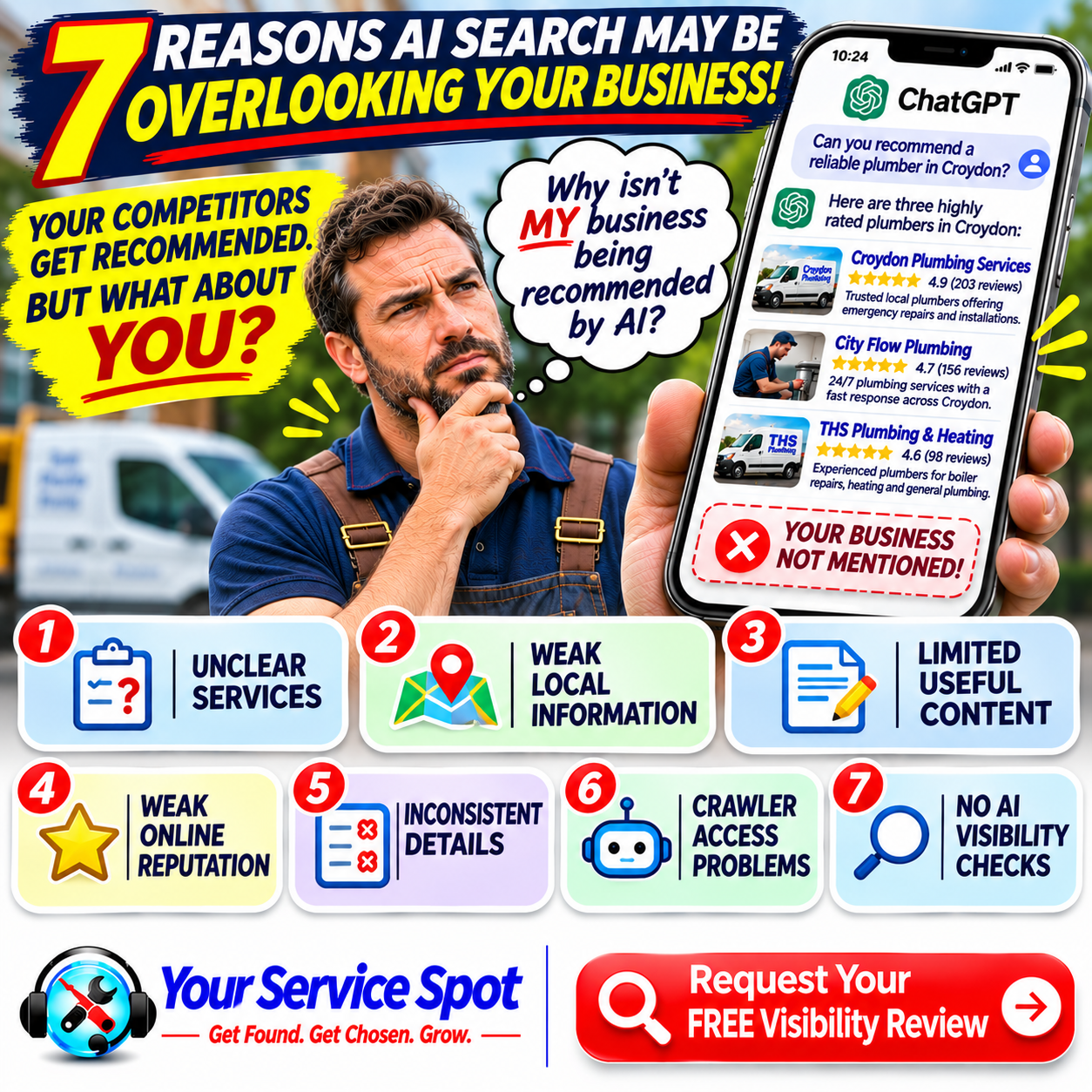
Imagine a potential customer asking ChatGPT to recommend a business just like yours.
They’re looking for a reliable local plumber, an experienced electrician, a reputable drainage company or a specialist service provider.
They ask a simple question:
“Can you recommend a reliable local business that provides this service?”
The AI platform generates an answer.
It mentions three businesses.
But yours isn’t one of them.
Perhaps you’ve been operating for years. You have satisfied customers, genuine experience and a professional website.
Yet your competitors are being mentioned while your business is overlooked.
It’s frustrating, especially when you know you provide an excellent service.
But there’s an important question worth investigating.
How easy is it for AI search platforms to discover, understand and accurately represent your business?
As customers increasingly explore conversational search tools, AI business visibility is becoming another area for small businesses to monitor alongside traditional Google Search and Google Maps.
Platforms such as ChatGPT, Google Gemini and Perplexity can help people research services, compare providers and discover businesses.
However, they don’t all work in the same way.
Their answers can depend on the question, available sources, search capabilities and other factors.
And there is no single published formula that guarantees your business will be recommended.
Nevertheless, there are practical improvements worth investigating.
Here are seven possible reasons AI search platforms may not recommend your business, along with steps you can take to strengthen your online presence.
-
Your Website Doesn’t Clearly Explain What You Do
One of the most common weaknesses on small business websites is vague messaging.
Consider a homepage that says:
“We deliver innovative solutions with exceptional customer service.”
That sounds professional.
But what does the business actually do?
- Which services does it provide?
- Where does it operate?
- Who are its customers?
Now compare that with:
“We provide emergency plumbing, boiler repairs and bathroom installations throughout Croydon and South London.”
The second description provides specific, useful information.
Customers can immediately understand the business.
Search engines and AI-powered systems accessing the page also have clearer information to work with.
Why This Matters for AI Business Visibility
Imagine someone asks:
“Can you recommend an emergency plumber in Croydon who also repairs boilers?”
A website that clearly describes emergency plumbing and boiler repair provides relevant information.
A website filled with generic marketing statements may be harder to interpret.
This doesn’t mean the clearer website is guaranteed a recommendation.
It simply makes the business easier to understand.
How to Improve Your Website
Review your homepage and ask whether it clearly explains:
- Your main services
- Your specialist expertise
- The customers you help
- Your genuine service areas
- The problems you solve
- How customers can contact you
Use straightforward language.
Create useful pages for important services.
Avoid relying entirely on slogans or generic claims.
The clearer your business information, the easier it is for customers and search systems to understand what you offer.
Why your homepage isn’t ranking.
-
Your Local Service Information Is Difficult to Find
Location matters when customers search for local services.
Imagine someone in Brighton asks an AI assistant:
“Which companies offer emergency drain unblocking in Brighton and nearby areas?”
The AI system may need information about both the services available and the geographical areas covered.
If your website doesn’t clearly explain where you operate, that information may be difficult to establish.
Common Location Information Problems
Some websites:
- Don’t mention their main service area clearly.
- Hide location details on a contact page.
- Use vague phrases such as “serving the surrounding area”.
- List towns without explaining which services are available.
- Contain inconsistent business addresses or service information.
These problems can also make the website less helpful for potential customers.
How to Strengthen Your Local Information
Clearly explain your genuine service areas.
For example:
“We provide emergency drainage services throughout Brighton, Hove and surrounding parts of East Sussex.”
Where appropriate, create useful location pages that provide relevant information about the services available in each area.
Include genuine local examples, service details and helpful customer questions.
However, avoid creating dozens of nearly identical pages that simply replace one town name with another.
And never invent local offices or addresses.
Does Adding More Locations Guarantee AI Recommendations?
No.
Listing more towns doesn’t guarantee AI mentions or higher Google Maps rankings.
The objective is to provide accurate information about where you genuinely operate.
Why local businesses need location pages.
-
Your Website Doesn’t Answer the Questions Customers Ask
Customers don’t always search using short keywords.
Traditional searches might include:
“Roof repairs Croydon”
But someone using an AI assistant might ask:
“How do I know whether my roof needs repairing or replacing, and which local companies provide this service?”
That question combines a request for information with an interest in finding a provider.
Businesses that publish useful answers to genuine customer questions can provide valuable information for people researching services.
Why Helpful Content Matters
A roofing company might publish articles answering:
- How do I recognise signs of roof damage?
- When should a roof be repaired rather than replaced?
- What should I do after discovering a roof leak?
- How long does a typical roof repair take?
- What affects the cost of roofing work?
A drainage company might explain:
- What causes recurring blocked drains?
- When is a CCTV drain survey necessary?
- What should I do if an outside drain overflows?
- When should I call an emergency drainage specialist?
These topics help customers understand their options.
They can also provide useful context to search systems accessing the content.
How to Create Better Content
- Start with the questions customers regularly ask by telephone, email or during appointments.
- Create useful service pages, FAQs and articles.
- Provide accurate, practical answers.
- Explain when professional assistance is appropriate.
- Avoid publishing large volumes of repetitive content simply to target AI search.
Useful content should help real customers first.
There’s no guarantee that an AI platform will cite or recommend your business because you’ve answered a particular question.
But helpful, accessible information is a sensible foundation for both traditional SEO and AI-powered discovery.
How to improve your business visibility in AI search.
-
Your Online Reputation May Not Provide Enough Useful Information
Imagine a customer asking:
“Can you recommend a reliable electrician in Croydon with good customer reviews?”
The question specifically mentions reputation.
Depending on the platform and sources available, an AI search system may encounter information from business websites, customer reviews, directories or other relevant sources.
If there’s limited credible information about your business online, customers and search systems may have less information available to assess it.
However, it’s important not to oversimplify this.
There is no publicly established rule that a particular number of reviews guarantees an AI recommendation.
What Can Strengthen Your Online Reputation?
Genuine customer reviews
Encourage honest feedback from customers.
Professional qualifications
Clearly explain relevant certifications and professional memberships.
Experience
Describe your genuine background and areas of expertise.
Examples of completed work
Where appropriate, publish authentic case studies or project examples.
Relevant third-party mentions
Maintain legitimate listings and professional relationships.
Why Review Quality Matters
A business with numerous genuine reviews may give potential customers more confidence than one with very little feedback.
But review numbers alone don’t determine which businesses AI platforms recommend.
Different systems may access different sources.
Some may not have current information about particular review platforms.
How to Improve Your Reputation
- Develop a consistent process for requesting genuine reviews.
- Respond professionally to feedback.
- Keep qualifications and business information current.
- Publish accurate examples of your work.
- Avoid fake reviews, purchased testimonials or unsupported claims.
Build a reputation that customers can verify rather than trying to manufacture artificial popularity.
Why Google reviews matter for local SEO.
-
Your Business Information Is Inconsistent Across the Internet
Imagine your business website lists one telephone number:
- Your Google Business Profile displays another.
- An industry directory contains an outdated address.
- And an old listing uses a previous business name.
- For potential customers, this can be confusing.
It can also make it harder to establish which information is current.
Why Consistency Matters
Search and AI systems may encounter information about your business from different sources.
Accurate, consistent information helps reduce ambiguity.
However, there is no universal AI ranking rule that guarantees recommendations when every listing matches.
Consistency is primarily about clarity, reliability and customer experience.
Which Details Should You Check?
Review your:
- Business name
- Website address
- Telephone number
- Physical address, where applicable
- Genuine service areas
- Opening hours
- Service descriptions
- Relevant professional information
Check important sources such as your website, Google Business Profile and legitimate industry listings.
What About Online Directories?
Relevant directories can provide useful business information.
But creating hundreds of low-quality listings isn’t a sensible AI visibility strategy.
Focus on legitimate platforms that customers might actually use.
Correct outdated information wherever practical.
Common Google Business Profile mistakes.
-
AI Search Crawlers May Struggle to Access Your Website
Your website might contain excellent information.
But what happens if relevant search systems cannot access it?
Technical restrictions can prevent crawlers from retrieving important pages.
This is worth investigating when assessing AI business visibility.
What Is a Web Crawler?
A web crawler is an automated system that accesses web pages to discover or retrieve information.
Different organisations operate different crawlers for different purposes.
For example, OpenAI identifies OAI-SearchBot as a crawler associated with ChatGPT search.
This is distinct from GPTBot, which is associated with model training.
The distinction matters because website owners may have different preferences about search discovery and model training.
Common Website Accessibility Problems
Potential issues include:
- Important pages blocked by robots.txt
- Accidental noindex instructions
- Broken service pages
- Server errors
- Unnecessary access restrictions
- Content that isn’t readily available to crawlers
However, not every AI search system uses the same crawler or discovery process.
And allowing a crawler doesn’t guarantee your business will appear in AI-generated answers.
How to Investigate Accessibility
- Start by checking that your main website pages are accessible.
- Review robots.txt and indexing settings.
- Use Google Search Console to investigate Google indexing problems.
- Check for broken links and server errors.
- If necessary, ask your web developer to review crawler access and website logs.
Be careful when changing robots.txt.
Blocking or allowing particular crawlers can have different implications depending on their purpose.
A technically accessible website provides a stronger foundation for discovery, but accessibility alone doesn’t guarantee visibility.
-
You’re Not Checking Whether AI Platforms Mention Your Business
Here’s a particularly important point.
Your business might already be appearing in some AI-generated responses.
Or it might be missing from questions that are relevant to your services.
If you’re not checking, you won’t know.
Unlike traditional Google SEO, AI search visibility doesn’t have one universal ranking report.
Different platforms can generate different answers.
Results may also vary depending on the wording of the question, available information and when the search takes place.
How to Check Your AI Business Visibility
Start with five realistic customer questions.
For example:
“Can you recommend a reliable emergency plumber in Croydon?”
“Which drainage companies provide CCTV drain surveys in Brighton?”
“Who offers weekly pool maintenance in Houston?”
“Which local electricians install EV chargers?”
“Can you recommend a roofing company with experience in emergency repairs?”
Then test relevant questions across platforms such as:
- ChatGPT with web search
- Google Gemini
- Perplexity
- Google’s AI search features, where available
Record What You Find
Create a simple worksheet.
| Customer question | AI platform | Your business mentioned? | Information accurate? |
| Emergency plumber Croydon | ChatGPT | Yes / No | Yes / No |
| Drain unblocking Brighton | Gemini | Yes / No | Yes / No |
| Pool cleaning Houston | Perplexity | Yes / No | Yes / No |
Also record which competitors appear and whether the platform provides relevant source links.
Repeat Your Tests
One answer isn’t a reliable measure of overall AI visibility:
- Test several relevant questions.
- Record the date and platform.
- Repeat the checks periodically.
- Look for patterns rather than treating one response as a permanent ranking.
What If Your Business Isn’t Mentioned?
Don’t immediately assume there’s a technical problem.
The platform may have selected other businesses because of the question, available sources or other factors.
Review your business information, website content, reputation and accessibility.
Then prioritise improvements that make your online presence more useful and accurate.
Why ChatGPT recommends some local businesses and not others.
-
Does Ranking Well on Google Guarantee AI Recommendations?
No.
A business can perform strongly in traditional Google Search or Google Maps without appearing in every AI-generated recommendation.
Likewise, a business mentioned by an AI assistant may not rank particularly highly in Google Maps.
The systems aren’t identical.
Google Maps uses relevance, distance and prominence as its main local ranking factors.
AI-powered search experiences can use different sources and processes to generate answers.
However, there is considerable overlap in the information that helps customers understand a business.
Clear services, accurate details, useful content and genuine reputation are valuable across both.
Should You Prioritise SEO or AI Search Visibility?
For most small businesses, abandoning traditional SEO to concentrate entirely on AI search would be unwise.
A better approach is to maintain a strong Google presence while investigating opportunities to improve AI-powered discovery.
Traditional SEO and AI business visibility can complement one another.
Google SEO vs AI search visibility.
-
Seven Practical Actions to Improve AI Business Visibility
Now that we’ve covered the possible reasons your business may be overlooked, here’s a practical action plan.
Action 1: Clarify Your Main Services
Review your homepage.
Make sure customers can quickly understand what you do and where you operate.
Action 2: Improve Local Information
Clearly describe your genuine service areas.
Update outdated information.
Action 3: Answer Customer Questions
Create useful FAQs and service content based on real customer needs.
Action 4: Strengthen Your Reputation
Encourage genuine reviews.
Showcase relevant experience and qualifications.
Action 5: Check Business Information
Review your website, Google Business Profile and important online listings.
Correct inconsistencies.
Action 6: Investigate Website Accessibility
Check important pages, indexing settings and relevant crawler restrictions.
Action 7: Monitor AI Mentions
Test realistic customer questions across several platforms.
Record results and repeat checks periodically.
These improvements won’t guarantee recommendations, but they can make your business easier to discover, understand and evaluate.
-
A Simple 30-Day AI Visibility Improvement Plan
You don’t need to tackle everything at once.
A manageable four-week approach can help you make progress.
Week 1: Establish Your Starting Position
- Test relevant AI search questions.
- Review your website’s main service information.
- Identify obvious content gaps.
- Record your current results.
Week 2: Improve Business Clarity
- Update your homepage.
- Improve important service descriptions.
- Clarify your service areas.
- Correct outdated business information.
Week 3: Strengthen Trust and Accessibility
- Review your customer feedback process.
- Add genuine experience and qualification details where appropriate.
- Investigate website indexing and crawler access.
- Fix important technical problems.
Week 4: Review and Prioritise
- Repeat selected AI search tests.
- Compare results.
- Review customer enquiries.
- Identify the next improvements worth making.
Thirty days is a useful period for organising the work, but it isn’t a guaranteed timeframe for AI recommendations.
-
How Do You Measure AI Business Visibility?
AI search measurement is still developing.
There isn’t one universally accepted metric that captures every platform’s recommendations.
However, several indicators can be useful.
Business Mentions
How often is your business mentioned across a defined set of relevant questions?
Information Accuracy
Are your services, location and other details represented correctly?
Source Citations
Does the platform link to your website or relevant third-party sources?
Competitor Visibility
Which competing businesses appear for similar questions?
Referral Traffic
Are identifiable visitors reaching your website from AI-powered platforms?
Customer Enquiries
Are customers contacting you after discovering your business through AI search?
Where practical, ask new customers how they found you.
A Word of Caution
AI responses can vary between tests.
A small number of prompts won’t provide a complete picture of market visibility.
Treat testing as a way to identify patterns and opportunities rather than a definitive ranking system.
-
Being Recommended Is Only Part of the Customer Journey
- Imagine an AI platform mentions your business.
- A potential customer sees the recommendation.
- They visit your website.
- But your services aren’t clearly explained.
- Your contact details are difficult to find.
- Or they can’t see evidence that your business is credible.
They may still choose someone else.
AI visibility creates an opportunity. Your website and reputation help determine what happens next.
At Your Service Spot, we focus on the complete customer journey.
GET FOUND
Help customers discover your business through relevant search experiences.
BUILD TRUST
Demonstrate your experience, credibility and reputation.
GET CHOSEN
Give customers clear reasons to consider your services.
GENERATE ENQUIRIES
Make it easy for interested customers to contact you.
How to make your website convert more visitors into leads.
-
Is AI Search Overlooking Your Business?
Your business may provide excellent service.
You might have years of experience and satisfied customers.
But potential customers need to discover you before they can consider choosing you.
If AI-powered search platforms regularly mention competitors while overlooking your business, it’s worth investigating why:
- Perhaps your website needs clearer service information.
- Maybe your local coverage isn’t obvious.
- Your online reputation may need strengthening.
- Or technical accessibility could be limiting discovery.
The important thing is to investigate rather than guess.
Request Your FREE Visibility Review
At Your Service Spot, we help local businesses identify opportunities to improve their visibility across Google and AI-powered search.
Our approach considers:
- Website content and service clarity
- Local business information
- Google Business Profile optimisation
- Online reputation and customer reviews
- Website accessibility
- Relevant AI search visibility checks
- Competitor visibility
We’ll help you understand where your business stands and which practical improvements may be worth prioritising.
Are your competitors being discovered while your business gets overlooked?
Frequently Asked Questions About AI Business Visibility
-
What is AI business visibility?
AI business visibility describes how a business is discovered, mentioned, cited or represented within AI-powered search experiences such as ChatGPT, Google Gemini and Perplexity.
-
Why doesn’t ChatGPT recommend my business?
Possible reasons include unclear business information, limited relevant content, inaccessible sources or the way a particular question is interpreted. However, the absence of a recommendation doesn’t prove that any specific problem exists.
-
How can I improve my AI business visibility?
Clearly explain your services, publish useful information, maintain accurate business details, demonstrate genuine credibility, check website accessibility and monitor relevant AI search questions.
-
Does ranking first on Google guarantee ChatGPT recommendations?
No. Traditional Google rankings and ChatGPT recommendations aren’t determined by identical systems.
-
Does my Google Business Profile affect AI recommendations?
Accurate business information can be useful wherever it is available to a search system. However, optimising your Google Business Profile doesn’t guarantee inclusion in ChatGPT or other AI-generated answers.
-
Are Google reviews important for AI search?
Reviews can provide useful reputation information. Whether a particular AI platform accesses or uses them depends on its available sources and processes.
-
How many reviews do I need to get recommended by AI?
There is no publicly established minimum number of reviews that guarantees an AI recommendation.
-
Do I need a website to appear in AI search?
A website isn’t necessarily required for every AI mention, but a useful, accessible website gives customers and search systems an authoritative source of information about your business.
-
Can AI search crawlers access my website?
That depends on your website’s technical configuration and the crawler involved. Review robots.txt, indexing settings and other access restrictions where appropriate.
-
What is OAI-SearchBot?
OAI-SearchBot is an OpenAI crawler associated with ChatGPT search. It is distinct from GPTBot, which is associated with model training.
-
Will allowing OAI-SearchBot guarantee ChatGPT mentions?
No. Allowing crawler access can support discovery but doesn’t guarantee your business will be included in generated answers.
-
Does AI search use the same ranking factors as Google Maps?
Not necessarily. Google Maps identifies relevance, distance and prominence as its main local ranking factors. AI-powered systems can use different sources and selection processes.
-
Can location pages improve AI business visibility?
Useful location pages can provide clear information about genuine service areas. However, publishing them doesn’t guarantee AI recommendations.
-
Should I create FAQs for AI search?
FAQs can be helpful when they answer genuine customer questions. They shouldn’t be created solely to manipulate AI systems.
-
Does schema markup guarantee AI recommendations?
No. Appropriate structured data can help describe website content, but there is no universal schema markup that guarantees inclusion in AI-generated recommendations.
-
How do I check whether AI recommends my business?
Ask realistic customer questions using relevant AI platforms, record whether your business appears, review accuracy and sources, and repeat checks periodically.
-
Why does ChatGPT recommend different businesses when I repeat a question?
Responses can vary because of question wording, available sources, search conditions and other system-specific factors.
-
How long does AI search optimisation take?
There is no guaranteed timeframe. Results can vary across platforms, and improvements may not lead to immediate or measurable mentions.
-
Can an agency guarantee that AI will recommend my business?
No. AI-generated responses can change, and no agency controls every platform’s recommendations.
-
Should I prioritise AI visibility over traditional local SEO?
For most local businesses, a balanced approach is more sensible. Traditional Google Search and Maps remain important, while AI search offers additional discovery opportunities.
-
How do I measure whether AI visibility generates customers?
Monitor identifiable AI referral traffic, customer enquiries, website conversions and customer-reported discovery sources. AI mentions alone don’t establish commercial value.
-
What’s the first step if AI platforms don’t mention my business?
Start by reviewing your website’s service information and testing several relevant customer questions. Then investigate accuracy, content, reputation and accessibility before deciding what to improve.