Google SEO vs AI Search Visibility: Why Your Business Needs Both
Your next customer might not search for your business the way they did a few years ago.
Imagine someone in Croydon needs an emergency plumber.
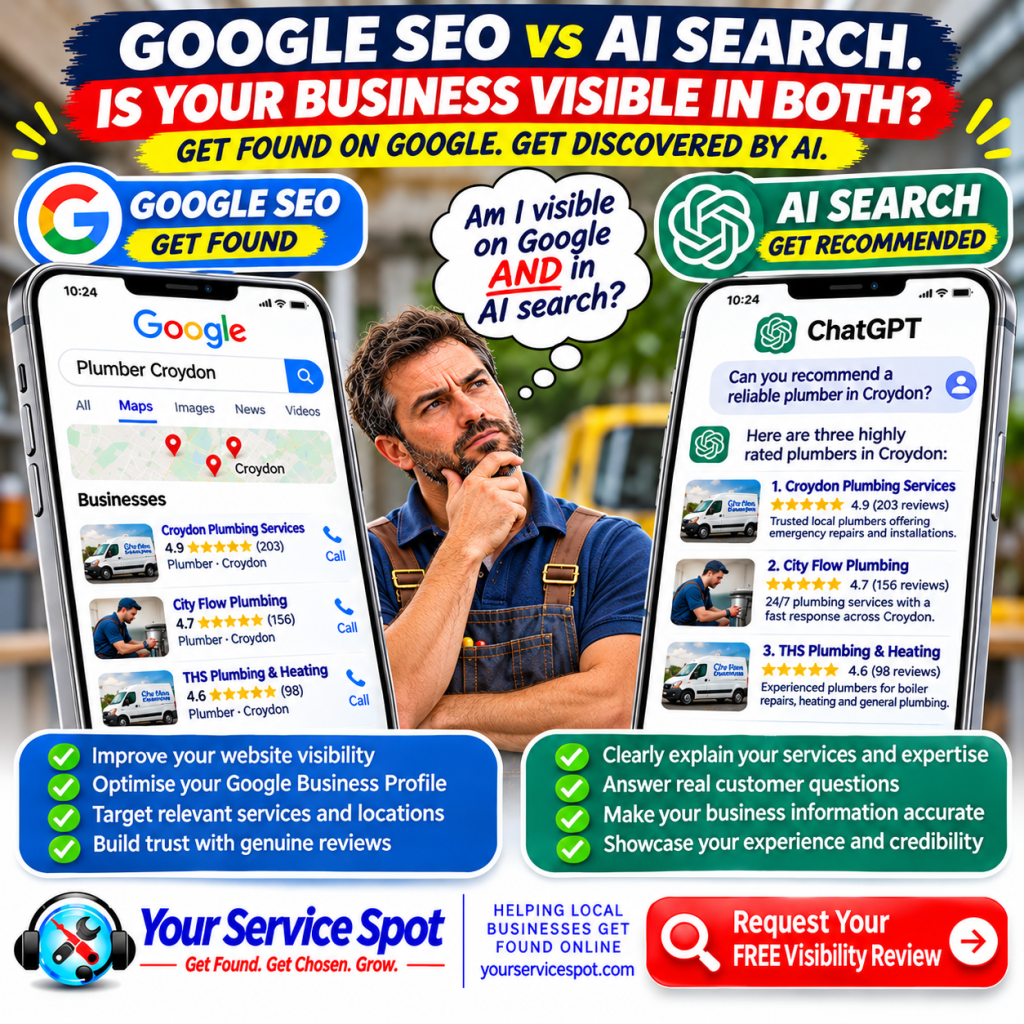
They might open Google and type:
“Emergency plumber Croydon”
Or they might open ChatGPT and ask:
“Can you recommend a reliable emergency plumber in Croydon with good customer reviews?”
Both searches could lead someone to a local business.
But the way information is discovered, presented and evaluated can be different.
For small business owners, this raises an important question:
Should you concentrate on traditional Google SEO, AI search visibility or both?
The answer is both.
Understanding SEO vs AI search can help you make better marketing decisions, strengthen your online presence and increase your opportunities to attract new customers.
In this guide, we’ll explain how traditional search engine optimisation compares with AI-powered search, why both matter and what practical steps your business can take to improve its visibility.
-
What Is the Difference Between SEO and AI Search?
Traditional search engine optimisation (SEO) helps search engines discover, understand and rank website content.
For local businesses, this often includes improving visibility in Google Search and Google Maps.
AI search visibility focuses on whether your business can be discovered, understood, mentioned or recommended through AI-powered search experiences.
These may include:
- ChatGPT with web search
- Google Gemini
- Google AI Overviews and AI Mode
- Perplexity
Although these platforms work differently, they can help customers research services, compare providers and discover businesses.
Traditional Google SEO
A customer searches:
“Roof repairs Croydon”
Google may display advertisements, local business listings, organic website results and other search features.
The customer can then visit websites, read reviews and compare providers.
AI-Powered Search
A customer asks:
“Which roofing companies in Croydon offer emergency repairs, and what should I check before choosing one?”
An AI-powered system may generate a conversational response, explain selection criteria and, depending on the platform and available information, mention relevant businesses or provide links.
However, AI responses aren’t guaranteed to include particular businesses.
The key distinction is that traditional SEO focuses heavily on search result visibility, while AI search visibility also considers how businesses are represented within generated answers.
Importantly, the two increasingly overlap. Google itself incorporates AI-generated features into its search experience.
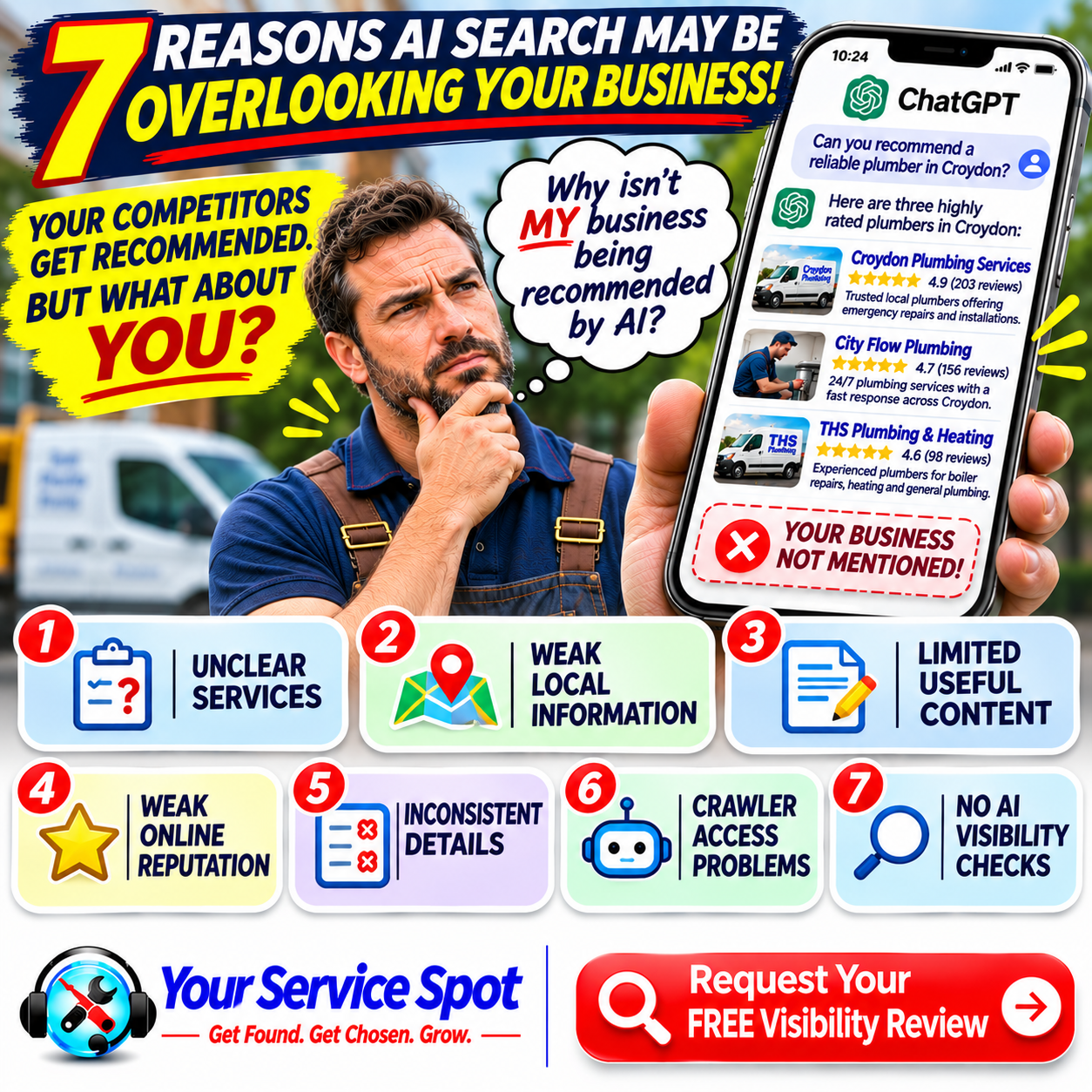
AI search visibility for small businesses.
-
SEO vs AI Search: A Side-by-Side Comparison
Understanding the differences can help you identify where your business may need attention.
| Feature | Traditional Google SEO | AI Search Visibility |
| Main objective | Improve visibility in search results | Improve discovery and representation in AI-generated answers |
| Typical customer behaviour | Searches using keywords or questions | Asks conversational questions |
| Where businesses appear | Organic results, Maps and other Google features | Generated responses, citations and linked sources |
| Important foundations | Relevant content, accessibility, reputation and technical SEO | Clear information, useful content, accessibility and credible supporting sources |
| Local information | Services, location, business profile and reviews | Services, location, reputation and relevant available information |
| Measurement | Rankings, impressions, clicks and conversions | Mentions, citations, accuracy, referrals and enquiries |
| Main challenge | Competing for relevant search visibility | Being discovered and accurately represented across changing AI systems |
These are broad distinctions rather than completely separate systems.
For example, an informative service page can support traditional SEO and also provide useful information to an AI-powered search system.
A strong website remains valuable in both environments.
-
Why Traditional Google SEO Still Matters
With so much attention surrounding artificial intelligence, it’s tempting to assume that conventional SEO is becoming obsolete.
That would be a mistake.
Google Search and Google Maps remain important ways for customers to discover local businesses.
Someone needing an emergency electrician, drain unblocking service or pool equipment repair may still search directly for a provider.
Google SEO Helps Customers Find Your Services
Effective SEO can improve the ability of search engines to understand your website.
This includes clearly explaining:
- What services you provide
- Where your business operates
- Which customer problems you solve
- What makes your business relevant
- How customers can contact you
For example, a plumbing business with a detailed emergency plumbing page gives Google and potential customers more useful information than a website containing only a vague list of services.
Google Maps Provides Local Discovery Opportunities
For many service businesses, Google Maps is especially important.
Google identifies three main factors in local rankings:
- Relevance: How closely a business matches the search.
- Distance: How far a business is from the location associated with the search.
- Prominence: How well-known or established the business is.
A properly maintained Google Business Profile helps communicate useful information to customers.
However, rankings depend on multiple factors, and no agency can guarantee a particular position.
Traditional SEO Supports Customer Enquiries
When someone finds your website through Google, they may already be looking for a particular service.
A useful website can then help them make a decision.
Clear service descriptions, genuine reviews, straightforward navigation and prominent contact details all contribute to the customer experience.
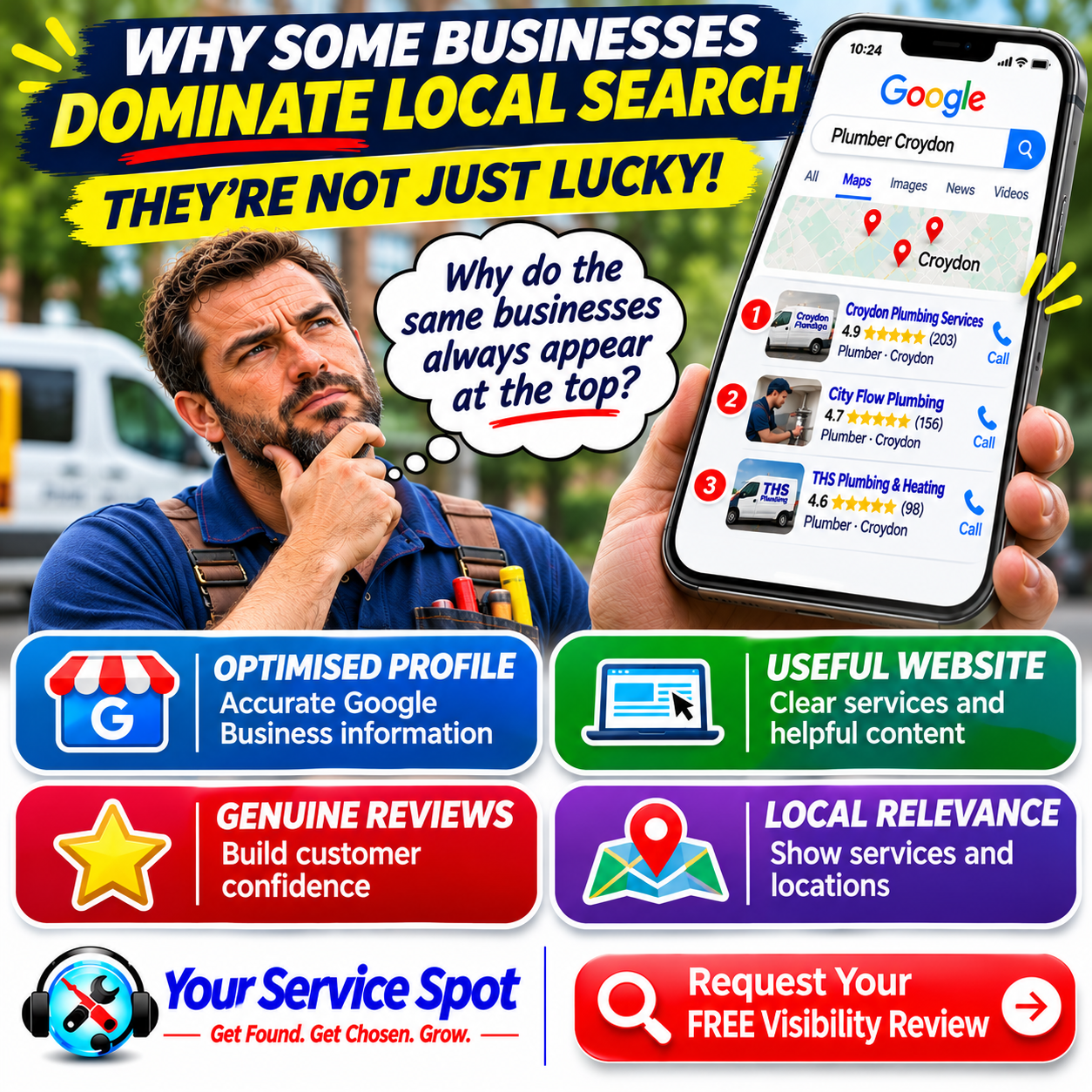
What Google visibility means for local businesses.
-
Why AI Search Visibility Is Becoming Important
AI-powered search offers customers another way to research businesses.
Instead of searching for a short phrase, customers can ask detailed questions.
For example:
“Can you recommend a reliable company in Brighton that offers emergency drain unblocking and CCTV drain surveys?”
Or:
“Which pool maintenance companies in Houston provide weekly cleaning and equipment repairs?”
These questions combine several requirements.
An AI system may attempt to identify relevant information and present it in a helpful response.
Customers Can Ask More Specific Questions
Conversational search allows customers to explain their needs in natural language.
They may ask about:
- Services
- Locations
- Experience
- Qualifications
- Customer reviews
- Pricing considerations
- Availability
- Differences between providers
A business whose website clearly explains these details provides information that can be useful to customers and potentially to AI-powered search systems.
AI Can Influence the Research Process
Some customers may use AI to create a shortlist before visiting individual websites.
Others may use it to understand what questions to ask a provider.
A business mentioned in a relevant answer may gain exposure to someone who hadn’t previously heard of it.
However, AI recommendations are not guaranteed, and there is no single universal ranking formula shared by ChatGPT, Gemini, Perplexity and Google’s AI search features.
Different systems may use different sources, retrieval methods and selection processes.
Why ChatGPT recommends some local businesses.
-
Does Ranking First on Google Mean AI Will Recommend Your Business?
No.
A strong Google ranking doesn’t automatically guarantee inclusion in a ChatGPT or Perplexity response.
Similarly, appearing in an AI-generated answer doesn’t guarantee a high organic Google ranking.
The systems aren’t identical.
They may evaluate different information and generate different results.
An Example
Imagine a customer searches Google for:
“Best plumber Croydon”
A particular plumbing company appears prominently.
The customer then asks ChatGPT:
“Recommend a plumber in Croydon who specialises in emergency boiler repairs.”
The AI response may differ because the question is more specific, the system may access different information and the available sources may not support the same businesses.
Even repeated questions on the same AI platform can produce different responses.
This is why measuring Google rankings alone doesn’t provide a complete picture of AI search visibility.
But there’s an important connection.
The work that improves a website’s clarity, usefulness and credibility can support both traditional search and AI-powered discovery.
-
Seven Foundations That Support Both SEO and AI Search Visibility
Fortunately, improving your presence across both types of search doesn’t necessarily require two completely separate marketing strategies.
Several important activities overlap.
-
Clearly Explain What Your Business Does
Your homepage should make your main services obvious.
Avoid vague statements such as:
“We provide innovative solutions for all your needs.”
Instead, use specific descriptions.
For example:
“We provide emergency plumbing, boiler repairs and bathroom installations throughout Croydon and South London.”
Clear information helps customers understand your business and gives search systems useful context.
Why your homepage isn’t ranking.
-
Create Useful Individual Service Pages
If you provide several important services, consider creating dedicated pages that explain each one.
A drainage company might publish useful pages about:
- Emergency drain unblocking
- CCTV drain surveys
- Drain repairs
- Commercial drainage maintenance
Each page should address genuine customer needs.
Explain what the service involves, who it’s suitable for, what customers can expect and how to enquire.
Avoid creating repetitive pages simply to target keywords.
-
Make Your Service Areas Clear
Local customers need to know whether you operate in their area.
Your website should clearly describe your genuine service coverage.
Location pages can be useful when they provide distinctive information about services in particular towns or neighbourhoods.
However, publishing large numbers of near-identical pages doesn’t automatically improve rankings.
And listing a town as a service area doesn’t guarantee Google Maps visibility there.
Why local businesses need location pages.
-
Answer Real Customer Questions
Helpful content can serve customers using both conventional search and AI-powered search.
For example, a heating engineer might answer:
“Why does my boiler keep losing pressure?”
A roofing company might explain:
“How do I know whether my roof needs repairing or replacing?”
And a drainage business could publish:
“What should I do if my outside drain keeps overflowing?”
These topics reflect genuine customer concerns.
Good answers demonstrate knowledge and help visitors make informed decisions.
Use FAQs where they add value, but don’t assume FAQ markup guarantees enhanced search results or AI citations.
-
Build a Genuine Online Reputation
Customer reviews help potential customers assess a business.
Google also states that review count and positive ratings can contribute to local ranking prominence.
For AI search, genuine reviews and credible third-party information may provide useful context, depending on the platform and sources accessed.
However, there’s no publicly established rule that a particular review count guarantees an AI recommendation.
Encourage authentic customer feedback.
Respond professionally to reviews.
And avoid fake or incentivised reviews that violate platform policies.
Why Google reviews matter for local SEO.
-
Keep Your Business Information Accurate
Your business name, website, telephone number and other relevant details should be accurate across your online presence.
This may include:
- Your website
- Google Business Profile
- Relevant business directories
- Professional association listings
- Industry platforms
Inconsistent information can confuse customers.
Clear, current details also make it easier for systems accessing those sources to understand your business.
Focus on accuracy rather than creating hundreds of unnecessary directory listings.
-
Make Your Website Accessible
Search engines and AI search systems need access to relevant information.
Check that important pages:
- Can be accessed without unnecessary restrictions
- Aren’t accidentally blocked from indexing
- Have appropriate internal links
- Display useful content on mobile devices
- Work without significant technical problems
For ChatGPT search visibility, OpenAI identifies OAI-SearchBot as a crawler associated with search.
This is distinct from GPTBot, which is associated with model training.
Allowing relevant search crawlers can support discovery, but it doesn’t guarantee inclusion in generated answers.
How to improve AI search visibility.
-
What Should You Do Differently for AI Search?
Although many foundations overlap, AI search visibility introduces additional considerations.
Think About Conversational Questions
Traditional keyword research remains useful.
But also consider the complete questions customers might ask an AI assistant.
Instead of focusing only on:
“Electrician Croydon”
Think about:
“Can you recommend an electrician in Croydon who installs EV chargers and provides domestic electrical inspections?”
Does your website clearly explain those services?
Are your qualifications and genuine areas of expertise easy to find?
Make Expertise Easy to Verify
Where appropriate, provide accurate information about:
- Professional qualifications
- Relevant certifications
- Years of experience
- Specific services
- Genuine examples of completed work
- Customer testimonials
- Professional memberships
These details help potential customers evaluate your business.
They can also provide useful factual context to systems accessing your website.
Avoid unsupported claims such as being the best or most trusted provider.
Monitor How Your Business Is Described
If an AI platform mentions your business, examine the response carefully:
- Is your business name correct?
- Are your services described accurately?
- Does the response mention the right location?
- Are the linked sources relevant?
- Does it confuse your business with another company?
AI-generated answers can contain errors, so accuracy matters as much as being mentioned.
-
How to Check Your Google SEO Performance
Traditional SEO provides several useful ways to monitor visibility.
Google Search Console
Google Search Console can help you understand how your website performs in Google Search.
You can examine:
- Search impressions
- Clicks
- Queries
- Average positions
- Indexing information
These metrics can reveal which pages and searches are generating visibility.
Google Business Profile Performance
Your Google Business Profile may provide useful information about customer interactions.
Depending on the features available, this can include calls, website clicks, direction requests and other activity.
Customer Enquiries
Ultimately, visibility should contribute to business outcomes.
Track relevant enquiries from:
- Telephone calls
- Contact forms
- Website visits
- Booking requests
Search rankings are useful indicators, but qualified enquiries and customers matter more.
How to make your website convert more visitors into leads.
-
How to Check Your AI Search Visibility
AI search visibility is less standardised than traditional SEO measurement.
There isn’t one universal dashboard showing how every AI platform represents your business.
However, you can perform practical checks.
Step 1: Choose Realistic Customer Questions
Identify five to ten questions potential customers might ask.
For example:
“Can you recommend a reliable plumber in Croydon?”
“Which drainage companies offer emergency call-outs in Brighton?”
“Who provides commercial pool maintenance in Houston?”
Step 2: Test Multiple Platforms
Try relevant questions in:
- ChatGPT with web search
- Google Gemini
- Perplexity
- Google’s AI search features, where available
Don’t assume every platform accesses the same information.
Step 3: Record the Results
Create a simple worksheet.
| Question | Platform | Business mentioned? | Accurate details? | Sources |
| Emergency plumber Croydon | ChatGPT | Yes/No | Yes/No | Record links |
| Drain unblocking Brighton | Gemini | Yes/No | Yes/No | Record links |
| Pool cleaning Houston | Perplexity | Yes/No | Yes/No | Record links |
Step 4: Compare Competitor Visibility
Look for patterns:
- Are certain competitors mentioned repeatedly?
- What information appears to support those mentions?
- Do they have clearer service pages or more relevant publicly available information?
Avoid assuming that a visible difference proves why a particular AI system selected a business.
Step 5: Repeat the Checks
AI answers can vary.
One test doesn’t establish a permanent ranking.
Repeat relevant questions periodically and record the date, platform and search conditions.
Why ChatGPT recommends some businesses and not others.
-
Common Mistakes Small Businesses Make With SEO and AI Search
As search continues to evolve, several mistakes are worth avoiding.
Mistake 1: Abandoning Traditional SEO
AI-powered search doesn’t make Google SEO irrelevant.
Businesses still benefit from useful websites, accurate business information and strong local search visibility.
Mistake 2: Assuming Google Rankings Guarantee AI Recommendations
Different systems can produce different results.
Strong Google visibility doesn’t guarantee an AI mention.
Mistake 3: Chasing AI Visibility Without Improving the Website
If your website doesn’t clearly explain your services, adding AI-related marketing tactics won’t fix that underlying weakness.
Mistake 4: Publishing Large Amounts of Generic AI Content
Content should help real customers.
Mass-producing repetitive articles without useful information is unlikely to be a sound long-term strategy.
Mistake 5: Ignoring Customer Trust
Being discovered is only part of the process.
Potential customers still need confidence in your business.
Mistake 6: Believing Guaranteed AI Ranking Claims
No agency can guarantee that ChatGPT, Gemini or Perplexity will recommend a particular business for every relevant question.
Be cautious of anyone claiming otherwise.
-
Do Small Businesses Need Two Separate Marketing Strategies?
Not necessarily.
For most small businesses, a sensible approach is to build a strong search foundation and then expand how visibility is monitored and improved.
Think of it as a coordinated strategy.
Traditional SEO Foundations
Start with:
- A clear, useful website
- Relevant service pages
- Accurate Google Business Profile information
- Genuine customer reviews
- Appropriate local content
- Technical website accessibility
AI Search Visibility Improvements
Build on that foundation by:
- Answering conversational customer questions
- Explaining expertise clearly
- Maintaining accurate online information
- Making useful content accessible
- Testing AI-generated answers
- Monitoring business mentions and accuracy
These activities frequently reinforce each other.
You don’t need to choose between Google SEO and AI search visibility.
The more practical approach is to understand how both fit into your customers’ search behaviour.
-
A Practical 30-Day SEO and AI Visibility Action Plan
If you’re unsure where to start, here’s a manageable four-week approach.
Week 1: Review Your Existing Visibility
- Check your Google Business Profile.
- Review Google Search Console.
- Search for your main services and locations.
- Test a selection of relevant AI search questions.
- Record your starting position.
Week 2: Improve Your Core Business Information
- Review your homepage.
- Clarify your main services.
- Check contact details and service areas.
- Correct inaccurate information.
- Make your expertise easier to understand.
Week 3: Strengthen Your Content and Reputation
- Improve an important service page.
- Add useful customer FAQs.
- Review your customer feedback process.
- Check relevant business listings.
- Resolve obvious website problems.
Week 4: Measure and Prioritise
- Repeat selected Google and AI visibility checks.
- Review website enquiries.
- Identify improvements that deserve further attention.
- Create a realistic ongoing content and optimisation plan.
This won’t guarantee rankings or AI recommendations within 30 days.
But it provides a practical starting point for understanding and improving your business visibility.
-
Getting Found Is Only the Beginning
Imagine a customer discovers your business through Google:
- They visit your website.
- Your services are clearly explained.
- Your reviews inspire confidence.
- Your contact details are easy to find.
- They make an enquiry.
Now imagine another customer discovers your business through an AI-generated recommendation:
- They visit the same website.
- They evaluate the same information.
- They make the same decision about whether to contact you.
Although the discovery process differs, the business objective remains similar.
You want potential customers to find your business, trust what they see and choose your services.
At Your Service Spot, that’s the customer journey we focus on.
GET FOUND
Improve your visibility across relevant search experiences.
BUILD TRUST
Demonstrate your experience, reputation and credibility.
GET CHOSEN
Help customers understand why your business is a suitable option.
GENERATE ENQUIRIES
Make it easy for interested customers to contact you.
-
Is Your Business Visible on Google and AI Search?
Your competitors may already be appearing in places where potential customers are researching local services.
Some may have stronger Google Maps visibility.
Others may be mentioned in AI-generated answers.
But before investing in new marketing activities, it’s worth understanding your current position:
- Are customers finding your website through Google?
- Does your business appear for relevant local searches?
- Are AI-powered search platforms mentioning your business accurately?
- And are those opportunities turning into enquiries?
Request Your FREE Visibility Review
At Your Service Spot, we help local businesses identify opportunities to improve their visibility across Google and AI-powered search.
Our approach considers traditional local SEO, Google Business Profile optimisation, website content, online reputation and emerging AI search opportunities.
We’ll help you understand where your business stands and which practical improvements may be worth prioritising.
Ready to discover how visible your business is?
Get Found. Get Chosen. Grow.
Frequently Asked Questions: SEO vs AI Search
-
What is the difference between SEO and AI search?
Traditional SEO focuses on helping search engines discover, understand and rank website content. AI search visibility concerns how businesses and their information are discovered and represented within AI-powered search responses.
-
Is AI search replacing Google SEO?
No. Traditional Google Search and Google Maps remain important discovery channels. AI-powered search introduces additional ways customers can research businesses, and the two increasingly overlap.
-
Does my business need both SEO and AI search visibility?
For many small businesses, paying attention to both is sensible. Traditional SEO supports established search channels, while AI visibility checks help you understand emerging customer discovery methods.
-
Will ranking first on Google make ChatGPT recommend my business?
Not necessarily. ChatGPT and Google don’t use identical systems, and a strong Google ranking doesn’t guarantee inclusion in an AI-generated answer.
-
How does ChatGPT decide which local businesses to recommend?
There is no publicly documented universal formula determining every local business recommendation. Results can depend on the question, available sources, search capabilities and other system-specific factors.
-
Does Google Business Profile help with AI search visibility?
Accurate business information can be useful wherever it is available to a search system. However, having an optimised Google Business Profile doesn’t guarantee recommendations from ChatGPT or other AI platforms.
-
Are customer reviews important for AI search?
Reviews can provide useful information about customer experiences and reputation. Whether and how an AI platform uses them depends on its available sources and processes. No fixed review count guarantees inclusion.
-
Do I need a separate website for AI search?
No. A well-structured website with clear services, useful content and accessible information can support both traditional search and AI-powered discovery.
-
What is AI search optimisation?
AI search optimisation refers to activities intended to improve how information about a business is discovered, understood and represented in AI-powered search experiences. It overlaps considerably with established SEO practices.
-
What is the difference between ChatGPT and Google AI Overviews?
ChatGPT is an AI assistant that can provide conversational responses and, when search is available, use web information. Google AI Overviews are AI-generated features within Google Search. Their sources, presentation and behaviour can differ.
-
How can I check whether AI recommends my business?
Ask relevant customer-style questions using AI search platforms, record whether your business appears, examine the sources and repeat checks periodically. A single response isn’t a reliable measure of overall visibility.
-
Can local SEO improve AI search visibility?
Some local SEO improvements, such as clearer service pages, accurate business information and stronger online credibility, can also support AI-powered discovery. However, results aren’t guaranteed.
-
How long does AI search optimisation take?
There is no established universal timeframe. Discovery and representation can vary across platforms, and improvements may not produce measurable mentions immediately.
-
Should I stop targeting keywords and focus only on questions?
No. Keywords remain useful for understanding search demand and organising website content. Conversational questions provide an additional way to understand customer needs.
-
Do I need special AI schema markup?
There is no universal special schema markup that guarantees AI recommendations. Appropriate structured data can help describe website content, but it should accurately reflect visible information and follow search engine guidance.
-
Can an agency guarantee my business will appear in ChatGPT?
No. AI-generated recommendations can vary, and no agency controls every response. Be cautious of guaranteed inclusion claims.
-
Is AI search visibility more important than Google Maps?
That depends on your customers and business. For many local service providers, Google Maps remains highly relevant. AI search visibility is an additional opportunity worth monitoring.
-
What should a small business do first?
Start with a clear website, accurate Google Business Profile, useful service information, genuine reviews and accessible content. Then test relevant AI search questions to identify possible improvements.
-
How do I measure the return on investment from SEO and AI search?
Track relevant website traffic, search visibility, enquiries and conversions. For AI search, also monitor mentions, citations, referral traffic where identifiable and the accuracy of business information.
-
What is the biggest mistake businesses make with SEO vs AI search?
Treating them as entirely separate or assuming one replaces the other. Both benefit from clear information, useful content, credible reputation and a website that helps customers make decisions.