How to Make Your Website Convert More Visitors Into Leads
Getting more visitors to your website sounds like the obvious way to generate more business.
More Google visibility means more traffic. More traffic means more enquiries. More enquiries mean more customers.
Except it doesn’t always work that way.
A business can attract hundreds — even thousands — of website visitors without generating enough enquiries.
Why?
Because getting someone onto your website is only half the job.
Once they arrive, your website needs to convince them that they’ve found the right business and make it easy for them to take the next step.
That’s where website conversion comes in.
If you’re already attracting visitors, improving the percentage who contact you could be one of the biggest opportunities hiding within your existing online presence.
What Is Website Conversion?
A website conversion happens when a visitor takes an action you want them to take.
For a local business, that might mean:
- Calling your business
- Completing an enquiry form
- Requesting a quote
- Booking an appointment
- Sending a message
- Making a purchase
- Visiting your premises
Your website therefore has a much bigger job than simply looking attractive.
It needs to help move someone from:
Visitor → Prospect → Enquiry → Customer
The easier and more convincing that journey is, the greater your opportunity to generate website leads.
-
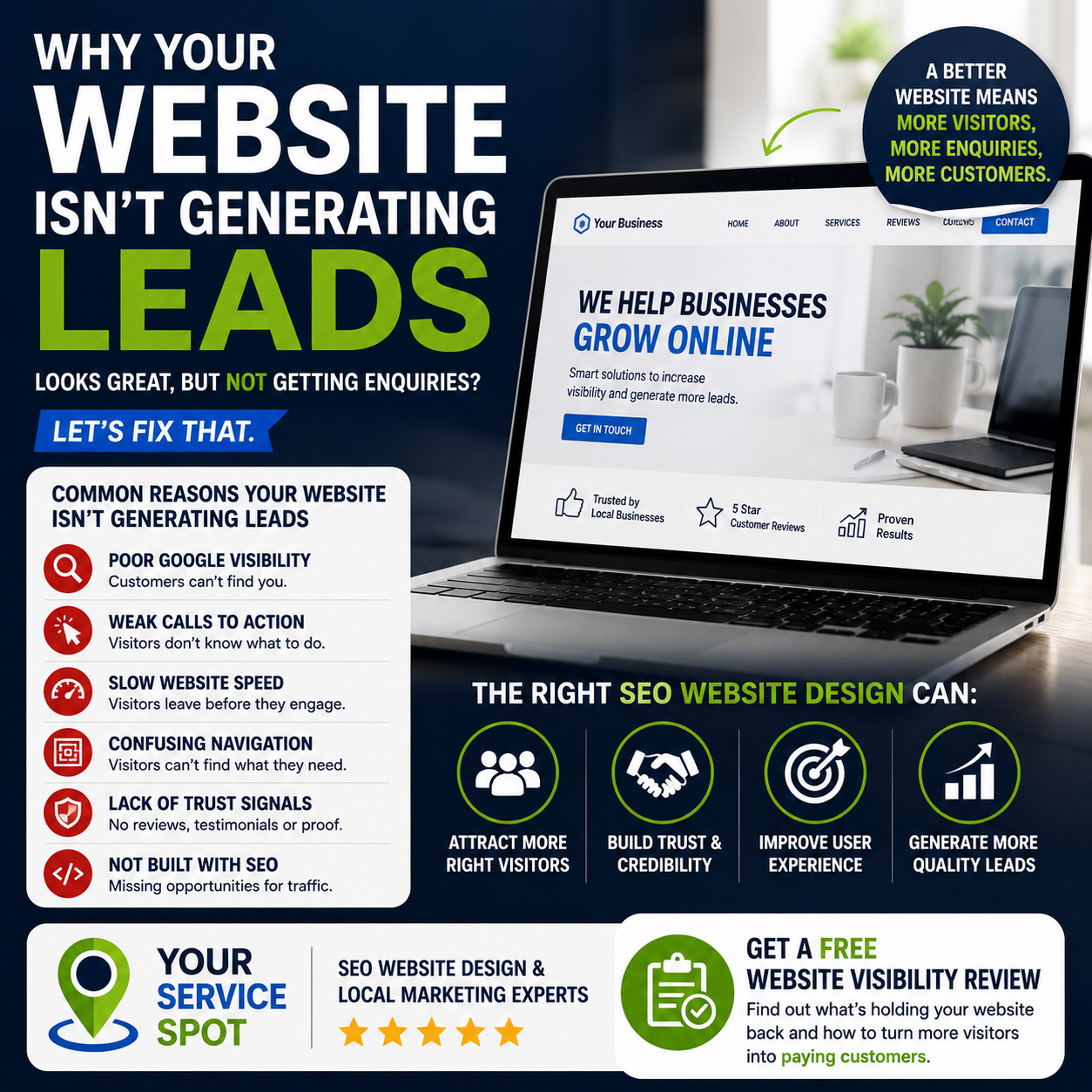
Make It Immediately Clear What You Do
When someone lands on your homepage, don’t make them solve a puzzle.
Within seconds, they should understand:
- What do you do?
- Who do you help?
- Where do you provide the service?
Imagine searching for a local plumber and arriving at a website with the headline:
“Quality You Can Trust.”
It sounds positive.
But what does the company actually do?
Compare that with:
“Emergency Plumber in Croydon – 24-Hour Plumbing & Boiler Repairs”
The second version immediately provides useful information.
Clever slogans have their place, but clarity usually needs to come first.
Google’s guidance similarly emphasises creating content primarily for people and providing information that helps visitors achieve their goals. For a local business, being found locally is a worthy goal.
-
Show Visitors They’re in the Right Place
Your potential customer probably arrived with a specific problem or requirement.
They need reassurance that you can solve it.
Your website should clearly communicate:
- Services you provide
- Locations you cover
- Types of customers you help
- Relevant experience
- What makes your service different
- What they should do next
If someone searches for “CCTV drain survey Brighton”, for example, and lands on a generic drainage homepage that barely mentions CCTV surveys, you’re making that person work harder than necessary.
A dedicated, useful service page can answer their questions far more effectively.
This is one reason good SEO and good conversion optimisation frequently work together.
The right page attracts the right visitor — and then helps them take action.
-
Give People a Reason to Trust You
Before contacting a business they haven’t used before, customers naturally look for reassurance.
They’re asking themselves:
- Is this business genuine?
- Are they good at what they do?
- Have other people had a positive experience?
- Can I trust them with my money, home or business?
Useful trust signals can include:
⭐ Genuine customer reviews
📷 Real photographs
👥 Team information
🏆 Relevant qualifications or accreditations
📍 Clear business and contact details
📝 Case studies or examples of work
💬 Customer testimonials
Don’t hide your strongest evidence on an obscure page nobody visits.
Place appropriate trust signals throughout the customer journey.
-
Make Your Calls to Action Obvious
What do you want visitors to do next?
Don’t assume they’ll work it out.
Use clear calls to action such as:
- Call Now
- Request a Quote
- Book an Appointment
- Get Your Free Estimate
- Send Us an Enquiry
A visitor shouldn’t need to scroll to the bottom of the website, open the Contact page and search for a telephone number.
Your primary action should be easy to find.
And don’t be afraid to repeat it naturally throughout longer pages.
Someone who isn’t ready to contact you at the top of the page might be ready after reading about your services, reviews and experience.
-
Make Contacting You Easy
Every additional obstacle can reduce the likelihood that someone completes an enquiry.
Imagine a form asking for:
- First name
- Surname
- Business name
- Job title
- Address
- Telephone
- Service
- Budget
- Preferred contact time
- How they heard about you
- Detailed message
…when all the business really needs initially is a name, telephone number and brief description of the problem.
Ask yourself:
Do we really need this information before speaking to the customer?
If not, consider removing it.
Google’s mobile-site guidance similarly recommends making common actions such as contacting a business quick and easy, while minimising unnecessary steps in forms and transactions.
-
Make Your Phone Number Easy to Find
For many local service businesses, the telephone remains one of the most valuable conversion routes.
Make the number prominent.
And on mobile devices, make it clickable.
This becomes particularly important for urgent services.
Someone standing in a kitchen with water leaking through the ceiling probably doesn’t want to complete a 12-field contact form.
They want:
📞 Call Now
Your website should recognise the customer’s situation and make the appropriate action easy.
-
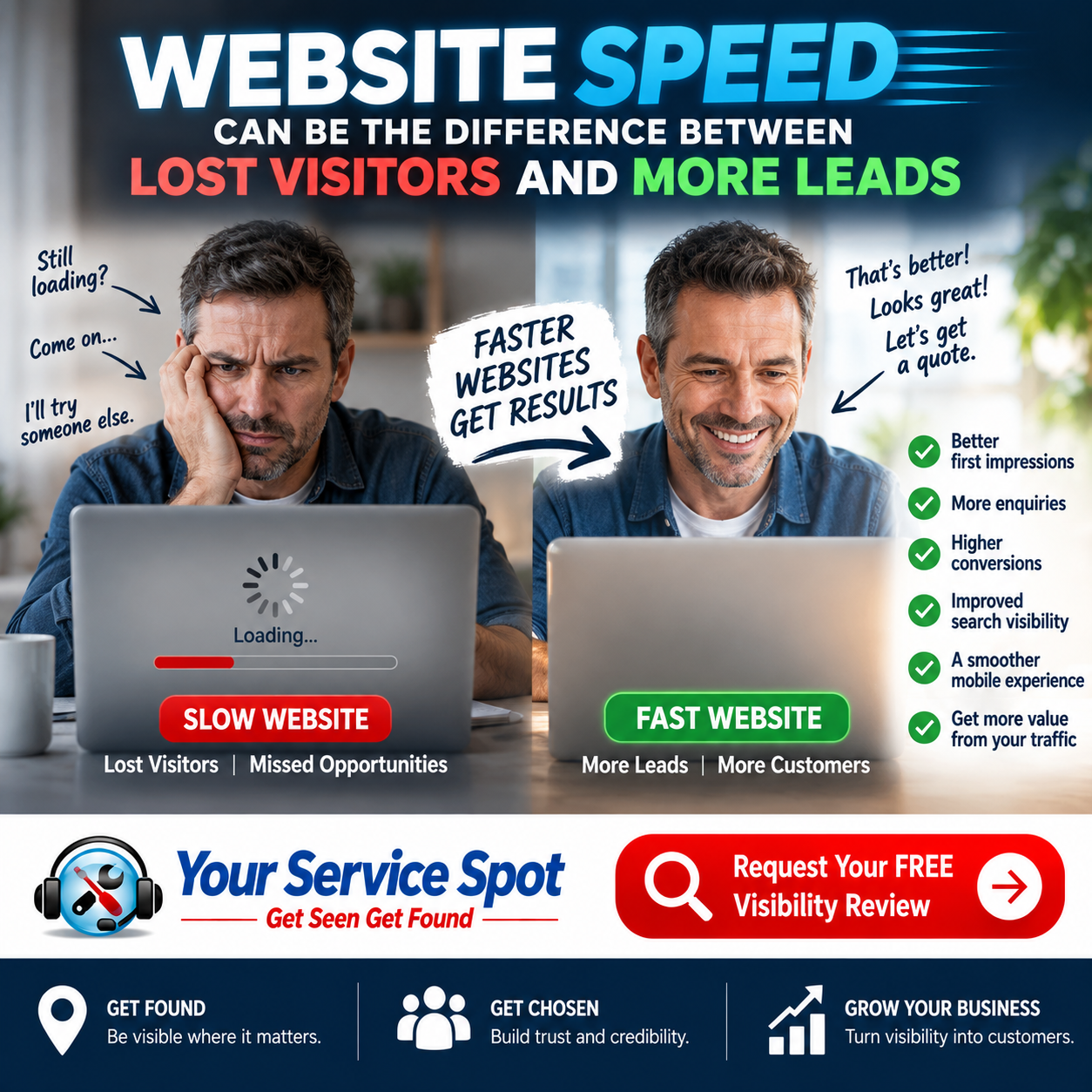
Make Sure Your Website Is Fast
You can have excellent content, glowing reviews and an irresistible offer.
But none of that helps if the visitor becomes frustrated waiting for the website to load.
Website speed and website conversion are closely connected through user experience.
Google’s Core Web Vitals measure real-world aspects of loading performance, responsiveness and visual stability, and Google recommends good Core Web Vitals both for Search and for user experience.
A fast website removes one more barrier between the visitor and the enquiry.
-
Design for Mobile Customers
Don’t judge your website only by how it looks on your laptop.
Look at it on your phone.
- Can you immediately understand what the business does?
- Can you read everything comfortably?
- Can you open the navigation easily?
- Can you tap the telephone number?
- Can you complete the enquiry form?
- Can you find the main call to action?
Google uses the mobile version of a site’s content for indexing and ranking and strongly recommends creating a mobile-friendly website for users.
For a local business, mobile usability is also commercially important because the person finding you on Google may be ready to contact you immediately.
-
Answer the Questions That Stop People Enquiring
Potential customers often have unanswered questions standing between interest and action.
For example:
- How much does it cost?
- Do you cover my area?
- How quickly can you come?
- Do you offer guarantees?
- What happens after I contact you?
- Do I need to prepare anything?
- Can you handle my particular problem?
You don’t necessarily need to publish every detail or quote an exact price.
But answering common questions reduces uncertainty.
That’s why FAQs can be valuable for website conversion as well as SEO.
A well-written FAQ doesn’t exist merely to include keywords.
It removes reasons not to contact you.
-
Focus on Benefits, Not Just Services
Businesses understandably like talking about what they do.
Customers are more interested in what the service does for them.
Instead of simply saying:
“We provide professional local SEO services.”
You could explain:
“We help local businesses improve their visibility when potential customers search Google for the services they provide.”
The service hasn’t changed.
The second version explains the outcome.
This principle applies across industries.
Don’t just describe the drill.
Explain the hole it makes.
-
Remove Distractions
More isn’t always better.
Your website doesn’t necessarily need:
- Multiple pop-ups
- Constant animations
- Numerous competing buttons
- Huge menus
- Auto-playing videos
- Several different offers on one page
- Walls of unnecessary text
Every page should have a purpose.
Ask:
What does this visitor need to know, and what would we like them to do next?
Then design the page around that journey.
Google recommends taking a holistic approach to page experience rather than focusing on one isolated metric, including ensuring content displays well on mobile and avoiding excessive distractions or intrusive elements.
-
Don’t Send Every Visitor to Your Homepage
Your homepage cannot be the perfect answer to every search.
Suppose you provide five services across six locations.
Someone searching for one specific service in one particular area may respond better to a page specifically addressing that requirement than to a general homepage.
This is where properly planned:
Service pages + Location pages + Helpful content
can become extremely valuable.
They can improve relevance for search engines and local visibility while giving potential customers a more appropriate landing experience.
-
Give Visitors a Clear Next Step
Every important page should answer one final question:
“What should I do now?”
If someone reaches the end of a service page and there’s nowhere obvious to go, you’ve created a dead end.
Instead, guide them.
For example:
- Need help with this problem? Call us today.
- Ready for a quote? Send us the details.
- Not sure what’s wrong? Speak to our team.
A good call to action doesn’t need aggressive sales language.
It needs clarity.
More Traffic Isn’t Always the Answer
This is perhaps the most important lesson.
Imagine two websites.
Website A
1,000 visitors
10 enquiries
1% conversion rate
Website B
1,000 visitors
30 enquiries
3% conversion rate
Website B generates three times as many enquiries from exactly the same amount of traffic.
That’s a simplified example rather than a benchmark for what your conversion rate “should” be, but it demonstrates the principle.
Before deciding you need more traffic, ask:
Are we making the most of the traffic we already have?
Sometimes improving website conversion can be just as important as attracting additional visitors.
SEO Gets You Found. Conversion Helps You Get Chosen.
This is where everything we’ve been discussing at Your Service Spot comes together:
- Local SEO can help potential customers discover your business.
- Your Google Business Profile can help establish your presence.
- Reviews can build confidence.
- Your website can provide the information customers need.
- Speed and usability remove friction.
- Clear calls to action make the next step obvious.
Think of it as:
VISIBILITY → TRUST → ACTION → ENQUIRY
Getting found matters.
But getting found without getting chosen leaves a huge part of the opportunity on the table.
Is Your Website Turning Enough Visitors Into Leads?
Your website shouldn’t simply exist.
It should have a purpose.
At Your Service Spot, we help local businesses identify the gaps between being visible online and turning that visibility into genuine business opportunities.
We’ll look at the bigger picture — including your Google presence, website, content, reputation and customer journey.
Could Your Website Be Losing Potential Customers?
Request your FREE Visibility Review and discover where your online presence could be improved.
Get Found. Get Chosen. Grow.
Frequently Asked Questions
What is website conversion?
Website conversion is the process of turning visitors into people who complete a desired action. For a local business, that might mean making a phone call, completing an enquiry form, requesting a quote or booking an appointment.
How can I generate more website leads?
Start by making it immediately clear what you offer and where you operate. Add strong trust signals, provide clear calls to action, simplify contact forms, improve mobile usability and make sure important pages load quickly. The objective is to remove unnecessary barriers between interest and enquiry.
What is a good website conversion rate?
There isn’t one conversion rate that every business should achieve. It depends on the industry, traffic source, type of conversion, customer intent, offer and other factors. Establish your own baseline and work on improving it rather than chasing a generic benchmark.
Why am I getting website traffic but no enquiries?
Possible reasons include attracting the wrong visitors, unclear messaging, weak calls to action, lack of trust, poor mobile usability, slow pages, confusing navigation or an unnecessarily difficult enquiry process. Investigate the complete customer journey rather than assuming you simply need more traffic.
Does website speed affect conversions?
A slow or unstable website can create friction for visitors. Google’s Core Web Vitals specifically measure loading performance, responsiveness and visual stability, all of which contribute to the user experience.
How important are reviews for website conversion?
Reviews can provide valuable reassurance to potential customers who haven’t used your business before. Consider displaying genuine testimonials or review evidence at appropriate points on service and landing pages rather than hiding all your social proof on a single testimonials page.
Should every website page have a call to action?
Important commercial pages should normally provide visitors with a logical next step. The appropriate action may differ by page — calling, requesting a quote, booking, enquiring or moving to another useful resource.
Do I need more website traffic to get more leads?
Not necessarily. More relevant traffic can certainly create additional opportunities, but improving the proportion of existing visitors who enquire can also increase leads without increasing visitor numbers.