How to Get Into Google’s Local 3-Pack: A Practical Guide for Small Businesses
Imagine a potential customer searching Google for the exact service your business provides.
They type something like:
- “Plumber near me”
- “Electrician Croydon”
- “Drain unblocking Brighton”
- “Pool cleaning Houston”
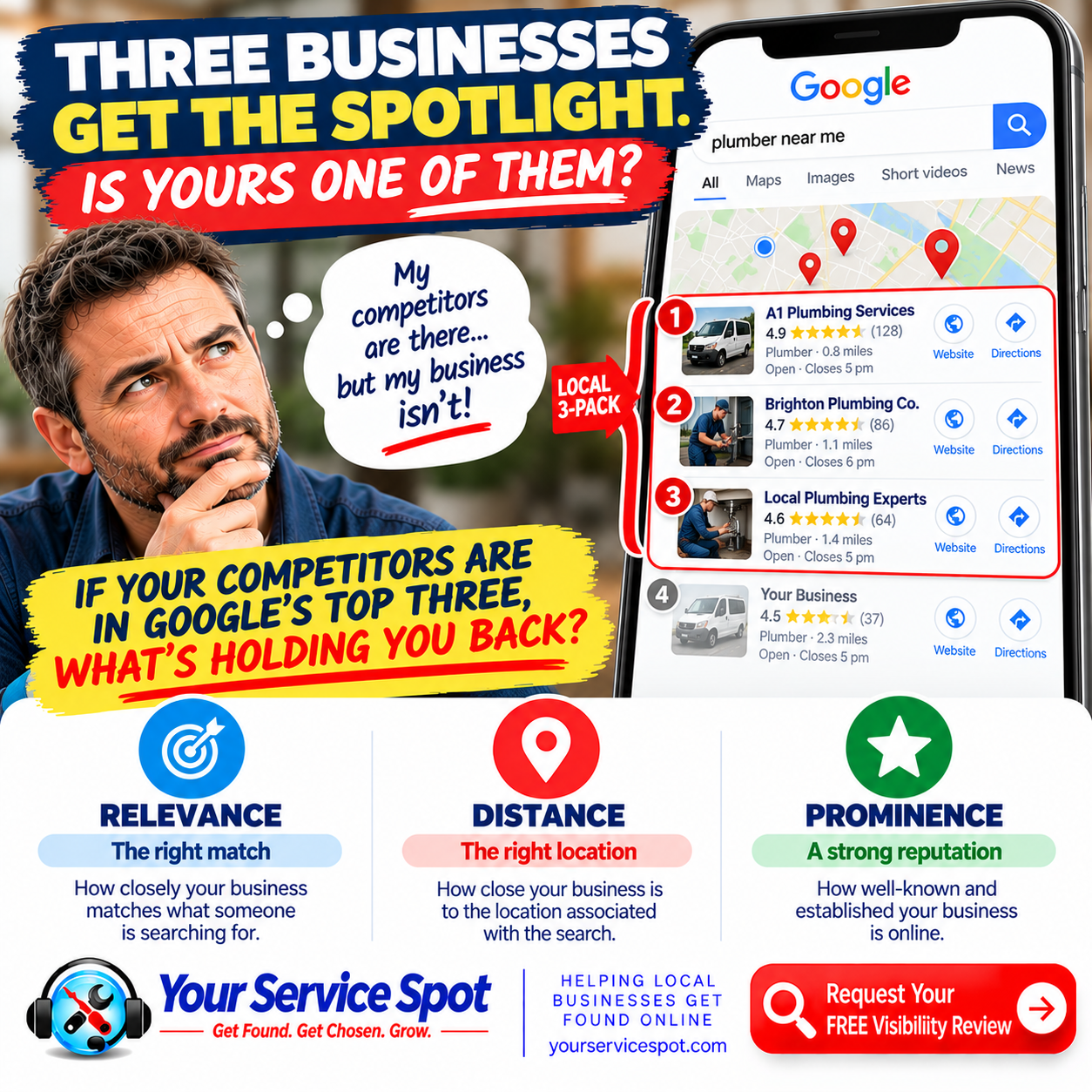
Google displays a map alongside three prominent local business listings.
Your competitors are there.
But your business isn’t.
Those three listings are commonly known as Google’s Local 3-Pack.
And when your business doesn’t appear among them, potential customers may notice and contact your competitors before discovering you.
So how do you get into the Google Local Pack?
Is it about collecting more reviews? Improving your website? Choosing better keywords?
The answer involves several factors.
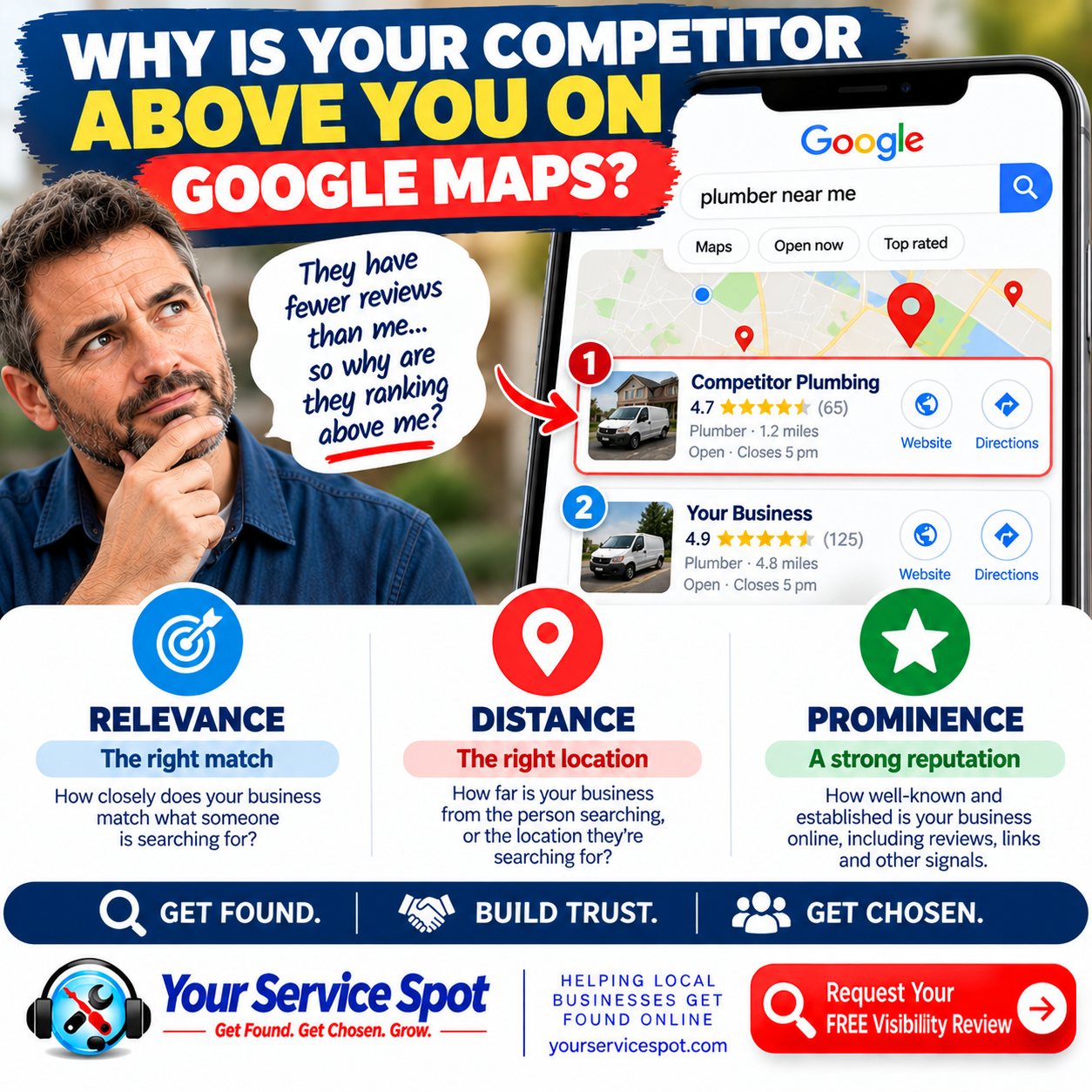
Google’s local rankings are primarily based on relevance, distance and prominence. Understanding these principles can help you make sensible improvements to your online presence.
In this guide, we’ll explain how the Local 3-Pack works, what influences your Google Maps ranking, and the practical steps you can take to improve your chances of appearing.
-
What Is Google’s Local 3-Pack?
Google’s Local 3-Pack is the group of three local business listings commonly displayed alongside a map in certain Google Search results.
For example, when someone searches for “roof repairs Croydon”, Google may show three relevant local businesses before or alongside other search results.
These listings can display information such as:
- Business name
- Google review rating
- Business category
- Address or service information
- Opening hours
- Directions or contact options
- A link to the business’s website
The exact appearance varies depending on the search, device and Google’s current interface.
For local service businesses, this prominent placement can be particularly valuable.
Potential customers can quickly compare businesses and decide which ones to investigate.
The Local 3-Pack puts a small selection of businesses directly in front of people searching for relevant local services.
But appearing there isn’t guaranteed.
And the businesses shown can change depending on the search.
-
Why Is the Google Local Pack Important?
Think about how you search for a local business.
You need a plumber, electrician, accountant or garage.
You search Google.
Several businesses appear prominently with their ratings, locations and contact information.
Would you investigate those businesses first?
Many customers do.
That’s why appearing in the Google Local Pack can create valuable opportunities for local businesses.
It can help you:
- Become more visible to people searching for your services
- Put your business alongside relevant competitors
- Display reviews and important business information
- Make it easier for potential customers to contact you
- Generate opportunities for website visits and enquiries
However, visibility doesn’t automatically produce customers.
Your business still needs to demonstrate credibility and make contacting you straightforward.
Getting found is the first step. Getting chosen is what matters next.
Read our guide on why visibility matters for local businesses.
-
How Does Google Decide Which Businesses Appear?
Google explains that local results are primarily based on three factors.
Relevance
How closely does your business match what someone is searching for?
For example, if someone searches for “emergency drain unblocking Brighton”, Google needs to identify businesses relevant to that service.
Your business categories, services and other information can help Google understand what you offer.
Distance
How far is your business from the location associated with the search?
A business may appear prominently for customers searching nearby but rank differently for people several miles away.
This is why local rankings can vary across different neighbourhoods.
Prominence
How well-known or established is your business?
Google considers information about businesses from across the web.
Review count, positive ratings, links and other information can contribute to prominence.
These factors work together.
A business with more reviews doesn’t automatically outrank every competitor.
A beautiful website doesn’t guarantee a top-three position.
And being the closest business doesn’t always mean appearing first.
Google evaluates multiple signals to determine which local results are most relevant and useful.
How Google decides which businesses rank first.
-
Choose the Right Google Business Profile Categories
Your Google Business Profile categories help describe your business.
They are particularly important for relevance.
Imagine you operate a business specialising in residential swimming pool maintenance.
Your primary category should accurately represent your main activity.
Choosing a broad or unrelated category could make your profile less useful to Google and potential customers.
What Should You Do?
Review your primary category.
Ask yourself:
Does this describe the main service my business provides?
Then examine your secondary categories.
Add relevant categories where appropriate, but don’t select categories for services you don’t actually provide.
For example, a business that only cleans swimming pools shouldn’t claim to provide unrelated services simply to appear for additional searches.
The objective is accuracy, not keyword manipulation.
Common Google Business Profile mistakes.
-
Complete and Optimise Your Google Business Profile
An incomplete Google Business Profile can make it harder for customers to understand your business.
Google recommends providing complete and accurate business information.
Review the following:
Business name
Use your genuine business name. Don’t add extra keywords or locations that aren’t part of your real-world name.
Business categories
Choose the categories that accurately describe your business.
Contact details
Make sure your phone number and website link are correct.
Opening hours
Keep regular and special opening hours up to date.
Services
Clearly describe the services you genuinely provide.
Business description
Explain what your business does and whom it serves in natural language.
Photographs
Use relevant, authentic images of your business, team, premises or completed work where appropriate.
Service areas
If you visit customers at their locations, configure your service areas accurately in accordance with Google’s guidelines.
A complete profile helps customers find the information they need.
It also provides Google with a clearer understanding of your business.
How Often Should You Update Your Google Business Profile?
-
Earn Genuine Google Reviews
Reviews are one of the most visible features of a Google Business Profile.
Potential customers may compare businesses based on ratings, review content and recent customer experiences.
Google also confirms that review count and positive ratings can help local ranking.
But there’s an important distinction.
More reviews don’t automatically guarantee a place in Google’s Local 3-Pack.
Reviews are one part of a broader ranking system.
How Can You Build a Stronger Review Profile?
Make requesting honest customer feedback part of your normal business process.
For example:
- Share your Google review link after completing a service.
- Include a review request in a follow-up email.
- Use a QR code where appropriate.
- Respond professionally to customer feedback.
- Make it easy for customers to leave genuine reviews.
Don’t purchase reviews, offer incentives or selectively ask only happy customers for feedback.
The goal is to develop an authentic reputation that reflects real customer experiences.
Why recent Google reviews matter.
-
Strengthen Your Website’s Local Relevance
Your Google Business Profile is important.
But your website also plays a valuable role in your overall local online presence.
A useful website should explain:
- What your business does
- Which services you offer
- Where you operate
- Why customers should trust you
- How they can contact you
For example, a plumbing company might have separate pages explaining boiler repairs, emergency plumbing and bathroom installations.
Each page should provide useful information about the service rather than repeating generic marketing claims.
Make Your Homepage Clear
Someone visiting your homepage should quickly understand your business.
A headline such as:
“Reliable Plumbing and Heating Services in Croydon”
is more informative than:
“Innovative Solutions for Modern Living.”
Clear content helps potential customers understand what you offer.
It also provides search engines with useful context.
Why your homepage isn’t ranking.
-
Make Your Service Areas Clear
Distance is an important local ranking factor.
And it’s one of the reasons Google Maps results can vary depending on where someone searches.
If your business serves several towns or neighbourhoods, make that information clear on your website.
For example, a drainage company might serve Brighton, Hove and nearby areas.
Useful service-area pages can explain:
- Which services are available locally
- The areas covered
- Common customer needs
- How to arrange an appointment
- Relevant local information
However, avoid creating dozens of almost identical pages that simply replace one town name with another.
Every location page should provide genuine value.
Also remember:
Adding more service areas to your Google Business Profile doesn’t automatically make you rank throughout those locations.
Google still considers distance and other local ranking signals.
Why local businesses need location pages.
-
Build a Stronger Online Reputation
Google’s prominence factor considers information about your business from across the web.
That means your wider online presence matters.
Useful opportunities may include:
- Accurate listings in relevant business directories
- Membership of recognised professional associations
- Genuine mentions from local organisations
- Relevant coverage in local publications
- Links from legitimate business partners
- Helpful website content that others choose to reference
The objective isn’t to create hundreds of low-quality directory listings.
It’s to establish a credible, accurate and consistent presence.
A strong reputation can support both customer confidence and your wider local SEO efforts.
-
Keep Your Google Business Profile Active and Accurate
Some business owners create a Google Business Profile and then forget about it:
- Months pass.
- Opening hours change.
- Services evolve.
- Photographs become outdated.
- Customer reviews go unanswered.
Although frequent posting isn’t a guaranteed direct ranking boost, keeping your profile useful and accurate is worthwhile:
- Review your information regularly.
- Respond to customer feedback.
- Update your services when necessary.
- Add relevant photographs.
- And make sure potential customers can easily contact you.
Why an inactive Google Business Profile can hurt visibility.
-
Understand Why Your Rankings Change
You might check Google Maps and find your business in third position.
The next day, you’re fifth.
Then someone searching from another part of town sees a completely different result.
That doesn’t necessarily mean something has gone wrong.
Google Maps rankings can vary according to:
- Search location
- Search wording
- Competitor relevance
- Available business information
- Changes to Google’s ranking systems
This is why checking your business from one location using one keyword provides only a limited picture.
A Better Approach
Identify the services and locations that matter most.
Then assess how your business appears across several relevant searches:
- Look for patterns.
- Which competitors appear consistently?
- Where is your visibility strongest?
- Where are the gaps?
- And are your Google Business Profile and website helping turn visibility into enquiries?
-
Seven Common Mistakes That Can Hold You Back
If your business isn’t appearing in Google’s Local 3-Pack, check whether any of these problems apply.
-
Incorrect business categories
Your categories don’t accurately describe your main services.
-
Incomplete business information
Important details are missing or outdated.
-
Weak website content
Your website doesn’t clearly explain your services or locations.
-
Few genuine customer reviews
Potential customers have limited feedback to help evaluate your business.
-
Inconsistent business information
Your contact details differ across relevant online listings.
-
Poor customer experience
People find your business but struggle to contact you or understand what you offer.
-
Focusing on rankings alone
You concentrate on position without considering whether visibility generates meaningful enquiries.
Some of these issues can affect Google’s understanding of your business. Others primarily affect customer trust and conversion.
Both deserve attention.
Signs your local SEO needs improving.
-
Can You Guarantee a Place in Google’s Local 3-Pack?
No.
And any marketing company promising guaranteed top-three organic rankings should be treated cautiously.
Google doesn’t sell better organic local rankings.
Paid advertising is separate from the unpaid local ranking system.
Even a well-optimised business can appear differently depending on the searcher’s location and search terms.
That doesn’t mean local SEO is ineffective.
It means the objective should be to improve the factors you can influence while measuring the results realistically.
A credible local SEO strategy focuses on:
- Improving relevance
- Maintaining accurate information
- Strengthening reputation
- Developing useful website content
- Assessing local visibility
- Generating better customer experiences
The aim is sustainable improvement, not unrealistic promises.
-
Getting Into the Local 3-Pack Is Only Half the Job
Imagine your business appears in Google’s Local 3-Pack.
Excellent.
But what happens when someone opens your profile?
- Do they see a business they can trust?
- Are your reviews reassuring?
- Are your photographs current?
- Does your website clearly explain your services?
- Can customers contact you easily?
Because visibility without trust doesn’t necessarily produce enquiries.
At Your Service Spot, we focus on the complete customer journey:
GET FOUND → BUILD TRUST → GET CHOSEN → GENERATE ENQUIRIES
The Local 3-Pack can help you get found.
But your reputation, website and customer experience help you get chosen.
How to turn more website visitors into enquiries.
-
How to Start Improving Your Local 3-Pack Visibility
You don’t need to change everything overnight.
Start with a few practical steps.
First, check your Google Business Profile.
Make sure your categories, services, contact information and opening hours are accurate.
Next, examine your website.
Does it clearly explain what you do and where you operate?
Then review your customer feedback.
Are you consistently encouraging genuine reviews and responding professionally?
Finally, investigate your local search visibility.
Which competitors appear in the Local 3-Pack for your most important searches?
What are they doing differently?
And where might your business have opportunities to improve?
Start with evidence, prioritise the most important improvements and measure progress over time.
Is Your Business Missing From Google’s Local 3-Pack?
Three businesses may be getting the spotlight when potential customers search for your services.
But is yours one of them?
And if not, do you know why?
At Your Service Spot, we help local businesses identify opportunities to improve their Google visibility, strengthen customer trust and generate more enquiries.
Request Your FREE Visibility Review
Discover where your business may be missing opportunities on Google and what practical improvements could help.
Get Found. Get Chosen. Grow.
Frequently Asked Questions About Google’s Local 3-Pack
What is Google’s Local 3-Pack?
Google’s Local 3-Pack is the group of three local business listings commonly displayed with a map in certain Google Search results. It helps users discover relevant businesses in a particular area.
How do I get my business into Google’s Local 3-Pack?
Start by maintaining an accurate Google Business Profile, selecting relevant categories, earning genuine customer reviews, improving useful website content and strengthening your online reputation. However, inclusion isn’t guaranteed.
What are the main Google Local Pack ranking factors?
Google says local rankings are primarily based on relevance, distance and prominence. These help determine how closely a business matches a search, how far away it is and how established it is online.
Do I need a website to appear in Google’s Local 3-Pack?
Not necessarily. An eligible business can appear through its Google Business Profile without having a website. However, a useful website can provide more information to customers and support your broader local online presence.
Do Google reviews help Local 3-Pack rankings?
Yes. Google confirms that review count and positive ratings can help local ranking. However, reviews are only one part of the ranking process and don’t guarantee a top-three position.
How long does it take to rank in Google’s Local 3-Pack?
There’s no guaranteed timeframe. Results depend on your business, competition, location, existing online presence and how Google processes updated information.
Can I pay Google to appear in the Local 3-Pack?
Google offers paid advertising placements, but paying for Google Ads doesn’t improve your organic local ranking. Paid advertising and unpaid local results are different.
Why does my competitor appear in the Local 3-Pack but I don’t?
Your competitor may be more relevant to the search, closer to the searcher or stronger in certain prominence signals. Having more reviews or a better-looking website doesn’t automatically mean your business will rank above them.
Does posting regularly on Google Business Profile improve rankings?
Google doesn’t guarantee a direct ranking improvement from posting frequently. However, relevant updates and accurate information can make your profile more useful to potential customers.
Can service-area businesses appear in the Local 3-Pack?
Yes. Eligible service-area businesses can appear in local search results. Their visibility still depends on Google’s local ranking systems, and adding more service areas doesn’t guarantee rankings throughout those locations.
Why does my Local 3-Pack position change?
Local rankings can vary with search location, wording, competition and other factors. A position observed in one search isn’t necessarily representative of your visibility across an entire service area.
What’s the difference between Google Maps ranking and the Local 3-Pack?
Google Maps ranking concerns how businesses appear in Google’s map-based local results. The Local 3-Pack is a prominent group of local listings shown in certain Google Search results. The two are related but aren’t identical displays.
Is ranking in the Local 3-Pack more important than appearing in organic search results?
Both can be valuable. The importance of each depends on how your customers search and interact with results. A strong local SEO strategy considers your Google Business Profile, website visibility and ability to convert interest into enquiries.