10 Signs Your Local SEO Needs Improving
Your business has a website. You’ve created a Google Business Profile. Perhaps you’ve collected some reviews and even published a few posts.
But there’s a much more important question:
Can potential customers actually find you when they’re searching for the services you provide?
Having an online presence isn’t the same as having online visibility.
If competitors repeatedly appear ahead of you in Google Search and Google Maps, or your website receives visitors but generates few enquiries, there could be opportunities to improve your local SEO.
Here are 10 warning signs worth looking for — and what you can do about them.
-
You Don’t Appear for Important Local Searches
Try searching Google for the services you provide rather than your business name.
For example:
- plumber Croydon
- drain unblocking Brighton
- accountant near me
- electrician Sutton
- pool cleaning Houston
Can you find your business?
If you only appear when somebody searches for your company name, that’s potentially a problem. People who already know your name aren’t the only customers you want to reach.
You also want to be discovered by people who need your service but haven’t heard of your business yet.
How to improve it
Identify the searches that matter commercially and make sure your website and Google Business Profile clearly communicate the services you provide and locations you serve.
Keyword research should come before blindly adding search terms to pages.
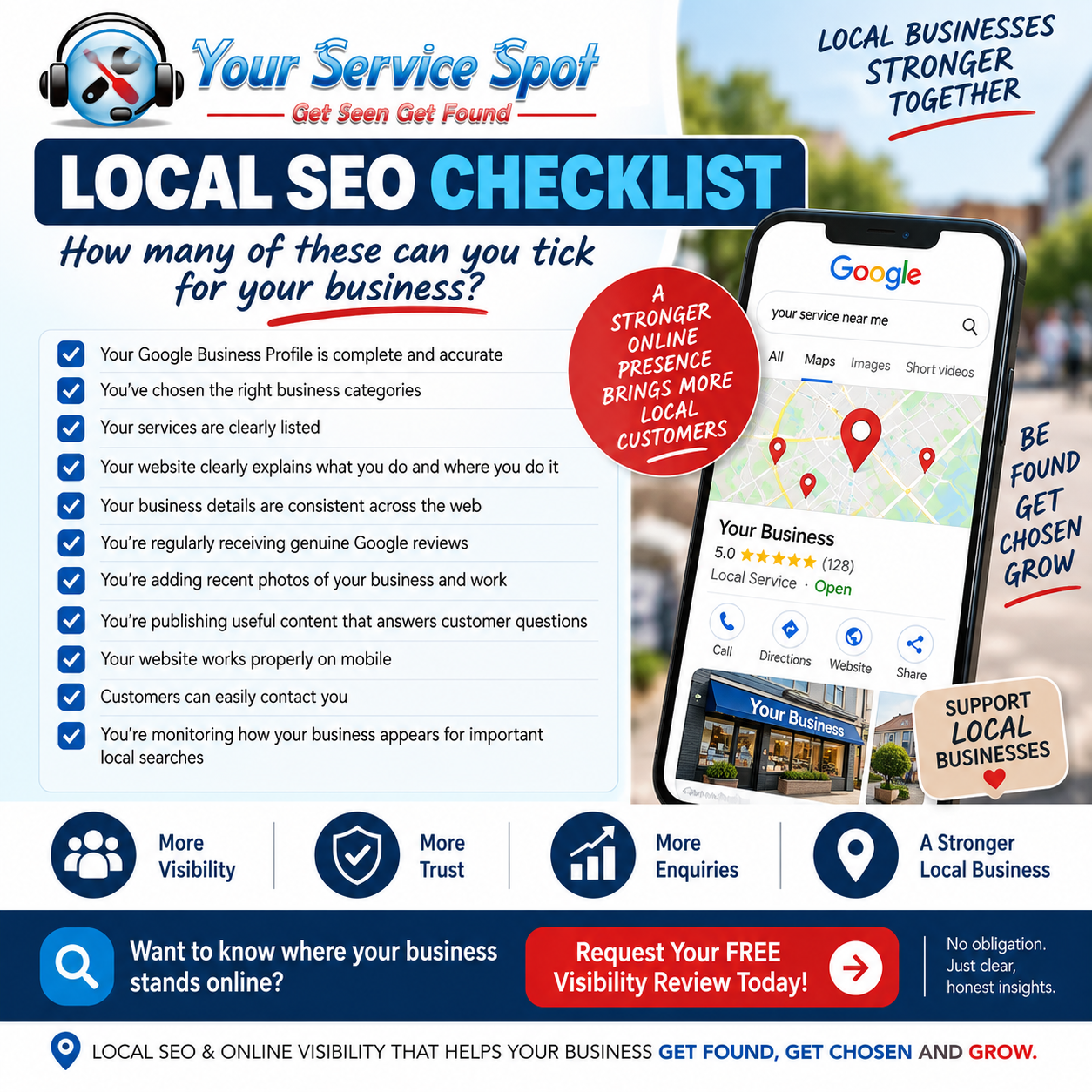
Take a look at our recommended local SEO checklist.
-
Your Competitors Consistently Appear Above You on Google Maps
If the same competitors continually appear prominently for your target searches while your business doesn’t, investigate what they may be doing differently.
Look at their:
- Google Business Profile
- Categories
- Services
- Reviews
- Website
- Service pages
- Location relevance
- Content
- Overall online presence
The objective isn’t to copy competitors.
It’s to understand why Google may consider them a stronger result for that particular search.
A competitor comparison should therefore form part of a good local SEO audit.
-
Customers Only Find You by Searching Your Business Name
Branded searches are useful. They demonstrate that people already know about your business.
But they don’t necessarily show that your local SEO is attracting new customers.
Suppose your business is called ABC Plumbing.
Someone searching for “ABC Plumbing” already knows you exist.
Someone searching for “emergency plumber near me” may not.
That’s the person your local SEO should also be helping you reach.
If almost all your search visibility comes from your business name, it’s worth investigating whether you’re visible for broader service-related searches.
-
Your Google Business Profile Gets Very Few Interactions
Your Google Business Profile can generate actions such as calls, website visits and requests for directions.
If hardly anyone interacts with it, don’t immediately assume the profile itself is the only problem.
Low engagement could be a symptom of low visibility.
If people aren’t seeing the profile for relevant searches, they can’t interact with it.
Review your Google Business Profile performance alongside your rankings, search visibility and website data to develop a fuller picture.
-
You Rarely Receive New Google Reviews
Reviews can influence customer confidence and contribute to the overall prominence of a local business.
Imagine finding two businesses offering a similar service.
One has numerous recent reviews and thoughtful responses from the owner.
The other has a handful of reviews, with the newest written two years ago.
Which one would you feel more comfortable contacting?
A healthy Google review strategy shouldn’t mean suddenly collecting dozens of reviews and then stopping.
Make requesting genuine feedback from satisfied customers part of your normal business process.
And remember:
Your response to a review isn’t only for the customer who wrote it. Future customers may read it too.
-
Your Business Information Is Incomplete or Inconsistent
Google and potential customers need clear information about your business.
Check your:
- Business name
- Address or service area
- Telephone number
- Website
- Opening hours
- Categories
- Services
Then compare that information across your Google Business Profile, website and other important places where your business appears online.
Old addresses, incorrect telephone numbers and conflicting opening hours can create unnecessary confusion.
Correcting inaccurate business information should be an important part of any local SEO audit.
-
Your Website Doesn’t Clearly Target Your Services and Locations
One page containing a huge list of everything you do isn’t always enough.
Important services often deserve their own useful pages. You can usually always improve your website and make it more useful for your visitors.
If you’re a drainage company, for example, customers searching for drain unblocking may want different information from someone researching a CCTV drain survey.
Likewise, if you serve multiple areas, your website should make your geographical coverage clear.
Useful service and location content can help customers — and search engines — understand:
- What you do.
- Where you do it.
- Why somebody should choose you.
- How they can contact you.
-
Your Google Business Profile Has Been Neglected
When did you last look closely at your Google Business Profile?
Not simply open it — actually review it?
Businesses change. Services change. Opening hours change. Websites change.
Your profile needs to remain accurate.
Useful ongoing activity can include adding genuine photos, checking services, responding to reviews, updating information when necessary and publishing relevant updates.
However, don’t fall into the trap of thinking that simply publishing more Google posts will automatically fix poor rankings.
To improve local SEO, you need to look at the complete picture.
-
Your Website Gets Visitors but Few Enquiries
More traffic isn’t automatically better.
Imagine attracting 1,000 website visitors who have little interest in buying from you.
Now compare that with 100 highly relevant local visitors actively looking for the exact service you provide.
Which group would you rather have?
If your website gets traffic but generates few calls, form submissions or bookings, investigate:
- Where visitors are coming from
- Which pages they visit
- Whether the content matches their search intent
- Whether your offer is clear
- Whether your website builds trust
- Whether contacting you is easy
- Whether pages work properly on mobile
SEO shouldn’t end when someone reaches your website.
Visibility needs to turn into opportunity.
-
You Don’t Know Which Searches Actually Matter
This may be the biggest warning sign of all.
If you don’t know what potential customers are searching for, how can you decide what to optimise?
Guessing keywords based on what you call your services can be misleading. Customers don’t always use the terminology businesses expect.
Keyword research can help identify searches based on:
- Relevance
- Search intent
- Services
- Locations
- Competition
- Commercial value
You can then prioritise the searches most likely to matter to your business.
How to Improve Local SEO: Start With Evidence
If you recognise several of these warning signs, resist the temptation to change everything at once.
Start by establishing a baseline.
A useful local SEO audit should examine areas such as your Google Business Profile, website, important search terms, competitors, reviews, service and location coverage, business information and current search visibility.
Then prioritise the improvements likely to make the greatest difference.
That might mean improving a Google Business Profile.
It could mean creating better service pages.
It might reveal a review gap.
Or the problem could be that the website and Google Business Profile aren’t giving search engines sufficiently clear and consistent information about the business.
Diagnose first. Optimise second.
Don’t Measure Local SEO by Rankings Alone
Rankings matter, but they aren’t the ultimate objective.
Most business owners don’t really want rankings.
They want:
More calls. More enquiries. More bookings. More customers.
That’s why measuring local SEO should go beyond asking, “Are we number one?”
Depending on your business, useful indicators can include:
- Visibility for commercially important searches
- Google Business Profile interactions
- Organic website traffic
- Calls
- Enquiry forms
- Bookings
- Review growth
- Organic leads
The goal is to connect increased visibility with genuine business outcomes. Consider local SEO as an investment in your business and not a cost.
Local SEO Is an Ongoing Process
There is rarely one magic change that transforms local visibility overnight.
Google says local results are mainly based on relevance, distance and prominence, and businesses cannot request or pay Google for a better local ranking.
Competition also changes.
Competitors gain reviews, update websites, add content and improve their own visibility.
That’s why local SEO shouldn’t be viewed as something you complete once and forget.
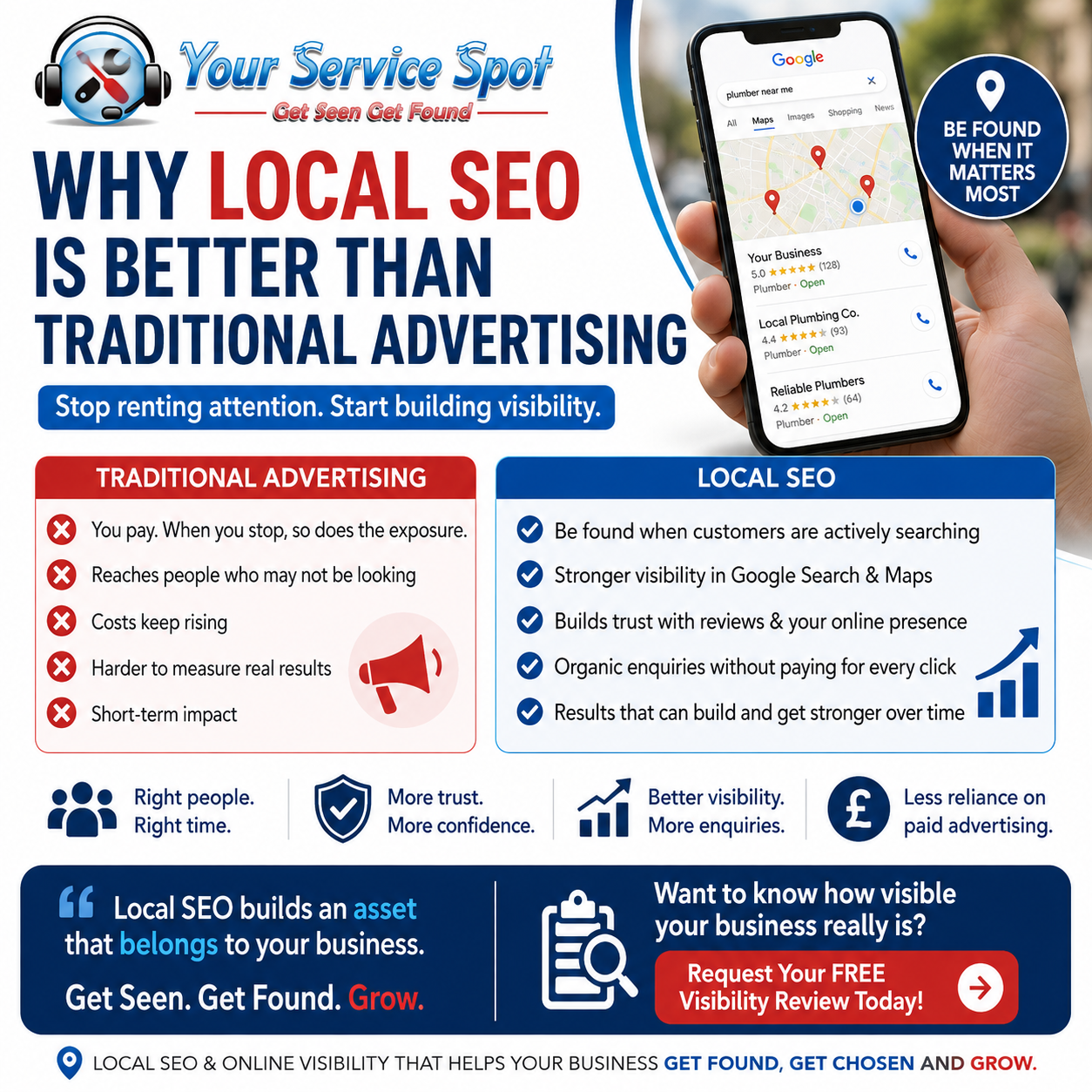
Unlike using traditional advertising like Google Ads, you are building an asset with local SEO and it will not stop working for you like advertising will once you stop paying.
The strongest approach is usually:
Research → Improve → Measure → Refine.
Is It Time for a Local SEO Audit?
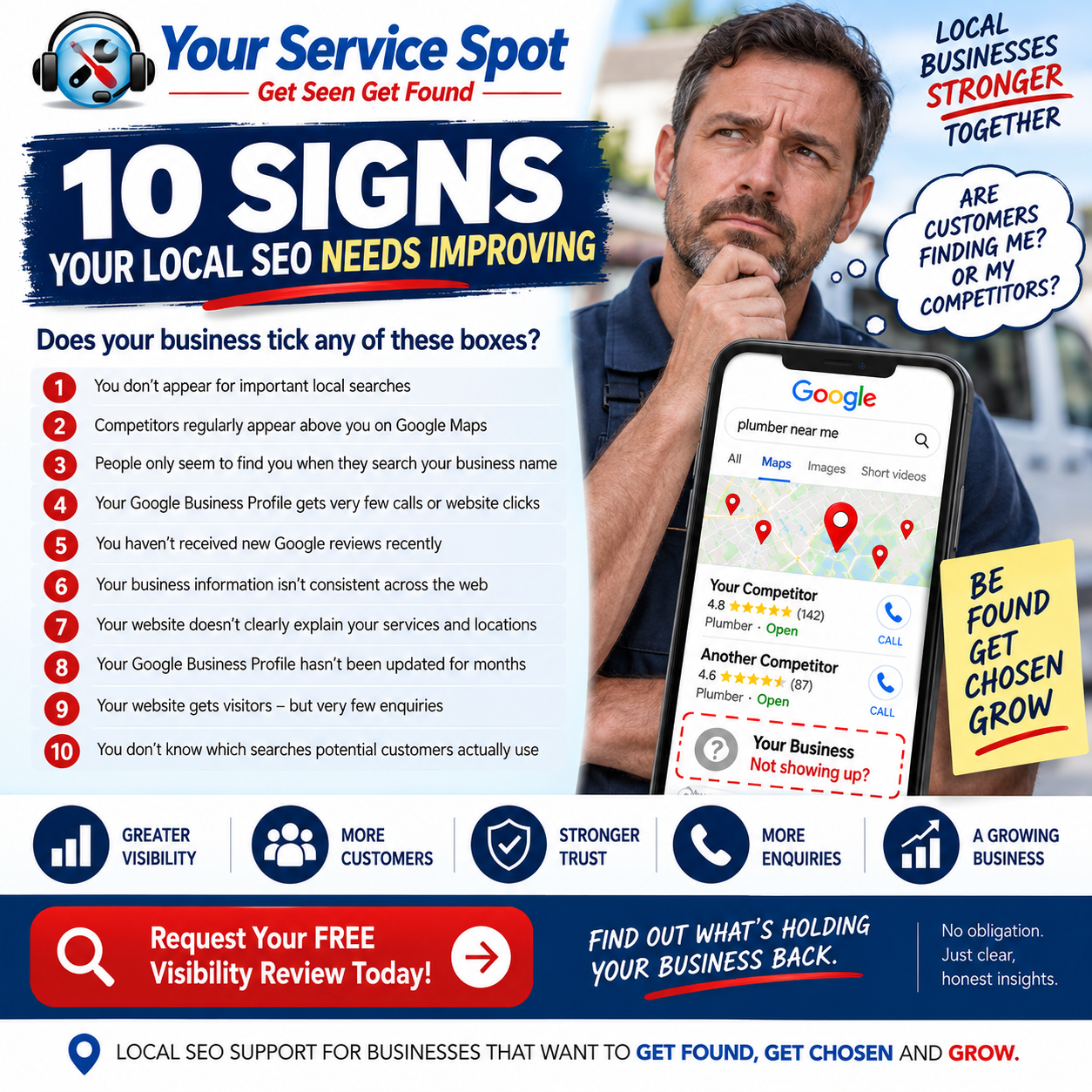
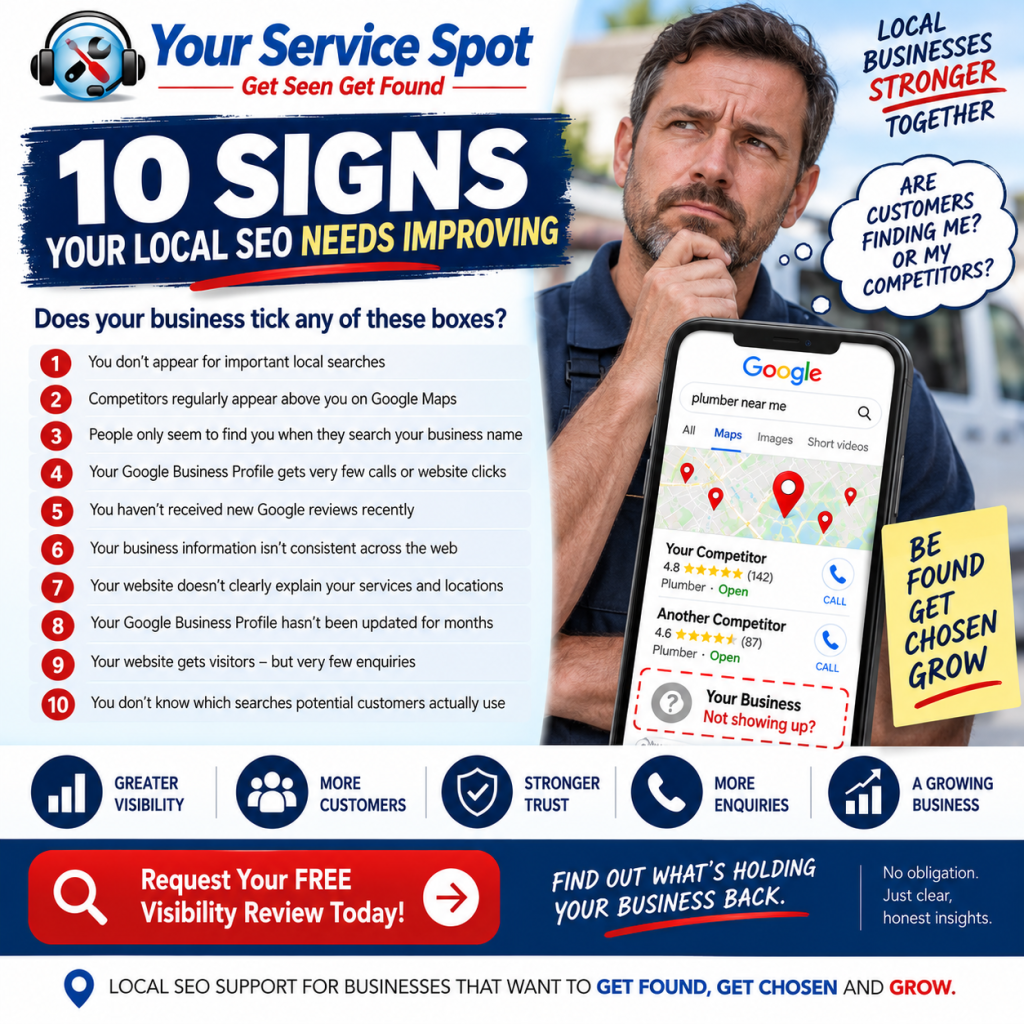
Go back through the 10 signs:
- You don’t appear for important local searches
- Competitors consistently appear above you
- You’re mainly found through branded searches
- Your Google Business Profile gets few interactions
- You’re not receiving new reviews
- Your business information is inconsistent
- Your website doesn’t properly cover services and locations
- Your Google Business Profile is neglected
- Website visitors aren’t turning into enquiries
- You don’t know which searches matter
If several sound familiar, you may already know the answer.
But don’t assume you know what’s causing the problem.
Find out.
At Your Service Spot, we help local businesses identify visibility gaps and understand where improvements could make a difference.
Find Out How Visible Your Business Really Is
Request your FREE Visibility Review.
We’ll take a look at your current online presence and help identify opportunities to strengthen your visibility.
Your customers are searching. Make sure they can find you.
Get Found. Get Chosen. Grow.
Frequently Asked Questions
How can I improve local SEO for my business?
Start by understanding your current position. Review your Google Business Profile, website, reviews, important keywords, competitors and local search visibility. Once you know where the weaknesses are, you can prioritise improvements rather than making random changes.
What is a local SEO audit?
A local SEO audit is a structured assessment of a business’s local online presence. It can examine Google Business Profile optimisation, website content, keywords, reviews, business information, competitors and visibility for relevant local searches.
How do I know if my local SEO is working?
Look at both visibility and business outcomes. Monitor relevant search rankings, Google Business Profile interactions, organic traffic, calls, enquiries, bookings and other conversions. Higher rankings have limited value if they don’t contribute to business opportunities.
Why does my business appear when I search its name but not its services?
A search for your business name is a branded search. Google already has a strong indication of which business the searcher wants. Ranking for non-branded service searches can be more competitive and depends on factors including relevance, distance and prominence.
How often should I audit my local SEO?
There isn’t a universal schedule, but periodic reviews are sensible, particularly when visibility or enquiries decline, business information changes, new competitors emerge or you’ve made substantial changes to your website or Google Business Profile.
Can Google Business Profile posts improve local SEO?
Posts can keep your profile useful and provide information to customers, but they shouldn’t be treated as a standalone ranking solution. Strong local visibility typically requires attention to your broader Google Business Profile, website, reviews, relevance and online presence.
How long does it take to improve local SEO?
There is no guaranteed timeframe. Results vary depending on competition, location, your starting position and the work required. Some improvements may be visible relatively quickly, while competitive local SEO usually requires sustained effort.