Why Your Homepage Isn’t Ranking — And What to Do About It
You’ve invested in a professional website.
Your homepage looks good.
It explains your business, includes your services and tells visitors how to contact you.
There’s just one problem.
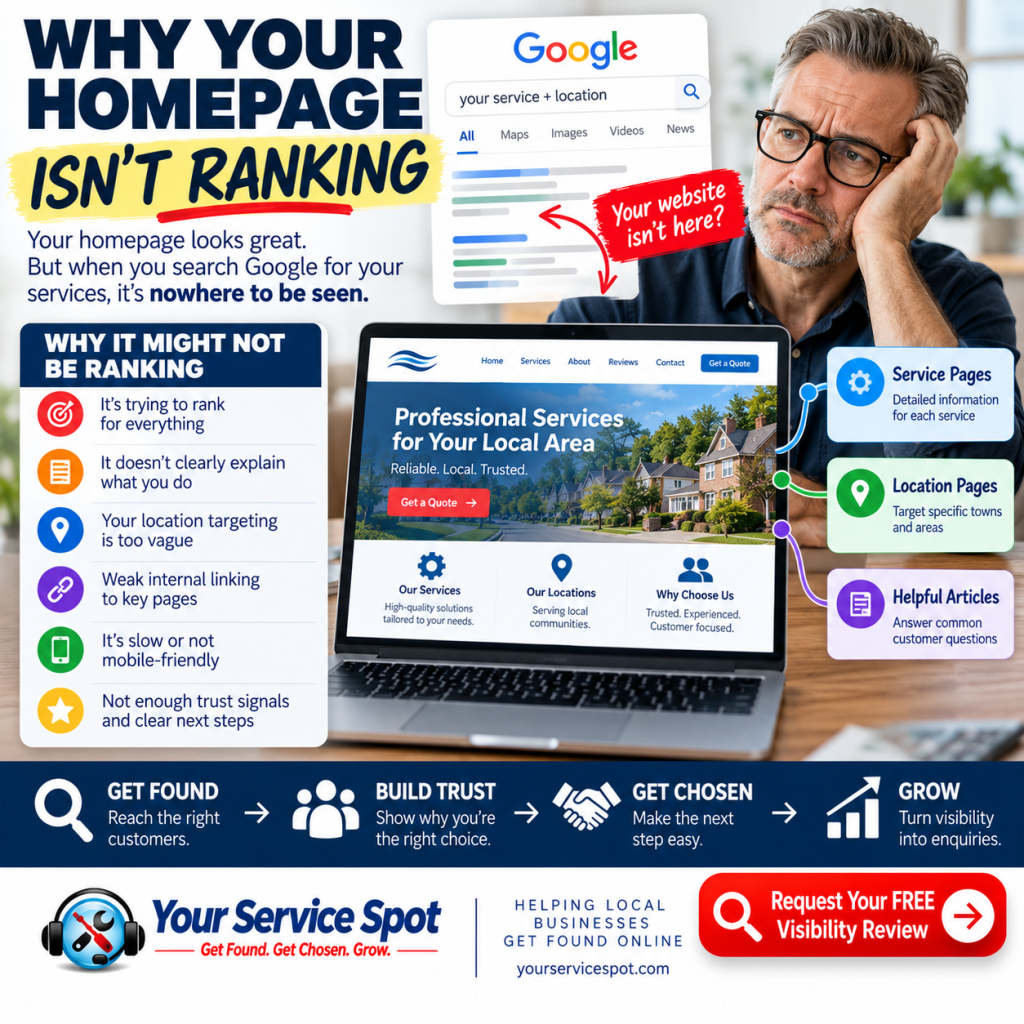
When you search Google for the products or services you want customers to find…
Your homepage is nowhere to be seen.
Why?
Effective homepage SEO involves much more than having an attractive website and mentioning a few important keywords.
Your homepage needs to help potential customers and search engines quickly understand:
- What does this business do?
- Who does it help?
- Where does it operate?
- Why should someone trust it?
- Where can visitors find more detailed information?
- What should they do next?
And perhaps most importantly, your homepage shouldn’t be expected to do the SEO work of your entire website.
Let’s look at some of the most common reasons a homepage struggles to rank — and what you can do about them.
What Is Homepage SEO?
Homepage SEO is the process of optimising your website’s main page so that it clearly communicates what your business is about while helping visitors and search engines navigate to your most important content.
For a local business, a well-optimised homepage will typically introduce:
- Your primary services
- Your main geographic market
- Your business and value proposition
- Reasons customers can trust you
- Important service and location pages
- Clear contact options
- A logical next step
But there’s an important distinction.
Your homepage should provide a strong overview of your business.
It doesn’t need to be the detailed answer to every search your potential customers make.
-
Your Homepage Doesn’t Clearly Explain What You Do
One of the first problems to investigate is surprisingly simple.
Can someone understand what your business does within seconds of arriving?
Businesses sometimes prioritise clever marketing slogans over clarity.
A homepage might open with:
“Quality You Can Trust.”
Or:
“Creating Better Solutions for Tomorrow.”
These phrases sound positive.
But what does the company actually do?
Compare that with:
“Local SEO & Google Visibility Services for Small Businesses”
The second version immediately gives the visitor — and search engines — useful context.
Your headline doesn’t need to sound robotic or be stuffed with keywords.
It does need to communicate clearly.
Google recommends creating helpful, people-first content that leaves visitors feeling they’ve learned enough to achieve their goal.
-
You’re Trying to Rank the Homepage for Everything
This is one of the biggest homepage SEO mistakes.
Imagine a company provides:
- Drain unblocking
- CCTV drain surveys
- Drain repairs
- High-pressure jetting
- Emergency drainage
- Commercial drainage
across:
- Brighton
- Hove
- Worthing
- Lewes
- Shoreham
- Eastbourne
Trying to optimise one homepage for every combination of service and location quickly becomes messy.
Instead of having one highly relevant page for a particular search, you end up with a homepage trying to say everything to everybody.
A better website structure might use the homepage as a central hub, supported by:
Homepage → Service Pages → Location Pages → Helpful Content
This gives important topics enough space to be covered properly.
-
You Don’t Have Strong Service Pages
Suppose someone searches:
“CCTV drain survey Brighton”
A generic homepage mentioning CCTV surveys once may not be the most useful answer.
A comprehensive page dedicated to CCTV drain surveys can explain:
- What the service involves
- Who needs it
- Common problems it can identify
- How the process works
- Relevant service areas
- Frequently asked questions
- How to request the service
The principle applies across industries.
A pool company might need separate pages for weekly pool service, repairs, equipment upgrades and green pool clean-ups.
A marketing company might need pages for local SEO, Google Business Profile optimisation, website optimisation and AI visibility.
Don’t force your homepage to do the job of pages that should exist elsewhere.
-
Your Location Targeting Is Too Vague
Local businesses sometimes include a line such as:
“Serving London, Surrey, Kent and surrounding areas.”
That may be accurate, but it doesn’t necessarily provide much detail for someone looking for a specific service in a particular town.
Well-planned location pages can provide more useful information about the areas you genuinely serve.
For example:
can provide a much more focused answer than trying to make the YSS homepage rank equally well for every town across Greater London and Surrey.
The homepage can introduce your primary geographic market and then guide visitors towards more specific location content.
-
Your SEO Title Doesn’t Clearly Describe the Page
Your SEO title helps search engines and potential visitors understand the subject of a page.
A title such as:
Home | ABC Ltd
wastes an opportunity to provide useful context.
A local service business might use something closer to:
Pool Service Houston | Chad’s Pool Service
The precise title depends on the business and page strategy, but it should accurately describe the content.
Google recommends descriptive, concise title text and warns against vague titles such as “Home” or keyword stuffing.
The objective isn’t to cram every possible keyword into the title.
Be specific, descriptive and useful.
-
Your H1 Doesn’t Support the Main Topic
Your main page heading should help visitors understand what the page is about.
Yet many websites use vague H1s such as:
- Welcome
- Welcome to Our Website
- Quality You Can Depend On
Again, these aren’t inherently bad marketing phrases.
They’re simply not very descriptive.
A stronger heading can combine clarity with persuasion.
For example:
Helping Local Businesses Get Found, Get Chosen and Grow
could then be supported immediately by copy explaining that YSS provides local SEO, Google visibility and website optimisation services.
Your SEO homepage should have a clear information hierarchy rather than a collection of disconnected marketing statements.
-
Your Homepage Content Is Too Thin
Some beautifully designed homepages contain surprisingly little useful information:
- A large photograph.
- A headline.
- Three icons.
- A contact button.
- That’s it.
Design matters, but search engines and potential customers need enough information to understand the business.
Consider whether your homepage adequately introduces:
- Your core services
- Customers you help
- Primary location or service area
- Reasons to choose you
- Evidence of experience
- Reviews or testimonials
- Important website sections
- Useful resources
- Contact information
That doesn’t mean writing 5,000 words simply because “Google likes content.”
There is no useful word-count target that applies to every homepage.
Write enough to satisfy the visitor’s needs and explain the business clearly.
-
Your Internal Linking Is Weak
Your homepage is often one of the most prominent pages on your website.
Use it to guide visitors towards your important content.
If you offer four core services, link to them.
If you have important location pages, make them accessible through a sensible site structure.
If you’ve created useful guides that answer common customer questions, surface them appropriately.
Google recommends using crawlable links and concise, relevant anchor text to help people and Google understand the pages being linked.
Instead of repeatedly using vague anchor text such as:
Learn More
consider descriptive links where appropriate:
Explore Our Local SEO Services
or:
See Our Website Optimisation Services
Internal linking helps turn your homepage into a useful navigation hub rather than an isolated sales brochure.
-
Your Website Is Slow or Difficult to Use
Even strong homepage content can be undermined by a poor user experience.
Potential problems include:
- Slow loading
- Oversized images
- Layouts that jump around
- Difficult mobile navigation
- Hard-to-read text
- Buttons that don’t work properly
- Intrusive pop-ups
- Complicated forms
Google recommends good Core Web Vitals and a good overall page experience, while also making clear that page experience isn’t simply one standalone ranking signal.
From a business perspective, the issue is even simpler.
You worked hard to get someone to your website.
Don’t give them a reason to leave.
-
Your Homepage Doesn’t Build Enough Trust
Ranking is only part of the challenge.
What happens when somebody actually visits?
Your homepage should give potential customers reasons to believe you’re a genuine, credible business.
Depending on the business, useful trust signals might include:
⭐ Genuine customer reviews
📷 Real photographs
👥 Team information
🏆 Qualifications or accreditations
📍 Clear contact information
📝 Case studies
🔧 Examples of completed work
📞 An obvious way to contact you
A visitor finding your homepage through Google is unlikely to care that you achieved position three rather than position four.
They care whether they should choose you.
-
Your Homepage Isn’t Converting Visitors
This is where rankings and business outcomes need to be separated.
Suppose your homepage moves from position eight to position three.
Excellent.
Traffic increases.
But nobody contacts you.
Has the improvement achieved the ultimate business objective?
Not yet.
Your homepage should guide visitors towards an appropriate action:
- Call
- Request a Quote
- Book
- Send an Enquiry
- Request a Visibility Review
Make the next step clear and easy.
Because traffic without action doesn’t automatically produce revenue.
- You’re Ignoring Search Intent
Not every Google search should lead to your homepage.
Someone searching:
“how long does local SEO take?”
probably wants information.
A useful blog article answering that question may be a better result than the YSS homepage.
Someone searching:
“local SEO Croydon”
may be better served by a Croydon service/location page.
Someone searching:
“Google Business Profile optimisation”
may need a dedicated service page.
And someone searching:
“Your Service Spot”
probably does want the homepage.
This is why a strong SEO strategy asks:
Which page is the best answer to this search?
rather than:
How can we make the homepage rank for everything?
-
Your Homepage Has to Compete
Sometimes there’s no glaring technical problem.
You’re simply operating in a competitive market.
Other businesses may have:
- Better-established websites
- Stronger content
- More relevant pages
- Better-known brands
- More authoritative links
- Stronger local prominence
- Better reviews
- More developed website structures
SEO isn’t performed in isolation.
You’re competing for visibility with other pages that Google could show instead.
That’s why diagnosing poor rankings should involve looking at the actual search results and competitors rather than assuming one homepage tweak will solve everything.
What Should a Good SEO Homepage Include?
There isn’t one perfect homepage template, but for many local businesses, a strong homepage should include:
A Clear Primary Message
Explain what the business does and who it serves.
Geographic Relevance
Make your primary location or service area clear where appropriate.
Core Services
Introduce your most important services and link to dedicated pages.
Reasons to Choose You
Explain genuine differentiators rather than relying on generic claims such as “best service” or “number one.”
Trust Signals
Use genuine reviews, testimonials, accreditations, experience and other relevant evidence.
Useful Internal Links
Help customers and search engines discover your important service, location and informational content.
Clear Calls to Action
Make it obvious how a visitor can take the next step.
Strong Mobile Experience
Make sure everything works properly on a smartphone.
Good Website Performance
Keep the page fast, stable and usable.
The objective isn’t simply to create an SEO homepage.
It’s to create a page that works for search engines, potential customers and the business.
Don’t Optimise Your Homepage in Isolation
Your homepage is important.
But it’s part of a website.
Think of the structure as an interconnected system:
HOMEPAGE
↓
SERVICE PAGES
↓
LOCATION PAGES
↓
HELPFUL ARTICLES
↓
CONVERSION PAGES / CONTACT
Pages should support each other through sensible internal links.
For YSS, for example, the homepage could introduce local SEO and then lead visitors towards:
Local SEO Services → Local SEO Croydon → Local SEO Guides → FREE Visibility Review
That’s far more powerful than trying to make the homepage contain every answer.
Rankings Aren’t the Final Goal
It’s easy to become obsessed with where your homepage appears on Google.
Rankings matter because they can create visibility.
But visibility is only one stage of the journey.
The bigger picture is:
GET FOUND → BUILD TRUST → GET CHOSEN → GENERATE AN ENQUIRY
A number-one ranking that generates no customers isn’t the ultimate objective.
A successful homepage local SEO investment strategy should help attract the right visitors, guide them to useful information and encourage them to take the next step.
Is Your Homepage Working Hard Enough?
If your homepage isn’t ranking, don’t immediately start adding keywords everywhere.
Diagnose the problem first.
Ask:
- Is the purpose of the page clear?
- Does it explain what we do?
- Does it explain where we work?
- Do we have dedicated service and location pages?
- Is our internal linking strong?
- Does the website work well on mobile?
- Is it fast?
- Does it build trust?
- Does it encourage enquiries?
Then prioritise the improvements that matter.
At Your Service Spot, we help local businesses look at the complete visibility picture — not simply individual rankings.
Is Your Homepage Helping Your Business Get Found — and Chosen?
Request your FREE Visibility Review and discover where your website and online presence could be improved.
Get Found. Get Chosen. Grow.
Frequently Asked Questions About Homepage SEO
Why isn’t my homepage ranking on Google?
There can be many reasons, including unclear content, weak service or location relevance, poor internal linking, competition, technical issues or trying to target too many unrelated keywords with one page. Diagnose the specific searches and competing pages before making changes.
What is homepage SEO?
Homepage SEO involves optimising your main website page so visitors and search engines can clearly understand your business, primary offering and important website content while making it easy to navigate to more detailed pages.
What keywords should my homepage target?
Focus on terms closely related to your primary business offering and market rather than attempting to target every service and location. More specific searches can often be addressed more effectively by dedicated service and location pages.
Should my homepage rank for all my services?
Not necessarily. If you offer several substantial services, dedicated service pages can provide much more detailed and relevant answers to searches relating to each one.
Should I put every location I serve on my homepage?
Your homepage can introduce your primary location and broader service area, but businesses serving multiple commercially important locations may benefit from dedicated, useful location pages rather than cramming dozens of place names into homepage copy.
How much content should an SEO homepage have?
There isn’t an ideal word count that applies to every business. Include enough useful content to explain what you do, who you serve, why customers should choose you and where they can find more detailed information. Avoid adding unnecessary copy purely to increase word count.
Does website speed affect homepage SEO?
Website performance contributes to overall page experience, and Google recommends good Core Web Vitals. More importantly for businesses, a slow or frustrating homepage can make visitors leave before they enquire.
Should my business name be in the SEO title?
Usually, including your brand can make sense, particularly if space allows, but the title should also accurately describe the page. Avoid titles consisting solely of the company name or generic wording such as “Home.”
How long does it take for homepage SEO changes to work?
There is no guaranteed timeframe. Google needs to crawl and process changes, and ranking outcomes depend on the query, competition, website and many other factors. SEO improvements should be monitored over time rather than judged immediately.