How to Improve Your Business Visibility in AI Search: 10 Practical Steps
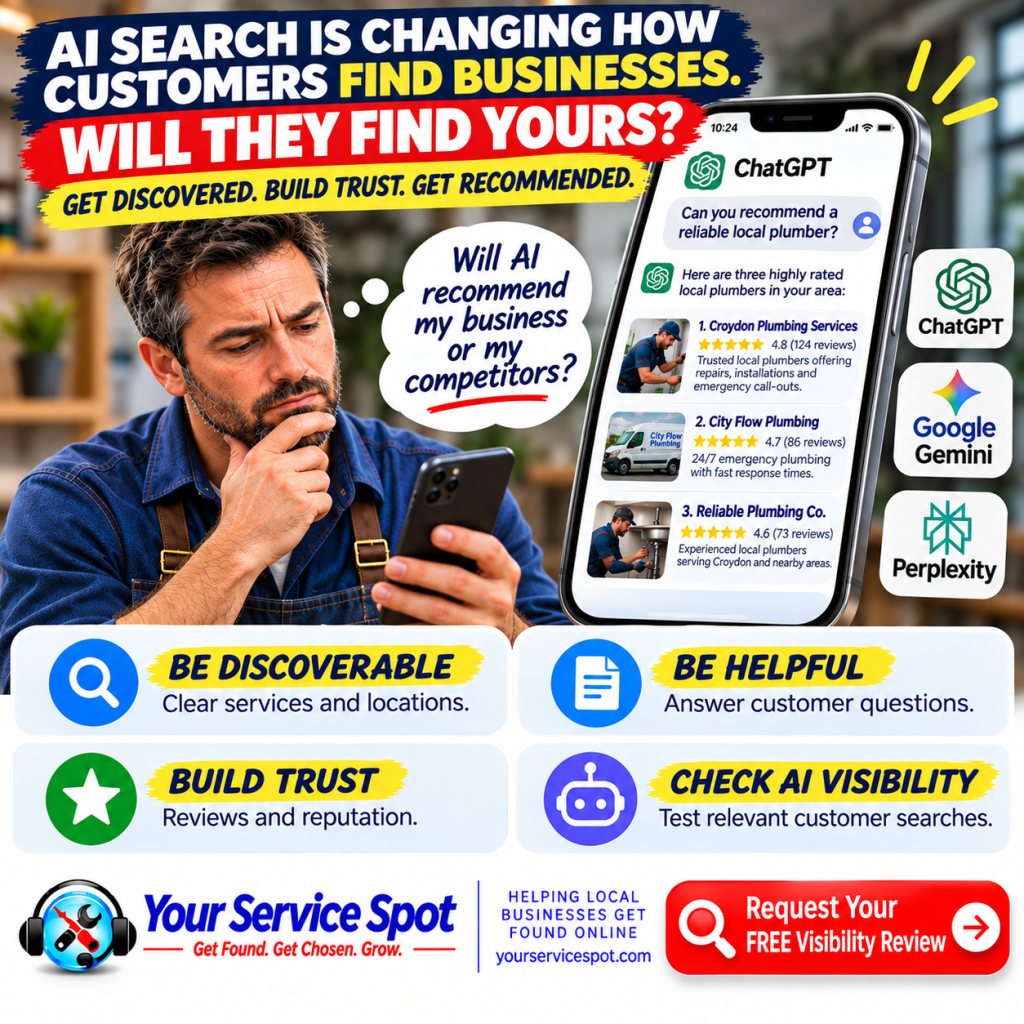
Imagine a potential customer asking ChatGPT:
“Can you recommend a reliable electrician in Croydon who installs EV chargers?”
Or asking Google Gemini:
“Which local roofing companies offer emergency repairs?”
Perhaps they’re using Perplexity to research swimming pool maintenance companies in Houston.
AI-powered search gives customers another way to discover businesses, compare services and find answers.
But here’s something worth considering.
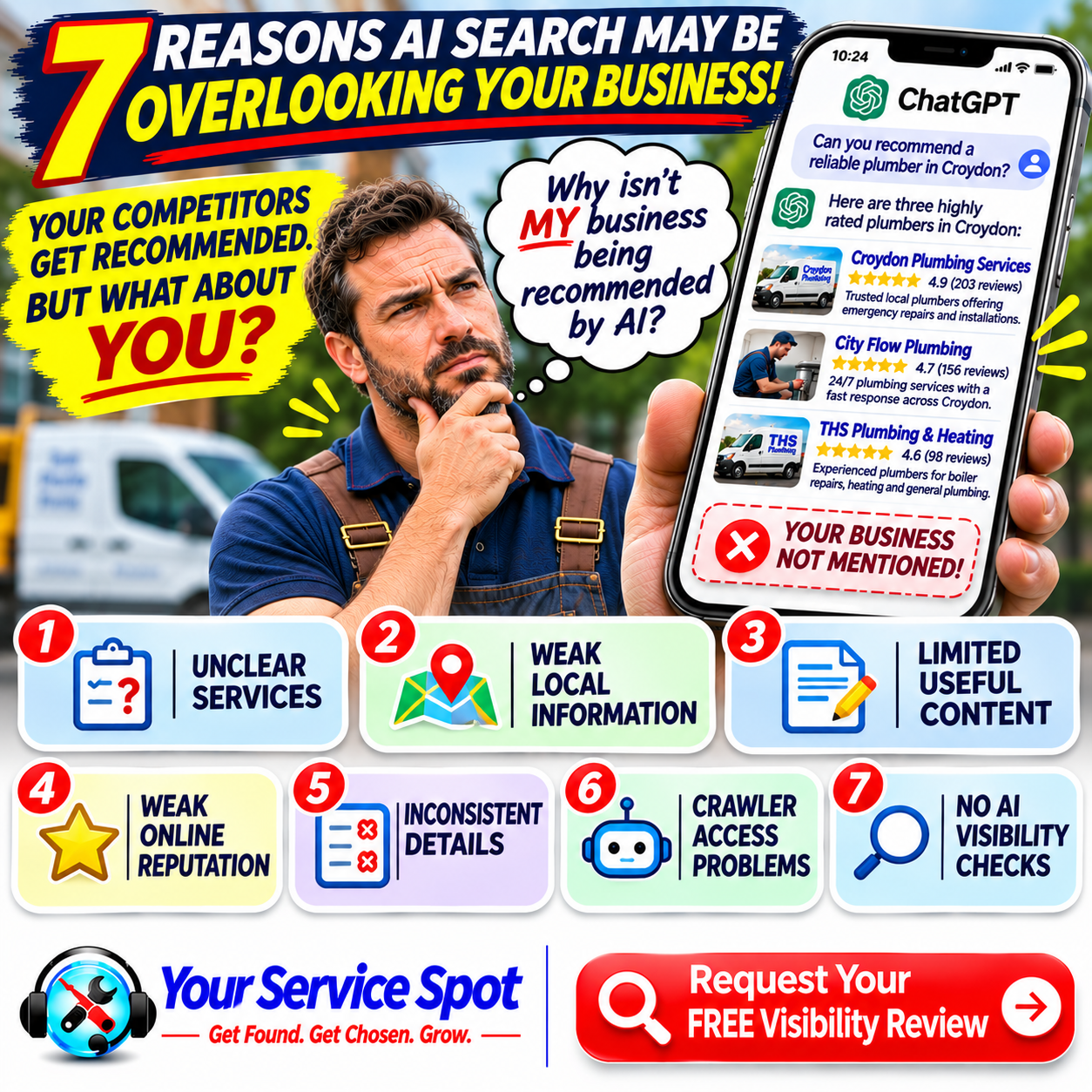
When someone asks AI to recommend a business like yours, will your company be mentioned?
And if your competitors appear instead, do you know why?
For local business owners, learning how to improve AI search visibility is becoming an increasingly useful part of online marketing.
The good news is that many of the improvements are straightforward.
You don’t necessarily need expensive technology, complicated AI tools or a completely new website.
You need clear business information, helpful content, a credible online presence and an understanding of how customers search.
In this guide, we’ll explain 10 practical ways to improve your business’s discoverability in AI-powered search, how to assess your current visibility and which mistakes to avoid.
-
What Is AI Search Visibility?
AI search visibility describes how discoverable, accurately represented and relevant your business is within AI-powered search experiences.
These experiences may include:
- ChatGPT with web search
- Google Gemini
- Google’s AI Overviews and AI Mode
- Perplexity
- Other AI-powered search and recommendation tools
Someone might ask an AI platform:
“Who provides emergency drain unblocking in Brighton?”
The platform may produce an answer containing business names, descriptions, links or supporting sources.
Whether your business appears depends on the question, the platform’s capabilities and the information available to it.
Importantly, different AI platforms don’t necessarily use the same sources or produce identical recommendations.
And there isn’t one universal AI ranking system.
Improving AI search visibility means making accurate, relevant information about your business easier to discover and understand.
It doesn’t mean controlling what an AI platform says.
-
Why Should Local Businesses Care About AI Search?
Traditionally, a customer might type:
“Plumber Croydon”
into Google.
Now they might ask:
“Can you recommend a reliable plumber in Croydon who offers emergency call-outs and has good customer reviews?”
The second question is more conversational and includes several requirements.
The customer wants to know:
- Which businesses serve Croydon?
- Which provide emergency plumbing?
- Which have a credible reputation?
- Which might be suitable for their needs?
AI-powered search can help customers explore those questions.
For local businesses, that creates another opportunity to be discovered.
However, AI search doesn’t replace traditional Google Search or Google Maps.
Both remain important parts of local customer discovery.
The sensible approach is to strengthen your existing online presence while also investigating how your business appears in AI-powered answers.
Read our guide on AI search visibility for small businesses.
-
Ten Practical Ways to Improve AI Search Visibility
There isn’t a guaranteed formula for getting your business recommended by ChatGPT, Gemini or Perplexity.
However, there are practical improvements that can make your business information clearer, more accessible and more useful.
Step 1: Clearly Explain What Your Business Does
Start with your homepage.
Does it immediately tell visitors what services you provide?
Consider these two descriptions.
Business A:
“We deliver innovative solutions and exceptional customer experiences.”
Business B:
“We provide emergency drain unblocking, CCTV drain surveys and drain repairs throughout Brighton and Hove.”
Business B is much easier to understand.
It identifies the services offered and the locations served.
That clarity helps customers and search systems determine whether the company is relevant to a particular question.
What to improve:
- State your main services clearly.
- Identify the customers you help.
- Explain your genuine service areas.
- Use straightforward, descriptive language.
- Avoid vague marketing statements that don’t explain your services.
Practical tip: Ask someone unfamiliar with your business to read your homepage for 10 seconds. Can they explain what you do and where you operate?
Learn why your homepage isn’t ranking.
Step 2: Create Useful Pages for Your Main Services
Imagine a customer asking:
“Which Houston pool companies provide weekly cleaning and natural gas pool heater repairs?”
A company whose website clearly explains both services provides information relevant to that question.
But what if its website only says “complete pool care solutions”?
The specific services may be harder to establish.
Dedicated service pages can help.
For example, a swimming pool company might have pages covering:
- Weekly pool maintenance
- Pool equipment repairs
- Pool heater servicing
- Pool pump replacement
- Commercial pool maintenance
Each page should explain the service, who needs it, what customers can expect and how to enquire.
Don’t create dozens of near-identical pages simply to target keyword variations.
Useful, accurate content is more valuable than repetitive content created purely for search engines.
Avoid these common website SEO mistakes.
Step 3: Make Your Service Areas Clear
Location matters when customers are looking for nearby businesses.
Someone might ask:
“Can you recommend a private London walking tour company for a corporate group?”
Or:
“Who provides emergency plumbing services in Purley?”
Your website should make it easy to establish whether you serve those locations.
This might include:
- Your main business location
- Towns and areas you genuinely serve
- Service-area information on relevant pages
- Useful location-specific content
- Accurate contact details
If you create dedicated location pages, make them genuinely helpful.
Explain the services available in that area and include relevant information that customers would find useful.
Avoid creating large numbers of pages that simply replace one town name with another.
Why local businesses need location pages.
Step 4: Answer the Questions Customers Actually Ask
AI-powered search often begins with a question.
Your website should provide useful answers to the questions your customers ask before choosing a business.
For example, a roofing company might answer:
“How quickly can you attend an emergency roof repair?”
“Do you repair flat roofs?”
“Which areas do you cover?”
“Do you provide written quotations?”
“What happens during a roof inspection?”
These questions can be addressed through:
- Service pages
- FAQ sections
- Helpful blog articles
- Guides explaining common problems
- Clear information about your processes
Write for customers first.
Avoid adding repetitive questions purely to increase keyword density.
Practical tip: Start with the questions customers regularly ask over the phone or by email. They’re often excellent subjects for useful website content.
How to make your website convert more visitors into leads.
Step 5: Strengthen Your Online Reputation
Trust matters when customers compare local businesses.
Your online reputation may include:
- Genuine customer reviews
- Accurate business listings
- Relevant industry qualifications
- Professional memberships
- Independent mentions
- Real examples of completed work
These details help potential customers evaluate your business.
They can also provide publicly accessible information that AI search systems may encounter.
However, don’t assume ChatGPT or another AI platform assigns a fixed ranking score to your reviews.
Different systems use different information sources.
What to improve:
- Encourage honest reviews from genuine customers.
- Respond professionally to feedback.
- Keep your business information accurate.
- Publish verifiable details about your experience and qualifications.
- Avoid buying reviews or making claims you cannot substantiate.
Why Google reviews matter for local SEO.
Step 6: Keep Your Business Information Consistent
Imagine your website displays one telephone number.
Your Google Business Profile shows another.
An industry directory lists an old address.
And your social media page still describes a service you stopped offering two years ago.
That inconsistency can confuse customers.
It can also make it harder to establish which information about your business is current.
Review your details across relevant platforms.
Check:
- Business name
- Address, where applicable
- Telephone number
- Website address
- Opening hours
- Services
- Service areas
Consistency doesn’t guarantee AI recommendations.
But accurate information supports a more reliable online presence.
5 Google Business Profile mistakes.
Step 7: Make Sure AI Search Systems Can Access Your Website
Here’s a technical issue that many business owners overlook.
Your website might contain excellent information.
But can relevant search crawlers access it?
Some websites accidentally block important pages through technical settings.
Others hide useful content behind logins or make it difficult to retrieve.
OpenAI identifies a crawler called OAI-SearchBot, associated with website discovery for ChatGPT’s search features.
This is separate from GPTBot, which is associated with OpenAI’s model-training crawling.
Google’s AI-powered search experiences also depend on Google’s search infrastructure and applicable indexing controls.
What to check:
- Your important pages are publicly accessible.
- Your robots.txt file isn’t unintentionally blocking relevant crawlers.
- Important pages aren’t accidentally marked noindex.
- Your website works on mobile devices.
- Your pages contain readable, useful information.
- Technical errors aren’t preventing normal access.
If you’re unfamiliar with these settings, ask your website developer or SEO provider to investigate.
Important: Allowing search crawlers doesn’t guarantee that your website will be retrieved, cited or recommended.
It simply helps remove potential accessibility barriers.
Step 8: Demonstrate Genuine Experience and Expertise
Customers want evidence that a business knows what it’s doing.
For example, a pool maintenance company might explain:
- How long it has served customers
- Relevant industry training
- The types of equipment it services
- Its approach to maintenance
- Common problems it helps customers resolve
A London walking tour company might explain its guide’s specialist historical knowledge and experience delivering private tours.
These details make your business easier to evaluate.
But they should be genuine.
Don’t invent qualifications, testimonials, awards or years of experience.
Where appropriate, support claims with verifiable information.
Practical tip: Review your About page. Does it explain why customers should feel confident choosing your business?
Step 9: Test Your Visibility Across AI Platforms
You can’t assess your AI visibility without investigating what customers might see.
Start with realistic questions.
For example:
“Can you recommend a reliable electrician in Croydon?”
“Which local electricians install EV chargers?”
“Who provides emergency electrical repairs in South London?”
Try these questions in relevant AI platforms.
Use current web search capabilities where available.
Record:
- Whether your business is mentioned
- Which competitors appear
- Whether your services are described accurately
- Whether your website is cited
- Which supporting sources are shown
Try several questions and repeat the exercise periodically.
A single AI response isn’t a reliable measure of overall visibility.
Results can vary depending on the question, platform, available sources and other context.
Why ChatGPT recommends some local businesses.
Step 10: Keep Improving Your Google Visibility Too
AI visibility shouldn’t be treated as a replacement for traditional SEO.
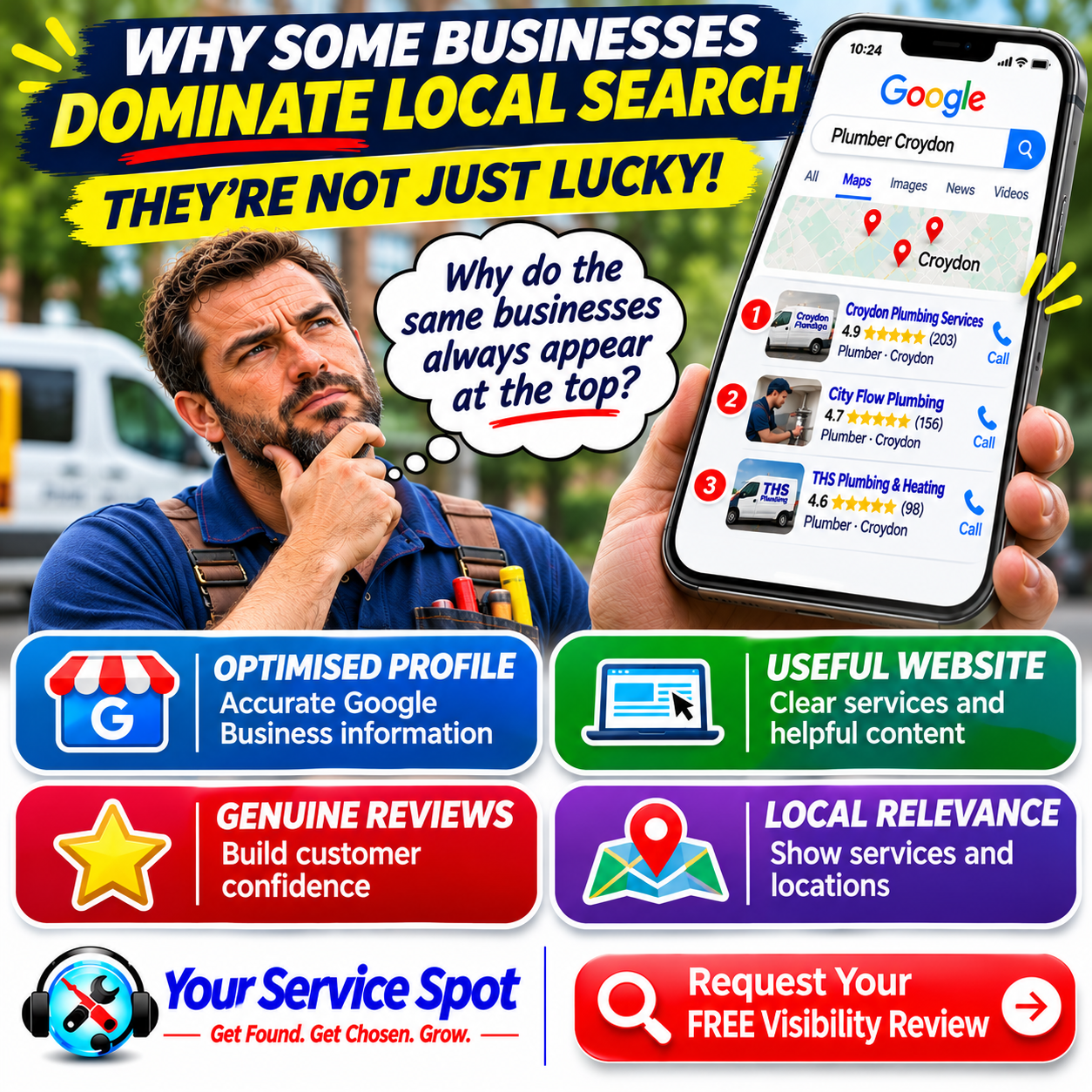
Google Search and Google Maps remain valuable discovery channels for local businesses.
Continue improving:
- Your Google Business Profile
- Website service pages
- Local SEO
- Customer reviews
- Website performance
- Search visibility for relevant services and locations
Google says its local rankings are primarily based on relevance, distance and prominence.
Those factors apply to Google’s local ranking systems, not as a universal formula for AI recommendations.
A stronger online presence can benefit several discovery channels.
But ranking highly on Google doesn’t automatically mean ChatGPT will recommend your business.
What Google visibility actually means.
-
How to Check Your Current AI Search Visibility
Before making changes, establish a starting point.
Here’s a simple assessment you can carry out.
Choose Five Realistic Customer Questions
Select questions that match the services you want to promote.
For example, a drainage company might use:
- “Can you recommend a reliable drainage company in Brighton?”
- “Who provides emergency drain unblocking in Brighton?”
- “Which companies offer CCTV drain surveys in Hove?”
- “Who repairs blocked drains in Brighton?”
- “Can you recommend a local drain cleaning specialist?”
Test More Than One AI Platform
Try ChatGPT, Google Gemini and Perplexity where their relevant search capabilities are available.
For Google, you can also investigate appropriate AI-powered search experiences.
Don’t assume that every platform uses identical sources or provides the same results.
Record the Evidence
Use a simple worksheet:
| Customer question | Platform | Your business mentioned? | Competitors mentioned? |
| Main service + town | ChatGPT | Yes / No | Record names |
| Main service + town | Gemini | Yes / No | Record names |
| Secondary service + town | Perplexity | Yes / No | Record names |
Also record the date, exact question, relevant links and whether the business information is accurate.
Look for Patterns
Perhaps your business appears for general searches but not specialist services.
Maybe competitors have clearer service pages.
You might discover outdated information about your company.
These findings can help identify areas worth investigating.
The objective is to understand your current visibility, not to draw sweeping conclusions from one AI-generated answer.
-
Common Mistakes That Can Limit AI Search Discoverability
Some businesses respond to AI search by making changes that provide little value.
Here are several mistakes worth avoiding.
Publishing Large Amounts of Generic AI Content
Producing dozens of repetitive articles doesn’t guarantee recommendations.
Content should be accurate, useful and relevant to customers.
Creating Pages for Locations You Don’t Really Serve
Misleading location claims can damage customer trust.
Describe your genuine service coverage.
Assuming More Reviews Guarantee Recommendations
Reviews matter for customer confidence, but there’s no published universal formula linking review counts to ChatGPT recommendations.
Ignoring Website Accessibility
Useful information cannot help a search system retrieve your pages if important content is unintentionally blocked.
Focusing Only on ChatGPT
Different AI platforms can produce different results.
A broader assessment is more useful.
Expecting Immediate Results
Changes may take time to be discovered and reflected in search-enabled responses.
No agency can guarantee a particular timeframe.
Neglecting Traditional Google Search
AI visibility complements established search marketing.
It doesn’t eliminate the value of local SEO, Google Maps or a useful website.
-
How Long Does It Take to Improve AI Search Visibility?
There’s no guaranteed timeframe.
Some improvements can be completed quickly.
For example:
- Correcting inaccurate business details
- Clarifying homepage content
- Improving service descriptions
- Fixing website accessibility problems
Other improvements take longer.
Building a credible reputation, earning relevant mentions and developing helpful content are ongoing activities.
Even after making changes, there’s no guarantee that a particular AI platform will mention your business.
That’s why regular assessment matters.
Monitor what changes, investigate possible explanations and avoid assuming that every difference in an AI response was caused by your marketing activity.
-
How Do You Measure Whether Your AI Visibility Is Improving?
AI visibility measurement is still developing.
There isn’t one universal score that reliably represents how every AI platform perceives your business.
For a practical local business assessment, consider tracking:
Recommendation frequency in a fixed test set
How often does your business appear across the same group of realistic customer questions?
Accuracy
Are your services, locations and contact details described correctly?
Source visibility
Does the platform cite or link to your website?
Competitor comparisons
Which businesses are repeatedly mentioned for relevant questions?
Website referrals
Where analytics data is available, are visitors arriving from AI-related sources?
Actual enquiries
Are customers contacting you after discovering your business through an AI platform?
These measures aren’t perfect.
AI responses can vary, referral information may be incomplete and a mention doesn’t automatically produce an enquiry.
But tracking several indicators is more useful than relying on a single screenshot.
-
Why Being Recommended by AI Isn’t the Final Goal
Imagine ChatGPT recommends your business:
- A potential customer clicks through to your website.
- But your services aren’t clearly explained.
- Your contact information is difficult to find.
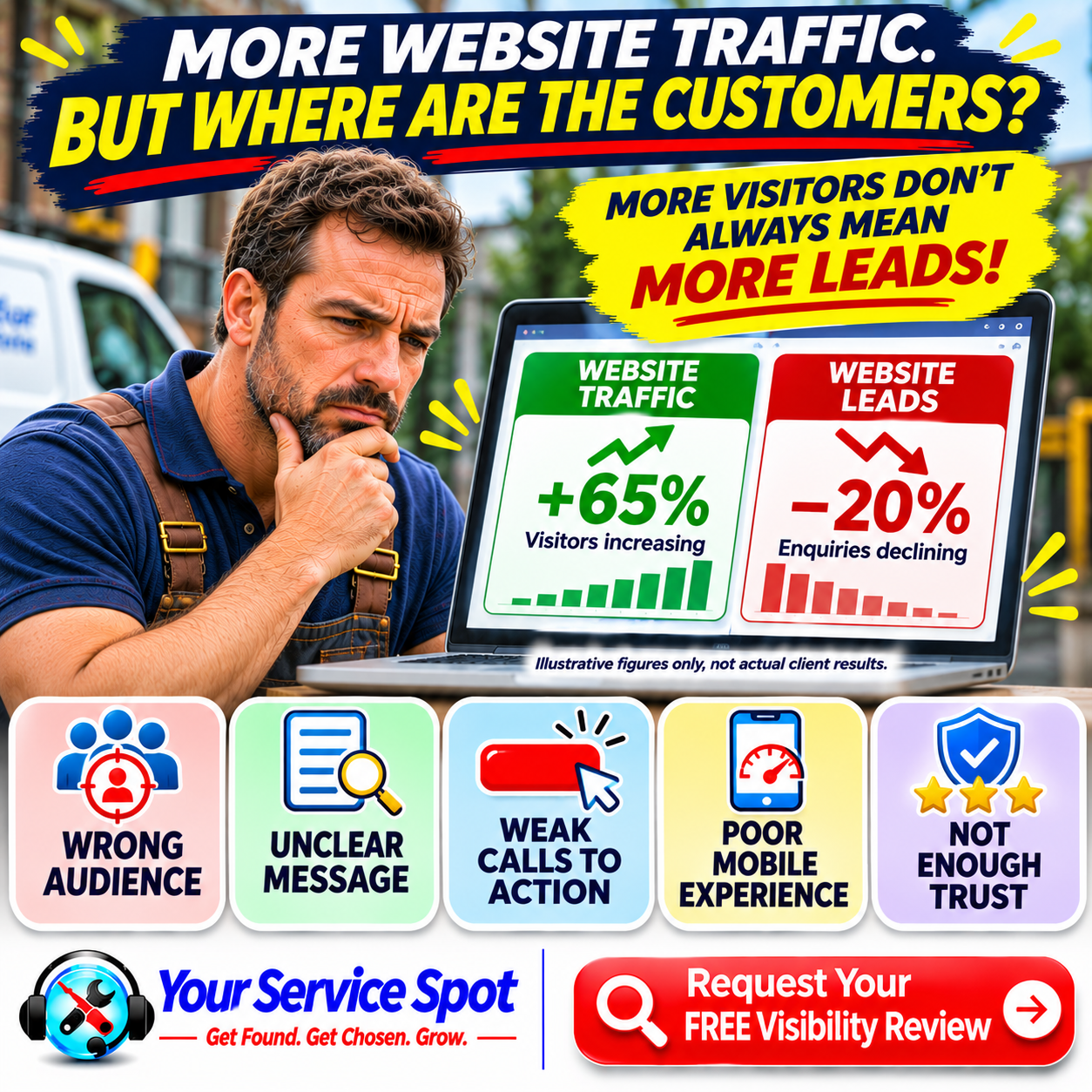
- Your website loads poorly on their phone.
- And there’s little evidence of why they should trust you.
They may choose a competitor.
That’s why AI visibility should support the entire customer journey.
At Your Service Spot, we focus on four connected stages:
GET FOUND
Help potential customers discover your business.
BUILD TRUST
Provide accurate information and credible reasons to choose you.
GET CHOSEN
Make your services and benefits clear.
GENERATE ENQUIRIES
Make it easy for customers to contact you.
AI visibility creates an opportunity. Your wider online presence helps turn that opportunity into business.
How to make your website convert more visitors into leads.
-
Can You Pay to Get Recommended by AI?
Be cautious of anyone promising guaranteed placement in independent AI-generated recommendations.
Advertising and independent recommendations are different.
Paying for marketing doesn’t guarantee that ChatGPT, Gemini or Perplexity will recommend your business.
Likewise, there isn’t a single AI optimisation technique that guarantees inclusion across every platform.
A credible AI visibility service should focus on evidence-based improvements.
That means assessing your current discoverability, identifying gaps, improving useful information and monitoring results.
The aim is to make your business easier to discover and evaluate, not to claim control over an independent AI system.
-
Start Improving Your AI Search Visibility Today
You don’t need to overhaul your entire marketing strategy overnight.
Start with a few practical actions:
- Review your homepage.
- Check whether your main services and locations are clearly explained.
- Look at your Google Business Profile and other relevant business listings.
- Review your customer feedback.
- Then ask several AI platforms the questions your customers might ask.
Is your business mentioned?
If not, which competitors appear?
Are there obvious differences in how their services are described?
Does your website contain the information customers need?
These questions can reveal useful opportunities.
And even when an AI platform doesn’t immediately recommend your business, improving the clarity and usefulness of your online presence can still benefit customers and traditional search visibility.
Is Your Business Being Found in AI Search?
Your next customer might discover a local business through Google Search.
They might use Google Maps.
Or they might ask ChatGPT, Gemini or Perplexity for a recommendation.
Will your business be part of their research?
At Your Service Spot, we help local businesses investigate their visibility across Google and AI-powered search platforms.
We identify opportunities to improve website content, business information, online reputation and search discoverability.
Our goal is to help more potential customers find your business, understand what you offer and feel confident getting in touch.
Request Your FREE Visibility Review
Find out where your business is appearing online, where potential visibility gaps may exist and which practical improvements are worth considering.
Get Found. Get Chosen. Grow.
Frequently Asked Questions About AI Search Visibility
What does AI search visibility mean?
AI search visibility describes how discoverable and accurately represented your business is in AI-powered search experiences. This can include being mentioned, described or linked to in answers from platforms such as ChatGPT, Gemini and Perplexity.
How can I improve AI search visibility for my business?
Start by clearly explaining your services and locations, publishing useful content, maintaining accurate business information, strengthening your reputation and checking website accessibility. Test realistic customer questions to assess your current visibility.
How does ChatGPT decide which businesses to recommend?
ChatGPT’s responses depend on the question, its available capabilities and the information used to generate an answer. When web search is used, retrieved sources may help inform recommendations. OpenAI doesn’t publish a universal local business ranking formula.
Does Google ranking affect AI search visibility?
Traditional search visibility and AI search visibility can overlap, but they aren’t identical. Ranking well on Google doesn’t guarantee a recommendation from ChatGPT or another AI platform.
Do Google reviews help with AI recommendations?
Genuine reviews contribute to your online reputation and may provide useful information where accessible. However, AI platforms don’t publish a universal formula guaranteeing recommendations based on review counts or ratings.
Do I need a website to appear in AI search?
Not necessarily. Information about your business may appear on other public websites. However, your own website gives you a valuable place to publish accurate details about your services, locations, experience and contact information.
What is OAI-SearchBot?
OAI-SearchBot is an OpenAI crawler associated with discovery for ChatGPT’s search features. Website owners can control its access through technical settings. Allowing it doesn’t guarantee that a website will appear in AI-generated answers.
Is AI search optimisation the same as SEO?
They overlap, but they aren’t identical. Traditional SEO focuses on search engine discoverability and performance. AI search optimisation examines how information is discovered, represented, cited or recommended within AI-powered search experiences.
Should I create FAQ sections for AI search?
Helpful FAQs can make your website more useful by answering real customer questions. However, adding FAQs doesn’t guarantee AI recommendations or special treatment by an AI platform.
How do I know whether ChatGPT recommends my business?
Ask realistic questions about your services and location, using web search where available. Record the results and repeat tests over time. One response shouldn’t be treated as a definitive assessment.
Can I guarantee my business will appear in Google AI Overviews?
No. Google doesn’t guarantee that a particular page or business will appear in AI Overviews. Its AI search experiences use Google’s search systems and applicable eligibility requirements.
How long does it take to improve AI visibility?
There’s no guaranteed timeframe. Some technical and content improvements can be made quickly, but discovery and inclusion in AI-powered responses can vary between platforms and questions.
Can an agency guarantee ChatGPT recommendations?
No credible agency should guarantee inclusion or permanent recommendations in independent AI-generated answers. An evidence-based service should identify opportunities, implement improvements and assess results realistically.
Is AI search replacing Google Maps?
AI-powered search provides additional ways for customers to discover businesses, but Google Maps and traditional Google Search remain important local discovery channels. Businesses should consider both.
How often should I check my AI search visibility?
A monthly or quarterly assessment can be a practical starting point. Use a consistent set of customer questions, record results and look for patterns rather than reacting to individual answers.
What’s the biggest mistake businesses make with AI visibility?
One common mistake is treating AI recommendations as something that can be guaranteed through a single trick. A stronger approach is to make your business information clear, accurate, accessible and useful across the wider web.