How Google Decides Which Businesses Rank First: Understanding Google Maps Ranking Factors
You’ve worked hard to build your business.
You provide an excellent service. Your customers are happy. You’ve collected some great Google reviews.
But there’s a problem.
When someone searches Google for your services, your competitors appear above you.
Perhaps you’ve searched for “plumber near me”, “drain unblocking Brighton” or “pool cleaning Houston” and wondered why certain businesses appear prominently on Google Maps while others are difficult to find:
- Is it because they have more reviews?
- A better website?
- A bigger marketing budget?
- Or is Google simply favouring your competitors?
The answer is more complicated than any one of those explanations.
Google uses several signals to decide which businesses appear in local search results. Understanding the main local ranking factors can help you identify where your business may have opportunities to improve.
In this guide, we’ll explain how Google Maps ranking works, what influences your position and what you can do to help more potential customers find and choose your business.
-
How Does Google Decide Which Businesses Rank First?
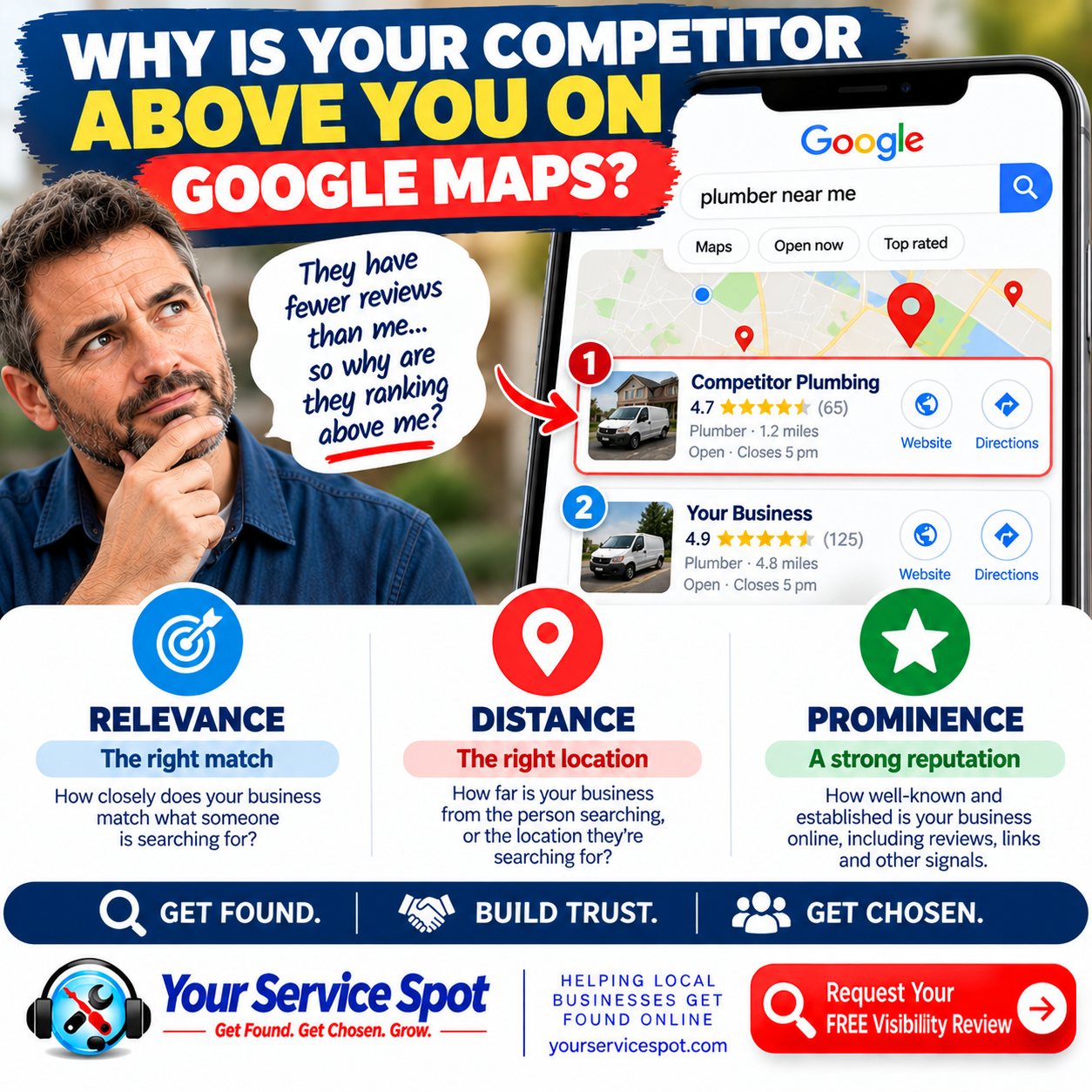
Google explains that local search results are primarily based on three factors:
Relevance, distance and prominence.
These factors help Google decide which businesses are most useful for a particular local search.
Here’s what each one means.
Relevance: Does Your Business Match the Search?
Relevance describes how closely your business matches what someone is searching for.
For example, imagine a homeowner searches for:
“Emergency drain unblocking Brighton”
Google needs to identify businesses that are relevant to that service and location.
A business with a clearly described drainage service, accurate business categories and detailed information may be easier for Google to understand than one with an incomplete profile.
What can you do?
- Choose the most accurate primary Google Business Profile category.
- Add relevant secondary categories where appropriate.
- Describe the services you genuinely provide.
- Complete your business information.
- Keep your website content relevant to your actual services.
The objective isn’t to repeat keywords as many times as possible.
It’s to help Google and potential customers understand exactly what your business offers.
Read our guide to 5 Google Business Profile Mistakes That Cost Businesses Customers to discover common problems that can make your business harder to understand or choose.
Distance: How Close Are You to the Searcher?
Distance is another important factor in Google Maps ranking.
Google considers how far a business is from the location associated with a search.
If someone searches for “electrician near me”, Google may use their approximate location to identify nearby businesses.
If they search for “electrician Croydon”, the location specified in the search helps establish the geographical context.
This explains something many business owners find confusing.
Your business may rank well in one neighbourhood but appear much lower just a few miles away.
That’s because Google Maps results aren’t necessarily the same for everyone.
They can vary depending on the searcher’s location, search terms and other contextual factors.
What can you do?
You can’t move your business closer to every potential customer.
But you can:
- Keep your business address accurate, if your profile is eligible to display one.
- Set appropriate service areas if you serve customers at their locations.
- Make sure your website clearly explains where you operate.
- Create useful, genuinely distinct location pages where appropriate.
Be aware that simply adding more service areas to your Google Business Profile doesn’t mean you’ll rank highly throughout those areas.
Distance remains a factor you cannot fully control.
Learn how properly structured service-area content can help customers find relevant information in Why Every Local Business Needs Location Pages.
Prominence: How Well-Known Is Your Business?
Prominence reflects how well-known or established a business is.
Google explains that prominence can be influenced by information about a business from across the web.
Examples include links, articles and directory listings.
Google also states that more reviews and positive ratings can help local ranking.
This means your Google Business Profile doesn’t operate in isolation.
Your wider online reputation matters too.
What can you do?
- Encourage genuine customer reviews.
- Respond professionally to customer feedback.
- Maintain accurate business details across reputable websites.
- Develop useful website content.
- Earn relevant links and mentions through legitimate business activity.
- Build a strong reputation through consistently good service.
Remember that prominence isn’t simply a competition to collect the largest number of reviews.
Google considers multiple signals, and their relative influence isn’t fully disclosed.
Discover why customer feedback matters in Why Google Reviews Matter for Local SEO.
- Why Does Your Competitor Rank Above You on Google Maps?
Imagine two businesses offering the same service.
Business A
- 125 Google reviews
- 4.9-star rating
- Professional website
- Located six miles from the searcher
Business B
- 65 Google reviews
- 4.7-star rating
- Simpler website
- Located one mile from the searcher
Which business will appear first?
You might expect Business A because it has more reviews and a higher rating.
But that’s not necessarily what happens.
Business B might be more relevant to the search, closer to the customer or stronger in other local ranking signals.
Google considers a combination of factors rather than ranking every business according to a single number.
That’s why copying one thing your competitor does won’t necessarily improve your position.
You need to understand the wider picture.
Explore this issue further in Why Competitors Are Getting More Calls From Google.
-
Does Having More Google Reviews Improve Your Ranking?
Reviews are important, but their role is often misunderstood.
Google confirms that review count and positive ratings can help local ranking.
However, that doesn’t mean the business with the most reviews will always appear first.
Relevance and distance still matter, alongside other prominence signals.
Reviews also have a second role that can be just as important.
They influence whether customers feel confident choosing you.
Imagine a customer comparing three local businesses.
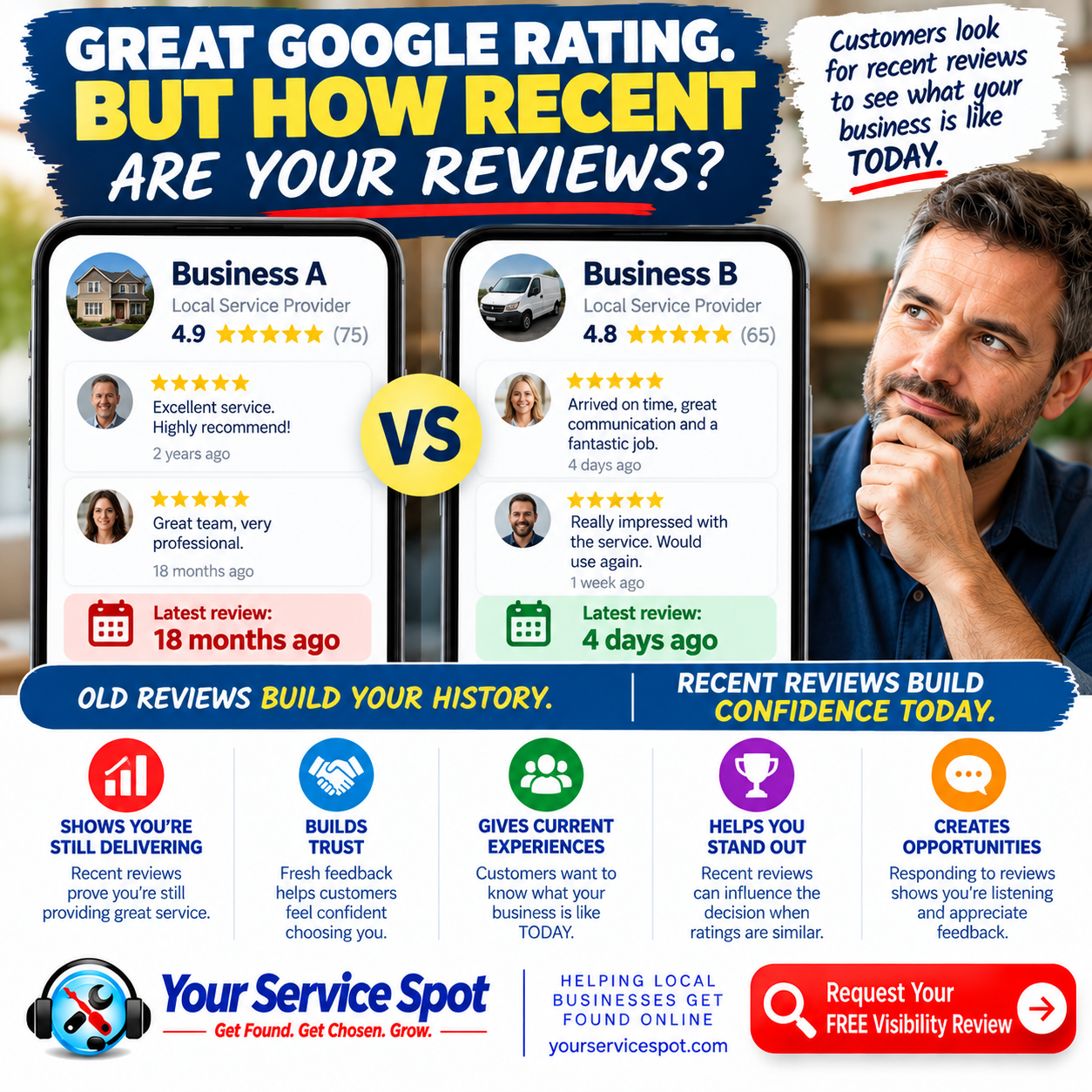
One has a high rating but hasn’t received a review in over a year.
Another has slightly fewer reviews but receives regular, detailed customer feedback.
A third has excellent reviews but never responds to customer concerns.
The customer may consider all those details before making contact.
Your objective should be to build a genuine, representative review profile — not chase an arbitrary review total.
See Why Recent Google Reviews Matter More Than Old Ones for more on how fresh feedback can influence customer confidence.
-
Does Your Website Affect Google Maps Ranking?
Your Google Business Profile is essential, but your website can also support your local online presence.
A useful website helps potential customers understand:
- What services you offer
- Which areas you serve
- Why they should trust your business
- How to contact you
- What happens after they make an enquiry
Google’s local ranking documentation identifies links as one source of prominence information, and website content can help establish your business’s relevance to particular searches.
However, having an expensive or visually impressive website doesn’t guarantee a higher Maps position.
A simple, well-organised website with clear service information may be more useful than a complicated website that leaves customers confused.
What Should Your Website Include?
For many local service businesses, the essentials are:
- A clear homepage explaining what you do and where you operate
- Dedicated pages for your main services
- Useful location-specific content where appropriate
- Clear contact information
- Evidence of experience and credibility
- A straightforward enquiry process
The goal is to make your website helpful to both search engines and real customers.
Read Why Your Website Isn’t Generating Leads to understand why website traffic doesn’t always turn into enquiries.
-
Does Posting Regularly on Your Google Business Profile Improve Rankings?
Keeping your Google Business Profile accurate and useful is good practice.
You can publish updates, share relevant photographs and keep customers informed about your services.
But there’s an important distinction.
Google doesn’t publicly guarantee that posting more frequently will directly improve your Maps ranking.
So promises such as “post every day and reach number one” should be treated with caution.
Instead, think about what a well-maintained profile does for potential customers.
It can show them:
- Your current services
- Useful business updates
- Recent photographs
- Accurate opening hours
- How to contact you
Those details can help customers make informed decisions.
Your Google Business Profile should be maintained because it’s an important customer-facing asset, not because every update is guaranteed to improve rankings.
See How Often Should You Update Your Google Business Profile? for practical guidance.
-
Can You Pay Google to Rank First on Maps?
This is another common misconception.
Google makes a clear distinction between paid advertising and organic local rankings.
Businesses can advertise through Google Ads, including certain placements connected with Maps.
But paying for advertising doesn’t improve your organic Google Maps ranking.
An advertisement may appear prominently because it’s a paid placement.
That isn’t the same as earning a higher position in the unpaid local results.
You cannot buy a guaranteed number-one organic Google Maps position from Google.
Be cautious about any marketing company promising otherwise.
A legitimate local SEO strategy should focus on improving the factors you can influence while recognising that rankings are never guaranteed.
-
Why Does Your Google Maps Ranking Change?
Perhaps you’ve checked your position several times and noticed something strange.
On Monday, your business appears third.
On Wednesday, it appears seventh.
Then a colleague searches from another location and sees a completely different result.
What’s happening?
Local rankings can change for several reasons, including:
- The searcher’s location
- Differences in search wording
- Changes to competing business profiles
- New or updated information Google discovers
- Changes in Google’s ranking systems
This means a single search from your own computer isn’t a reliable way to judge your visibility across an entire service area.
A more useful approach is to examine how your business appears for relevant searches across the locations that matter commercially.
And don’t judge success purely by ranking position.
Also look at whether your Google presence is generating useful enquiries.
-
Seven Practical Ways to Improve Your Google Maps Visibility
Understanding local ranking factors is helpful.
But what should you actually do?
Here are seven sensible priorities.
-
Complete Your Google Business Profile
Check your categories, contact details, business description, opening hours and services.
Make sure everything is accurate and up to date.
-
Use Accurate Business Categories
Your primary category should describe your core business as closely as possible.
Add secondary categories only where they genuinely apply.
-
Keep Your Business Information Consistent
Make sure customers encounter accurate information on your website, Google Business Profile and relevant business listings.
-
Build a Genuine Review Strategy
Ask customers for honest feedback.
Make the process easy, respond professionally and avoid incentives or selective review requests.
-
Improve Your Website Content
Explain your services clearly, answer common customer questions and make it easy to contact you.
-
Strengthen Your Online Reputation
Look for legitimate opportunities to earn relevant mentions and links through local partnerships, community involvement, professional associations and useful content.
-
Measure What Matters
Review your Google Business Profile performance and the enquiries you receive.
Look for patterns over time rather than reacting to every small ranking movement.
Use our Local SEO Checklist for Small Businesses to identify other opportunities to improve your online presence.
-
Why Ranking First Isn’t the Whole Story
Imagine your business appears near the top of Google Maps.
That’s great.
But what happens next?
- A potential customer opens your Google Business Profile.
- They see outdated photographs.
- Your opening hours are unclear.
- You haven’t responded to reviews.
- Your website is difficult to navigate.
- And they can’t quickly find the information they need.
What might happen?
They choose a competitor.
This is why local SEO shouldn’t focus exclusively on rankings.
You also need to think about the customer’s decision-making process.
At Your Service Spot, we describe that journey simply:
GET FOUND → BUILD TRUST → GET CHOSEN → GENERATE ENQUIRIES
Google Maps visibility helps customers discover you.
Your reviews, business information and website help them decide whether to trust you.
And a clear, straightforward enquiry process helps them take the next step.
Discover how to turn more visitors into enquiries in How to Make Your Website Convert More Visitors Into Leads.
-
How Do You Know If Your Local SEO Needs Improving?
Ask yourself a few simple questions.
When someone searches for your main service in your target area:
- Does your business appear prominently?
- Are the businesses appearing above you genuinely comparable?
- Is your Google Business Profile complete and accurate?
- Do your reviews inspire confidence?
- Does your website explain your services clearly?
- Can customers contact you easily?
- Are you receiving enough relevant enquiries?
If you’re unsure about several of those answers, there may be opportunities worth investigating.
But avoid making changes based on assumptions alone.
For example, if your competitor ranks above you, don’t automatically assume you need more reviews.
The real issue might involve relevance, location, website information or another factor.
The first step is understanding where your business stands today.
See 10 Signs Your Local SEO Needs Improving.
-
The Right Approach to Google Maps Ranking
There isn’t a secret trick that guarantees first place on Google Maps.
And no responsible marketing company should promise one.
What you can do is build a stronger local online presence.
That means helping Google understand your business, making sure your information is accurate, developing your online reputation and giving customers compelling reasons to choose you.
Some factors, such as distance, are largely outside your control.
Others, such as your business information, website content and review-management processes, can be improved.
The objective isn’t simply to appear above every competitor.
It’s to become easier to find, easier to trust and easier to choose.
That’s how local visibility becomes a business opportunity.
Is Your Business Losing Customers on Google Maps?
Your competitors may be appearing above you when potential customers search for your services.
But do you know why?
And more importantly, do you know what you could improve?
At Your Service Spot, we help local businesses identify opportunities to strengthen their Google visibility, build customer trust and generate more enquiries.
Request Your FREE Visibility Review
We’ll help you understand where your business may be missing opportunities online and highlight practical areas worth improving.
Get Found. Get Chosen. Grow.
Frequently Asked Questions About Google Maps Ranking
What are the main Google Maps ranking factors?
Google says local rankings are primarily based on relevance, distance and prominence. Relevance concerns how closely a business matches a search, distance considers geographical proximity and prominence reflects how well-known a business is.
How does Google decide which business appears first on Maps?
Google evaluates local ranking signals to identify results it considers useful for a particular search. The result can vary according to the search terms, location and information available about competing businesses.
Can I improve my Google Maps ranking?
You can improve aspects of your local online presence by maintaining an accurate Google Business Profile, choosing appropriate categories, developing useful website content and earning genuine reviews. However, no specific ranking improvement can be guaranteed.
Do more Google reviews help local rankings?
Google confirms that review count and positive ratings can help local ranking. However, reviews are only part of the picture. Having more reviews than a competitor doesn’t guarantee that your business will rank above them.
Does Google Maps ranking depend on distance?
Yes. Distance is one of Google’s three main local ranking factors. Your business may appear in different positions depending on where someone searches from or which location they specify.
Can a business rank in Google Maps without a website?
Yes. An eligible business can appear on Google Maps through its Google Business Profile without having a website. However, a useful website can support customer confidence, provide more detailed information and create additional opportunities to attract enquiries.
Does posting on Google Business Profile improve rankings?
Google doesn’t publicly guarantee a direct ranking improvement from posting frequently. Relevant updates can still help keep customers informed and make your profile more useful.
Can I pay to rank first on Google Maps?
You can pay for advertising placements through Google Ads, but advertising doesn’t improve your organic local ranking. Paid placements and unpaid Google Maps results are different.
Why does my competitor rank higher despite having fewer reviews?
Google considers relevance, distance and prominence rather than review quantity alone. A competitor may be closer to the searcher, more relevant to the query or stronger in other ranking signals.
Why does my Google Maps ranking change depending on where I search?
Location is an important factor in local results. Different searchers may see different businesses or ranking orders depending on where they are and what they search for.
How long does it take to improve Google Maps rankings?
There is no guaranteed timeframe. Results depend on your starting position, competition, the changes made and how Google processes updated information. Local SEO should be treated as an ongoing process rather than a one-time fix.
What is the difference between Google Maps ranking and local SEO?
Google Maps ranking refers to where a business appears in Google’s local map-based results. Local SEO is the broader process of improving a business’s visibility and usefulness across relevant local searches, including its Google Business Profile, website and online reputation.