How to Respond to Google Reviews: A Guide for Local Businesses
A customer leaves your business a five-star Google review.
What do you do?
Perhaps you reply with:
“Thanks!”
Or maybe you don’t respond at all.
Then another customer leaves a critical review.
Suddenly, responding feels considerably more important.
But there’s something many businesses overlook:
When you respond to Google reviews, you’re not only talking to the person who wrote the review.
You’re also communicating with potential customers who may read that conversation before deciding whether to choose your business.
That makes your responses an important part of your online reputation.
Whether a review is glowing, disappointing or somewhere in between, a thoughtful response can demonstrate that your business listens, appreciates its customers and handles problems professionally.
Here’s how to do it well.
Why Should You Respond to Google Reviews?
You need to understand why Google reviews matter.
Think about the way people choose local businesses:
- They search Google.
- They compare businesses using their Google Business Profiles.
- They look at ratings.
- They read Google reviews.
- And they may also read the owner’s responses.
Your responses provide another opportunity to demonstrate what dealing with your business is actually like.
A good response can communicate:
- Professionalism
- Appreciation
- Personality
- Customer care
- Accountability
- Willingness to solve problems
Even a negative review can provide an opportunity to make a positive impression through the way you handle it.
That’s why review management shouldn’t simply mean:
“Get more reviews.”
It should also mean:
“Look after the reviews you’ve already received.”
-
Respond to Positive Google Reviews
Positive reviews are easy to appreciate — but surprisingly easy to ignore.
A customer has taken time to recommend your business publicly.
Acknowledging that effort is good customer service.
Instead of:
Thanks.
Try something warmer and more personal:
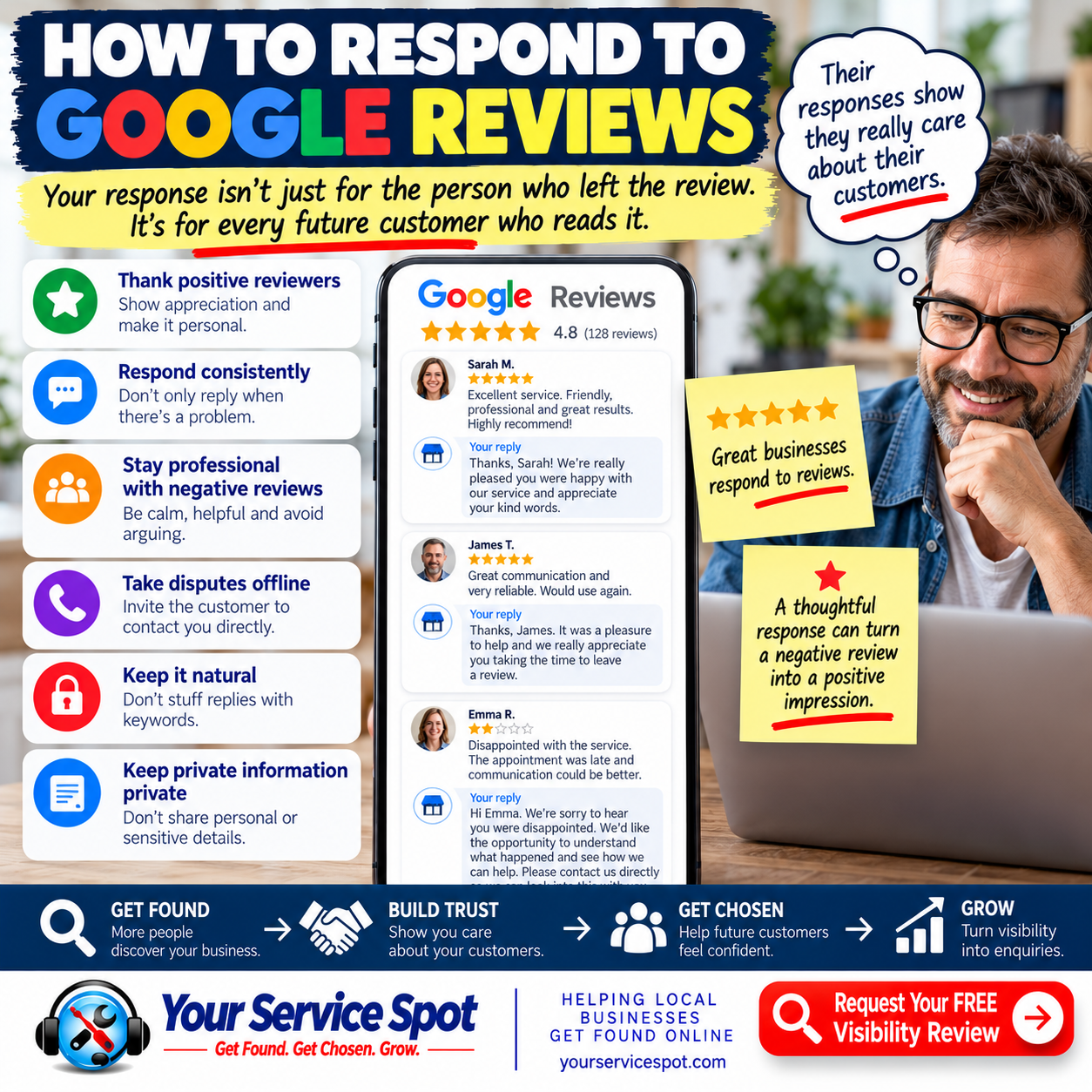
Thank you, Sarah. We’re really pleased you were happy with the service. We appreciate you taking the time to leave us a review.
It doesn’t need to be long.
It just needs to sound like a human being wrote it.
Why respond when the customer is already happy?
Because the response isn’t only for Sarah.
A potential customer may read:
Review → Business response → Next review → Business response
and begin forming an impression of the company.
Consistent, thoughtful responses can reinforce the message:
This business cares about its customers.
-
Personalise Your Responses
Have you ever seen a business respond to every review with exactly the same message?
Thank you for your review. We appreciate your feedback.
Then again:
Thank you for your review. We appreciate your feedback.
And again…
Technically, the business is responding.
But it doesn’t feel particularly personal.
You don’t need to write a completely original essay every time.
Small changes can make a considerable difference.
Where appropriate:
- Use the customer’s first name
- Refer naturally to something they mentioned
- Thank them for choosing the business
- Acknowledge a specific compliment
- Invite them back where appropriate
For example:
Thanks, James. We’re delighted you were pleased with the pool equipment repair and really appreciate the recommendation.
That’s considerably more engaging than a generic template.
-
Keep Your Responses Natural
Local SEO is important.
But a review response shouldn’t sound as though it was written for a search engine to try and improve local SEO.
Imagine a customer writes:
Great service. Really pleased with the work.
And the business replies:
Thank you for choosing the best emergency drain unblocking company in Brighton for your blocked drain Brighton emergency drainage requirements.
That doesn’t sound natural.
It sounds like somebody is trying to squeeze keywords into a conversation.
Your review responses are part of your public customer communication.
Write them for people.
If a service or location naturally belongs in the response, that’s fine.
Don’t force it.
-
Don’t Ignore Negative Reviews
This is where many business owners understandably become uncomfortable.
A negative review can feel personal — particularly when you believe it’s unfair.
The temptation may be to:
- Ignore it
- Defend yourself immediately
- Correct every detail publicly
- Argue with the reviewer
- Write an angry response
Usually, none of those approaches helps.
Remember who else may be reading.
A future customer may know nothing about the disagreement.
They’re assessing how your business behaves when something goes wrong.
A calm, professional response can sometimes tell them more about your company than another five-star review.
-
Don’t Respond While You’re Angry
If a review has annoyed you, you don’t necessarily need to respond immediately:
- Read it.
- Check what happened.
- Speak to anyone involved.
- Then respond when you can do so calmly and professionally.
Before posting, ask yourself:
“Would I be comfortable with a potential customer reading this response?”
If the answer is no, rewrite it.
The objective isn’t necessarily to prove that you’re right.
The objective is to represent your business professionally.
-
Acknowledge the Customer’s Experience
Acknowledging somebody’s experience doesn’t always mean agreeing with every claim they have made.
There’s an important difference between:
“Everything you’ve said is correct.”
and:
“We’re sorry to hear that you were disappointed with your experience.”
The second acknowledges the customer’s dissatisfaction without automatically accepting facts that may be disputed.
A useful response might be:
We’re sorry to hear you were disappointed with your experience. We’d appreciate the opportunity to understand what happened and see whether we can help. Please contact us directly at [contact details].
This demonstrates concern without conducting an argument in public.
-
Take Detailed Disputes Offline
Google review responses are rarely the best place to resolve complicated disagreements.
If a situation requires discussion, invite the reviewer to contact you directly.
For example:
We’re sorry to hear about your experience. We’d like the opportunity to look into this properly. Please contact us directly on [phone/email] so we can discuss what happened.
This achieves two things.
It gives the customer a route towards resolution.
And it shows anyone else reading that you’re willing to engage constructively.
Keep private information private
Don’t use a public review response to disclose personal information, transaction details or other information that shouldn’t be published.
Take sensitive conversations offline.
-
Don’t Use the Same Response for Every Negative Review
Templates can be useful starting points.
But copy-and-paste responses can make a business appear indifferent.
Compare:
We apologise for any inconvenience caused. Please contact us.
with:
Hi David. We’re sorry the appointment didn’t go as expected. We’d like to understand what happened and see whether we can help. Please contact us directly so we can look into this with you.
The second feels like somebody has actually read the review.
That’s the goal.
-
What If the Negative Review Is Unfair?
Not every negative review will accurately reflect what happened:
- Some may contain misunderstandings.
- Others may be exaggerated.
- Occasionally, you may receive a review you don’t recognise at all.
- You can still respond professionally.
For example:
Hi Mark. We’re unable to identify a customer or job matching the details in your review. We’d be happy to look into this, so please contact us directly with further information.
Notice what that doesn’t say:
“You’re lying.”
Even if you strongly suspect the review is false, a public argument may do more harm than good.
Where a review appears to violate Google’s policies, you can also use Google’s available reporting process.
But don’t assume that Google will remove a review simply because it’s negative or because you disagree with it.
-
Should You Respond to Every Google Review?
For many small local businesses, responding consistently is a sensible goal. It is also beneficial to update your Google Business Profile regularly.
You don’t necessarily need to write several paragraphs for every review.
A short, genuine acknowledgement can be enough.
What matters is establishing a habit.
For example:
Five-star review:
Thanks, Claire. We really appreciate the kind words and are delighted you were happy with the service.
Detailed positive review:
Thank you, Robert. It’s great to hear you were pleased with the work and communication throughout. We really appreciate you taking the time to share your experience.
Negative review:
We’re sorry to hear you were disappointed. We’d like the opportunity to understand what happened and see whether we can help. Please contact us directly so we can look into this properly.
Use examples like these as frameworks rather than scripts to paste underneath every review.
-
Don’t Turn Review Responses Into Sales Pitches
Someone compliments your business.
You reply:
Thanks, John! Don’t forget we also offer Service A, Service B and Service C. Call now for a special offer!
Probably not.
A review response is primarily a customer conversation.
Let it be one.
There’s no need to turn every interaction into an advertisement.
A genuine response can often do more to build trust than an unnecessary sales message.
-
Check Your Reviews Regularly
One of the simplest ways to improve review management is to make it routine.
Depending on the volume of reviews your business receives, establish a regular process to:
- Check for new reviews
- Read each review carefully
- Investigate problems where necessary
- Respond appropriately
- Identify recurring feedback
- Learn from what customers are telling you
Reviews aren’t only a marketing asset.
They can also provide valuable business intelligence.
If customers repeatedly praise the same employee, service or aspect of your business, that’s useful information.
If several customers complain about the same issue, that’s useful too.
Google Reviews Are About More Than Star Ratings
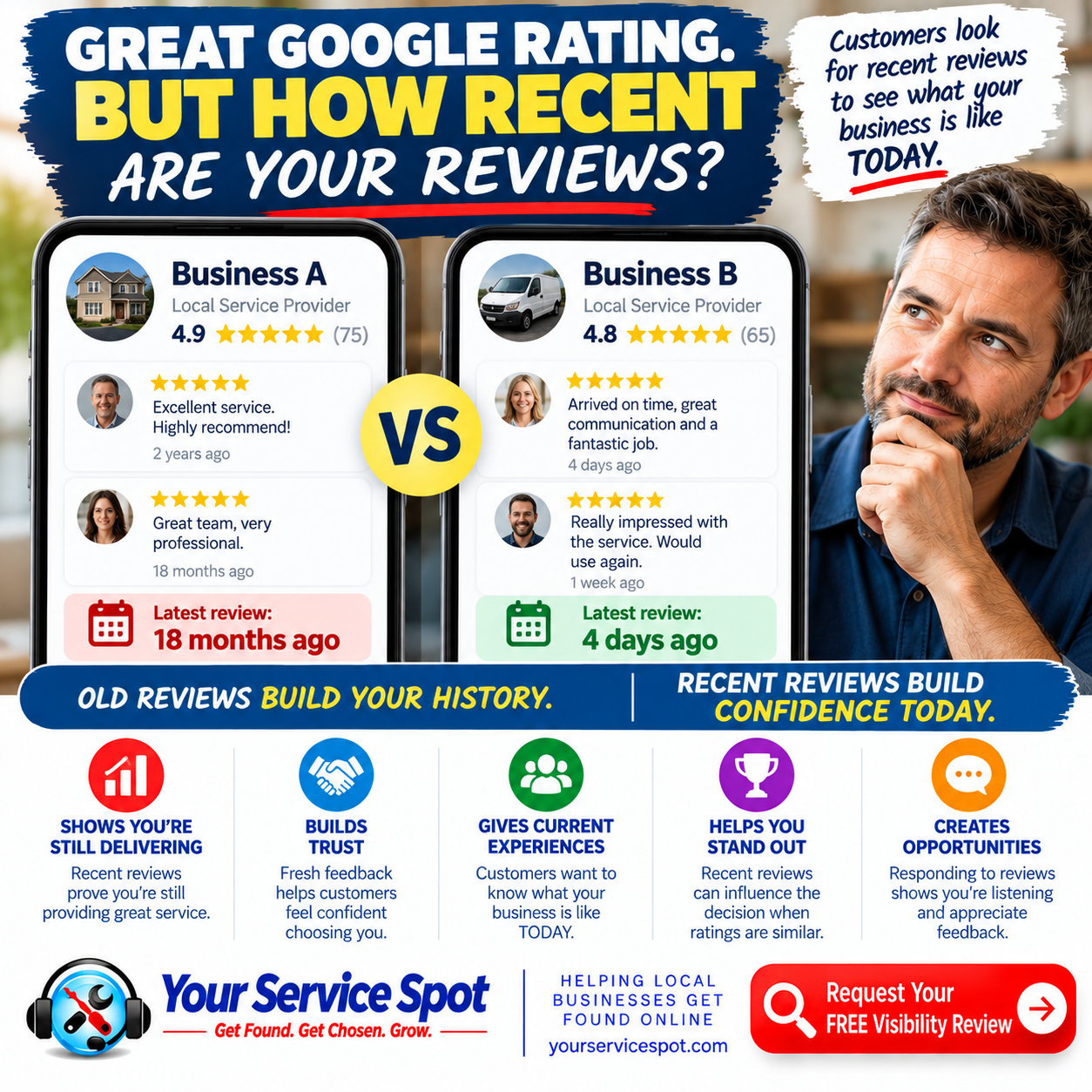
Suppose you’re choosing between two businesses.
Both have good ratings.
Business A rarely responds to customers.
Business B regularly thanks customers, acknowledges feedback and handles criticism professionally.
Which one feels more engaged?
The answer won’t be the same for everyone, but review responses give customers additional information with which to make their decision.
Your review profile isn’t just:
NUMBER OF REVIEWS + STAR RATING
It’s also the collection of customer experiences — and how your business responds to them.
A Simple Google Review Response Formula
When you’re unsure what to write, use this framework:
For a positive review:
THANK → PERSONALISE → ACKNOWLEDGE → CLOSE
For example:
Thanks, Emma. We’re delighted you were pleased with the service and really appreciate you taking the time to recommend us. We look forward to helping again whenever you need us.
For a negative review:
ACKNOWLEDGE → STAY CALM → OFFER HELP → MOVE OFFLINE
For example:
Hi Emma. We’re sorry to hear you were disappointed with your experience. We’d like to understand what happened and see whether we can help. Please contact us directly so we can look into this properly.
- Simple.
- Professional.
- Human.
What Not to Do When Responding to Google Reviews
Here’s a quick checklist:
❌ Don’t argue with customers publicly
❌ Don’t respond while angry
❌ Don’t reveal private customer information
❌ Don’t copy and paste exactly the same reply repeatedly
❌ Don’t stuff responses with keywords
❌ Don’t turn every response into a sales pitch
❌ Don’t automatically admit fault before understanding what happened
❌ Don’t ignore your positive reviewers while only responding to complaints
Instead:
✅ Be polite
✅ Be genuine
✅ Be concise
✅ Personalise where appropriate
✅ Take complicated disputes offline
✅ Remember that future customers are watching
Your Review Response Is Part of Your Reputation
This is the principle I’d encourage every business owner to remember:
You’re not just answering one customer. You’re showing everyone else how your business treats its customers.
That changes the way you think about responding:
- A five-star review becomes an opportunity to demonstrate appreciation.
- A three-star review becomes an opportunity to listen.
- A one-star review becomes an opportunity to demonstrate professionalism.
You can’t control everything customers write about your business.
You can control how your business responds.
Are Your Google Reviews Helping Customers Choose You?
Generating more reviews can be important. This can be good for your overall Google visibility.
But don’t overlook the reviews you already have.
Look at your Google Business Profile from a potential customer’s perspective. Does it build trust?
Ask:
- Are reviews recent?
- Are customers receiving responses?
- Do the responses sound genuine?
- Are negative reviews handled professionally?
- Does the overall profile inspire confidence?
Your goal isn’t simply to get found.
You also need to give potential customers reasons to get chosen.
At Your Service Spot, we help local businesses identify opportunities to strengthen their Google presence, online reputation and overall visibility.
Request Your FREE Visibility Review
Find out where your business could improve its presence on Google and create a stronger impression with potential customers.
Get Found. Get Chosen. Grow.
Frequently Asked Questions About Responding to Google Reviews
Should I respond to Google reviews?
Yes, responding to reviews can demonstrate that your business values customer feedback and takes customer service seriously. Your responses may also be read by potential customers comparing your business with competitors.
How should I respond to a positive Google review?
Thank the customer, personalise the response where appropriate and acknowledge something specific from their feedback. Keep the response natural and genuine rather than using exactly the same template every time.
How should I respond to a negative Google review?
Stay calm and professional. Acknowledge the customer’s experience, avoid arguing publicly and offer an appropriate way to continue the conversation privately when further discussion is necessary.
Should I apologise for a negative review?
You can express regret that someone had a disappointing experience without automatically accepting responsibility for disputed facts. Investigate what happened before making detailed admissions.
What should I do if a Google review is fake?
If you don’t recognise the customer or transaction, respond professionally rather than making public accusations. If you believe the review violates Google’s policies, you can report it through Google’s review-management process.
Should I use keywords when I respond to Google reviews?
Write naturally for the customer rather than deliberately stuffing review responses with keywords. If a service or location is genuinely relevant to the conversation, mentioning it naturally may be appropriate.
How quickly should I respond to Google reviews?
Aim to respond reasonably promptly, but quality matters more than reacting instantly. If a negative review requires investigation or has made you angry, take enough time to understand what happened and prepare a calm response.
Can responding to Google reviews improve SEO?
Review responses are useful primarily for customer engagement and reputation management. Avoid treating responses as a place to force SEO keywords. Your broader Google Business Profile, website, reviews and local-search strategy should work together.
Should I use the same review-response template every time?
Templates can save time and provide a useful framework, but identical responses can appear impersonal. Adapt your response to the individual review whenever possible.
Can I ask a customer to change a negative review?
If you’ve genuinely resolved a customer’s problem, you can appropriately let them know they are welcome to update their review if they wish. Avoid pressuring customers or making resolution conditional on changing or removing a review.