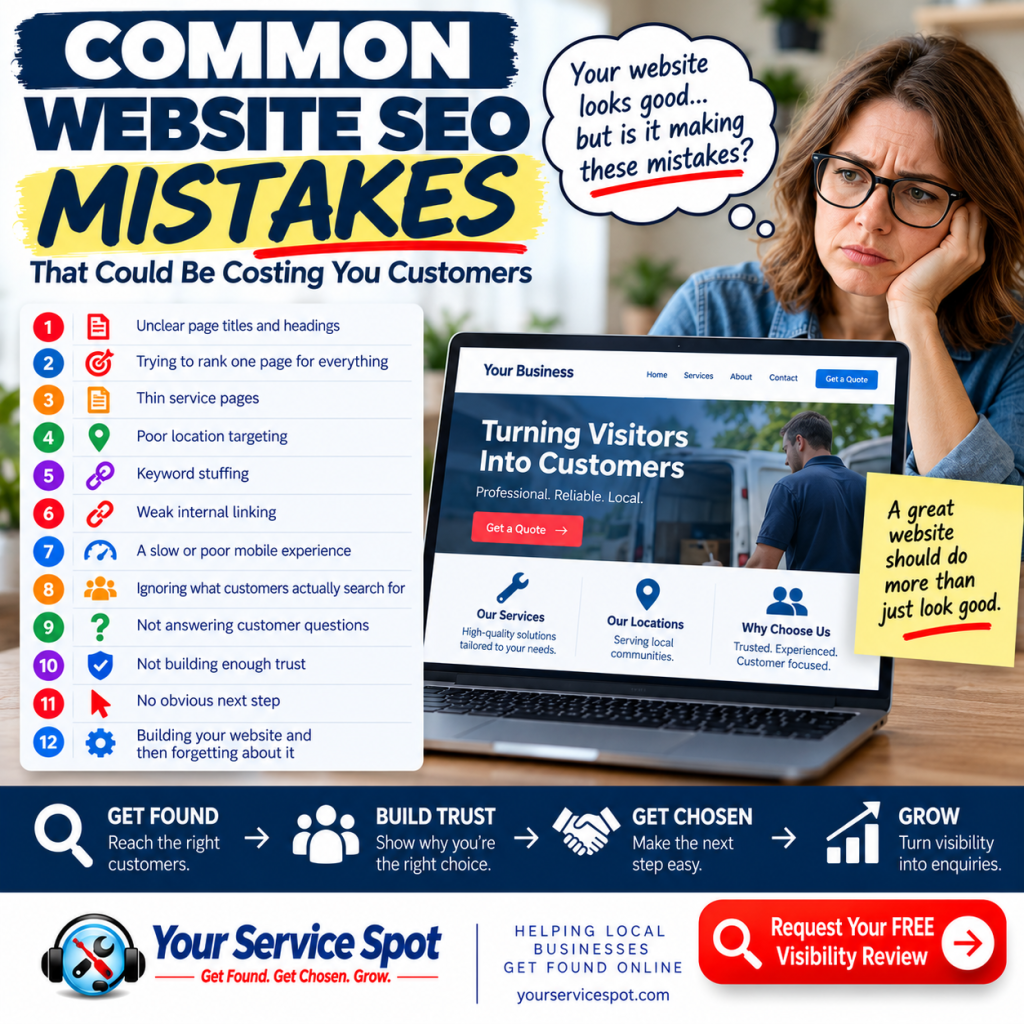
Common Website SEO Mistakes That Could Be Costing You Customers
Your website looks professional.
Your services are listed.
Your contact details are there.
So why aren’t more potential customers finding you on Google?
The problem may not be your business. It could be your website.
Many small business websites contain website SEO mistakes that make it harder for search engines to understand their content — and harder for potential customers to find the information they need.
Some problems are technical.
Others are surprisingly simple.
And several have nothing to do with trying to “trick” Google.
Good SEO is increasingly about creating a website that clearly communicates:
- What you do.
- Where you do it.
- Who you help.
- Why customers should trust you.
- What they should do next.
Let’s look at some of the most common website SEO mistakes — and what you can do about them.
-
Your Website Doesn’t Immediately Explain What You Do
Visit your homepage and imagine you’ve never seen the business before.
Within a few seconds, can you answer:
- What does this company do?
- Who does it help?
- Where does it operate?
- What should I do next?
Businesses sometimes sacrifice clarity for clever marketing.
A headline such as:
“Creating Excellence Every Day”
might sound impressive.
But excellence at what?
Compare that with:
“Pool Cleaning & Pool Equipment Repair in Houston”
The second version immediately provides useful context.
Your website doesn’t need to sound robotic or be stuffed with keywords.
It does need to be clear.
SEO principle: Write for customers first, while making the subject and purpose of each page easy for search engines to understand.
-
Your Page Titles Are Too Vague
Another common website SEO mistake is failing to optimise page titles.
Titles such as:
- Home | ABC Ltd
- Services
- About Us
tell search engines and potential customers very little about the page.
Your SEO title should accurately describe its content.
For example:
Pool Equipment Repair Houston | Chad’s Pool Service
is considerably more descriptive than:
Repairs | Chad’s Pool Service
Don’t go to the other extreme and cram every possible keyword into your title.
Aim for:
RELEVANCE + CLARITY + SEARCH INTENT
-
Your Headings Don’t Describe the Page
Your main heading — normally the H1 — should help visitors understand the page they’ve landed on.
Yet many websites still use headings such as:
Welcome to Our Website
That’s a missed opportunity.
A useful H1 could be:
Drain Unblocking Services in Brighton
or:
Local SEO Services for Croydon Businesses
Then use H2 and H3 headings to organise the supporting information naturally.
Good headings aren’t merely for SEO.
They make pages easier for people to scan and understand.
-
You’re Trying to Make One Page Rank for Everything
This is particularly common on small business websites.
Imagine a drainage company provides:
- Drain unblocking
- CCTV surveys
- Drain repairs
- Drain jetting
- Emergency drainage
across several towns.
Trying to make one homepage rank for every combination of service and location can result in a confusing page overloaded with keywords.
A better SEO website structure might look like:
Homepage
↓
Service Pages
↓
Location Pages
↓
Helpful Articles
Each page has a clearer purpose.
Your homepage introduces the business.
Service pages explain individual services.
Location pages provide useful information for customers in genuinely important service areas.
Blog content answers questions potential customers are searching for.
-
Your Service Pages Are Too Thin
Does each important service have a useful page?
Or does your entire services section consist of a few sentences?
A potential customer looking for a particular service may want to know:
- What the service involves
- Whether you can solve their problem
- Where you provide it
- How the process works
- Why they should choose you
- Frequently asked questions
- How to contact you
A detailed service page gives you space to answer those questions.
For example, rather than mentioning pool equipment repair briefly on a homepage, a pool company could have a dedicated page explaining pumps, filters, heaters, automation systems and other equipment it diagnoses and repairs.
The objective isn’t to make the page long for the sake of SEO.
The objective is to make it useful enough to answer the customer’s questions.
-
You Don’t Have Useful Location Pages
If you serve several locations, simply adding:
“We serve Croydon, Purley, Coulsdon, Sutton, Caterham…”
to the bottom of every page isn’t the same as creating genuinely useful local content.
Well-planned location pages can explain:
- Services available in the area
- Who you help locally
- Relevant local information
- Customer experiences
- Frequently asked questions
- How customers can contact you
But there’s an important warning.
Don’t create dozens of near-identical pages and simply change the town name.
SERVICE + LOCATION + USEFUL INFORMATION + TRUST + CLEAR NEXT STEP
That’s a much stronger formula.
-
You’re Stuffing Keywords Into Your Content
You’ve been told keywords matter.
So, if your target phrase is local SEO Croydon, perhaps using:
local SEO Croydon
50 times will help?
No.
It will probably make the page unpleasant to read and can look manipulative.
Use your primary topic naturally.
Include related terminology where it helps explain the subject.
Write for the person reading the page rather than repeatedly asking:
“Where can I put the keyword again?”
This article targets website SEO mistakes, for example.
You’ll see the phrase several times because that’s what we’re discussing.
But every paragraph doesn’t need to contain it.
-
Your Internal Linking Is Weak
Your pages shouldn’t exist as isolated islands.
Internal links help visitors discover related information and help search engines understand the structure and relationships between your pages.
For example, someone reading an article about website SEO could naturally be directed to information about:
- Homepage SEO
- Website speed
- Location pages
- Local SEO
- Conversion optimisation
- Google reviews
Use descriptive anchor text where it makes sense.
Instead of:
Click here
something such as:
learn how website speed affects leads
provides considerably more context.
Think of internal links as creating pathways through your website.
-
Your Website Is Too Slow
You’ve managed to get somebody to click your Google result.
Then they wait.
And wait.
And leave.
Website speed isn’t simply a technical issue.
It’s a customer experience issue.
Common causes of slow websites can include:
- Oversized images
- Poor hosting
- Excessive plugins
- Unnecessary scripts
- Bloated page builders or themes
- Poor caching/configuration
Don’t become obsessed with achieving a perfect performance score at the expense of everything else.
The objective is a website that feels fast and works reliably for real visitors — particularly on mobile devices.
-
Your Website Doesn’t Work Well on Mobile
Potential customers aren’t necessarily sitting at desks.
They may be searching while:
- Travelling
- Walking
- Sitting in a car
- Dealing with an emergency
- Comparing businesses
- Looking for a phone number
Check your website on an actual smartphone.
Can you easily:
- Read the text?
- Use the menu?
- Tap the buttons?
- Find the telephone number?
- Complete the contact form?
- Understand what the business does?
An SEO website needs to work for the people actually using it.
-
You’re Ignoring What Customers Actually Search For
Businesses sometimes optimise websites around the terminology they use internally.
Customers may use completely different language.
A specialist might talk about a technical procedure.
The customer might simply search:
“Why is my pool water green?”
or:
“Emergency blocked drain near me.”
or:
“How much does local SEO cost?”
Keyword research isn’t simply about finding phrases with search volume.
It’s about understanding customer intent.
Ask:
What problem is this person trying to solve?
Then create the best page to answer it.
-
Your Content Doesn’t Answer Enough Questions
Useful content can help a business appear for searches beyond its main commercial keywords.
Think about the questions customers repeatedly ask you.
Those questions can become:
- FAQ sections
- Blog articles
- Guides
- Service-page content
- Comparison articles
- Troubleshooting information
A pool company might answer:
How often should my pool be serviced?
A drainage company might answer:
Why does my drain keep blocking?
A local SEO company might answer:
How long does local SEO take?
If customers are asking a question, there’s a reasonable chance other potential customers are wondering about it too.
-
Your Website Doesn’t Build Enough Trust
SEO can get somebody through the door.
Then what?
A visitor may compare your website with two or three competitors before deciding whom to contact.
Trust signals can include:
⭐ Genuine customer reviews
📷 Real photographs
👥 Team information
🏆 Relevant qualifications
📍 Clear business information
📞 Visible contact details
📝 Case studies
🔧 Examples of completed work
💬 Testimonials
Avoid vague claims such as:
“We’re the best.”
Show people why they should believe you.
-
You Don’t Have Clear Calls to Action
Imagine a visitor likes what they’ve read.
What happens next?
Don’t make them hunt for your contact page.
Useful calls to action might include:
- Request a Quote
- Call Now
- Book an Appointment
- Check Availability
- Request Your FREE Visibility Review
The appropriate CTA depends on the business and the customer’s stage in their decision.
Your website should make the next step obvious.
-
You’re Getting Traffic — But Not Converting It
Here’s another mistake:
Assuming more traffic is always the answer.
Imagine Website A receives 1,000 visitors and generates 10 enquiries.
Website B receives the same 1,000 visitors and generates 30.
Website B is extracting considerably more business value from the same traffic.
That’s a simplified illustration rather than an expected conversion benchmark, but it demonstrates an important principle.
You may not always need more visitors.
Sometimes you need to convert more of the visitors you already have.
-
You’re Optimising for Rankings Instead of Customers
Ranking number one can be valuable.
But ranking isn’t the ultimate objective.
The business journey is:
GET FOUND → BUILD TRUST → GET CHOSEN → GENERATE AN ENQUIRY
If a page ranks but visitors don’t trust the business or take action, something is missing.
When measuring SEO performance, consider:
- Relevant search visibility
- Organic traffic
- Calls
- Contact forms
- Quote requests
- Bookings
- Qualified leads
- Customers
Rankings are part of the story and justify SEO investment.
Business results are the bigger picture.
A Quick Website SEO Checklist
How many of these can you tick?
☐ Every important page has a clear purpose
☐ Page titles accurately describe their content
☐ Headings are clear and useful
☐ Important services have dedicated pages
☐ Important service areas have useful location content
☐ Keywords are used naturally
☐ Pages link logically to related content
☐ The website loads quickly
☐ The website works properly on mobile
☐ Content reflects what customers actually search for
☐ Important customer questions are answered
☐ Genuine trust signals are visible
☐ Calls to action are clear
☐ Contacting the business is easy
☐ SEO performance is measured against enquiries and business outcomes
Found several you can’t tick?
Don’t panic and start changing everything at once.
The better approach is:
Diagnose first. Optimise second.
Identify which website SEO mistakes are actually limiting your visibility or conversions, then prioritise the improvements likely to make the greatest difference.
Don’t Build Your Website and Forget About It
Perhaps the biggest SEO mistake of all is treating your website as a one-off project:
- A business changes.
- Services change.
- Customers ask new questions.
- Competitors improve their websites.
- New locations become important.
- Old information becomes outdated.
- Your website should evolve with your business.
- That doesn’t mean constantly redesigning it.
It means regularly checking whether the website still accurately represents:
- What you do.
- Where you do it.
- What customers need to know.
- Why they should choose you.
- How they can take the next step.
Is Your Website Helping Your Business Get Found and Chosen?
A professional-looking website is a good start.
But appearance alone doesn’t generate visibility.
And visibility alone doesn’t generate customers.
A strong SEO website brings the pieces together:
SEARCH VISIBILITY + USEFUL CONTENT + TRUST + USER EXPERIENCE + CONVERSION
At Your Service Spot, we help local businesses identify the gaps that could be preventing their websites and online presence from performing as effectively as they should.
Request Your FREE Visibility Review
We’ll help you identify opportunities to improve your website, Google presence and overall online visibility.
Get Found. Get Chosen. Grow.
Frequently Asked Questions About Website SEO Mistakes
What are the most common website SEO mistakes?
Common problems include vague page titles and headings, thin service content, poor website structure, keyword stuffing, weak internal linking, slow performance, poor mobile usability, inadequate location content and failing to match content with what customers are actually searching for.
How do I know if my website has SEO problems?
Start by checking whether Google can find your important pages, what searches are generating impressions and clicks, which pages receive organic traffic and whether that traffic produces enquiries. A structured website and visibility audit can help identify specific weaknesses rather than relying on guesswork.
Can a good-looking website still have poor SEO?
Absolutely. Design and SEO are related but different. A visually attractive website can still have unclear content, poor page structure, weak titles, slow performance or insufficient information about its services and locations.
Does every service need its own page?
Not necessarily. But an important service that customers specifically search for often deserves enough dedicated content to answer their questions properly. Avoid creating separate pages simply to target minor keyword variations.
Do location pages improve SEO?
Useful location pages can help businesses communicate their relevance to genuine service areas and give potential customers more specific information. Avoid creating large numbers of near-identical pages that merely swap one location name for another.
Is repeating keywords good for SEO?
Keywords help communicate what a page is about, but excessive repetition can make content unnatural and unhelpful. Use your primary topic and related terminology naturally while prioritising the reader.
Are internal links important for SEO?
Yes. Internal links help visitors navigate your website and help search engines discover pages and understand relationships between content. Link relevant pages together using useful, descriptive anchor text.
Does website speed affect SEO?
Website performance is part of the overall user experience. Regardless of ranking effects, a slow website can frustrate potential customers and cause them to leave before contacting you.
How often should I update my website for SEO?
There’s no requirement to change pages simply to make them look fresh. Update content when information becomes outdated, services change, customer needs evolve or you can genuinely make a page more useful.
Should I focus on SEO rankings or leads?
Monitor both, but don’t lose sight of the business objective. Rankings and traffic can create opportunities, while calls, enquiries, bookings and customers tell you whether that visibility is producing useful results.