AI Search Visibility for Small Businesses: Are You Being Found and Recommended?
Your business has a website.
You’ve worked on your Google Business Profile.
You’ve collected some positive customer reviews.
Perhaps you’ve even invested in local SEO to help customers find you on Google.
But there’s a new question worth asking.
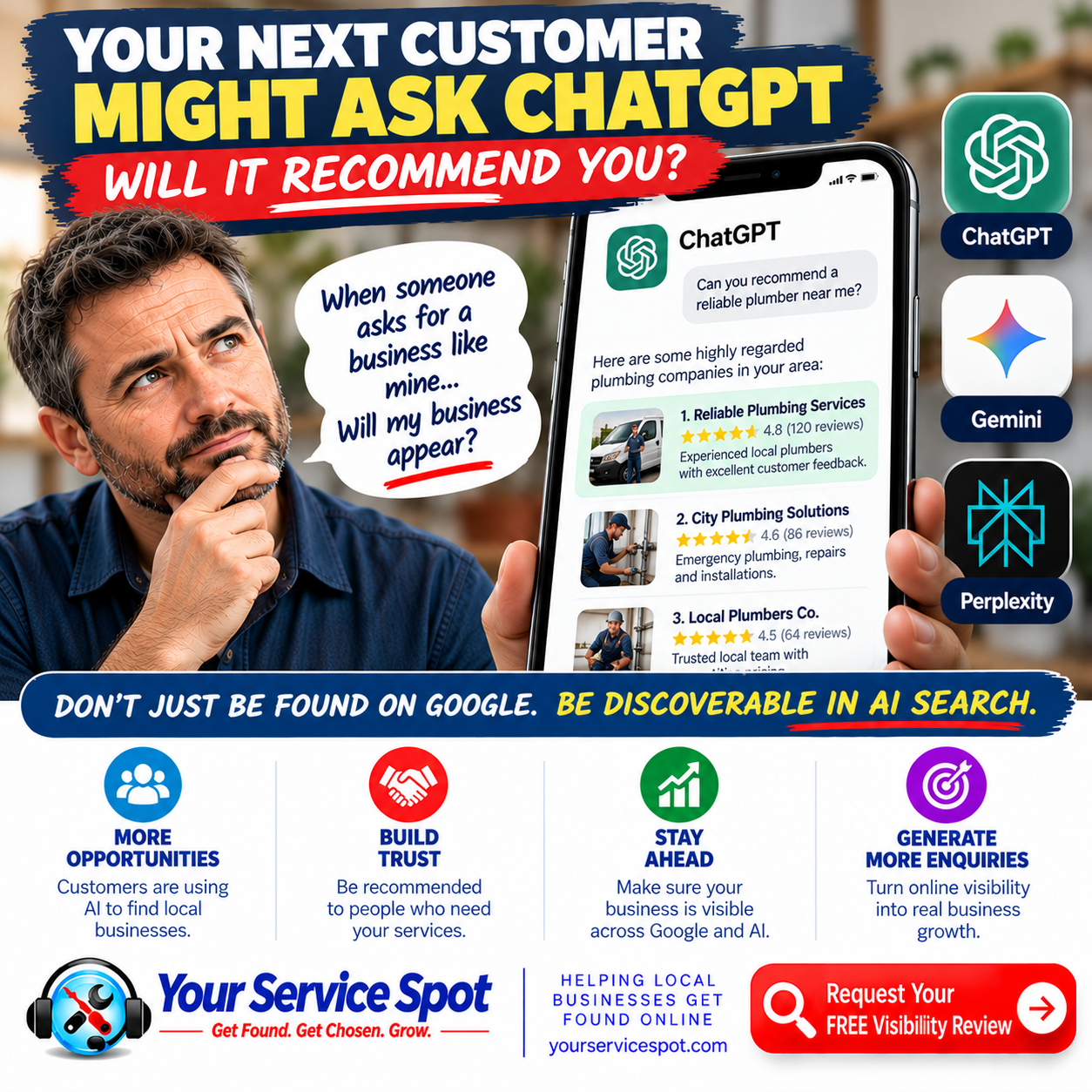
When someone asks ChatGPT, Gemini or Perplexity to recommend a business like yours, does your business appear in the answer?
Imagine a homeowner asking:
“Can you recommend a reliable plumber in Croydon?”
Or a business owner asking:
“Which local accountants specialise in helping small businesses?”
Or someone planning a home improvement project asking:
“Who are the best-rated bathroom installers near me?”
Increasingly, people can use AI-powered search and answer platforms to research businesses, compare options and decide whom to contact.
And instead of simply presenting a traditional list of search results, these platforms may provide a written answer that mentions particular businesses, explains their services and links to supporting sources.
If your business isn’t being discovered or accurately represented in those answers, you could be missing opportunities to reach potential customers.
That’s where AI search visibility (alternatively called Generative Engine Optimization) comes in.
In this guide, we’ll explain what AI visibility means, how it differs from traditional SEO, why it matters for small businesses and what practical steps you can take to improve your chances of being found and recommended.
-
What Is AI Search Visibility?
AI search visibility describes how easily your business can be discovered, understood and represented when people use AI-powered search and answer platforms.
For a local business, this could mean appearing when someone asks:
- Who provides a particular service in my area?
- Which businesses have experience with a specific problem?
- Can you recommend a reliable local company?
- What are the differences between several nearby providers?
- Which company should I consider for this type of work?
AI search visibility isn’t simply about whether an AI system recognises your business name.
It’s also about whether it can find relevant information about your services, understand where you operate and provide accurate information when someone asks a related question.
There are several possible outcomes.
Your business might be mentioned by name.
An AI-generated answer could include your business among several relevant options.
Your website might be cited as a source.
Some AI platforms provide links to websites supporting their answers.
Your business might be described accurately.
The platform may explain your services, expertise or location using information it can access.
Or your business might not appear at all.
Even if you have a good website and a strong Google Business Profile, inclusion in AI-generated answers isn’t guaranteed.
That’s why it’s worth investigating.
-
Why Does AI Search Visibility Matter for Small Businesses?
Traditional search engines remain extremely important.
But the ways customers discover and evaluate businesses are evolving.
A customer might still search Google for:
“Plumber Croydon”
But they might also ask an AI platform:
“I need a reliable plumber in Croydon who can fix a leaking radiator. Which local companies should I consider?”
That second question contains more detail.
The customer isn’t simply searching for a category.
They’re explaining a problem and asking for help choosing a provider.
An AI-powered platform may respond with a shortlist of businesses, practical advice or links to relevant sources.
This creates an additional opportunity for businesses to be discovered.
It also creates a challenge.
If your competitors are easier for AI platforms to discover and understand, they may appear in relevant answers while your business is overlooked.
However, AI visibility should be viewed as an additional discovery channel, not a replacement for Google, your website or traditional local SEO.
The sensible approach is to build a strong online presence that serves customers wherever they begin their search.
-
Which AI Platforms Should Your Business Pay Attention To?
Three useful starting points are ChatGPT, Gemini and Perplexity.
Although they all use AI to answer questions, their features, search capabilities and information sources differ.
ChatGPT
ChatGPT can help people research products, services and local businesses.
When search capabilities are used, it may retrieve current information and provide links to supporting sources.
For example, someone might ask:
“Which independent walking tour companies in London offer private corporate experiences?”
The response could discuss relevant providers and provide links that help the user investigate further.
Google Gemini
Gemini is Google’s AI assistant.
It can help people research businesses, compare options and explore questions in a conversational format.
Google also offers AI-powered experiences within Search, although Gemini and Google’s Search features shouldn’t be treated as identical products.
For small businesses, both are worth understanding because customers may encounter AI-generated information through different Google experiences.
Perplexity
Perplexity focuses heavily on answering questions using information retrieved from the web, often accompanied by source links.
Someone might ask:
“Which local swimming pool maintenance companies serve West University in Houston?”
Perplexity may use available online sources to help formulate an answer.
Should You Focus on Just One Platform?
Not necessarily.
A business may appear in one platform’s answer but not another’s.
Even the same platform can produce different responses depending on the wording of the question, available sources and other contextual factors.
That’s why a meaningful AI visibility assessment should examine more than one platform and more than one search question.
-
How Is AI Search Visibility Different From Traditional SEO?
Traditional search engine optimisation focuses on helping your website and business information appear prominently in relevant search results.
For example, a local SEO campaign might target searches such as:
- Emergency plumber Croydon
- Pool cleaning Houston
- Private walking tours London
- Drain unblocking Brighton
AI search introduces an additional consideration.
People may ask longer, more conversational questions that include specific requirements.
For example:
“Which plumbing companies in Croydon offer emergency repairs and have good customer feedback?”
Rather than only matching a short keyword phrase, the AI system may need to understand several things about a business:
- Does it provide emergency repairs?
- Does it serve Croydon?
- Is there accessible evidence of customer experiences?
- Can its services be verified from relevant online information?
This doesn’t mean traditional SEO has become obsolete.
Quite the opposite.
Many of the foundations of good local SEO also help make business information easier for AI-powered systems to discover and interpret.
These include clear website content, accurate business information, useful service pages, reputable references and accessible web pages.
The difference is that you’re now considering how your business is represented in AI-generated answers as well as conventional search results.
-
What Information Might AI Platforms Use to Understand Your Business?
There’s no single universal database that all AI platforms use to decide which businesses to mention.
Different platforms use different technologies and information sources.
Depending on the platform and how a question is answered, useful information may come from:
Your Website
Your website can explain what your business does, where it operates and what makes its services relevant.
A website with clear, detailed service information is generally easier to interpret than one containing only vague marketing statements.
Your Google Business Profile
Your Google Business Profile helps customers find important information about your business through Google Search and Maps.
It may also contribute to the broader availability of accurate business information online.
However, maintaining a Google Business Profile doesn’t guarantee inclusion in ChatGPT, Gemini or Perplexity responses.
Customer Reviews
Genuine customer reviews can provide useful information about customer experiences.
They may also help prospective customers evaluate your business when they encounter it through traditional or AI-assisted research.
Different AI platforms may have different access to review content, so you shouldn’t assume every platform can see or use every review.
Relevant Business Directories and Websites
Industry directories, professional associations, local organisations and other reputable websites can provide additional information about your business.
Accurate mentions across relevant sources can help establish a clearer public picture of your company.
Articles, Guides and Useful Content
Helpful content can explain your services and demonstrate your knowledge.
For example, a swimming pool company publishing a useful guide about maintaining pool equipment provides information that may be relevant to customers researching that problem.
The goal isn’t to publish hundreds of generic articles.
It’s to make genuinely useful information available to customers and the systems helping them research their options.
-
How to Check Whether Your Business Appears in AI Search
You don’t need expensive software to perform an initial AI visibility check.
You can start with a few carefully chosen questions.
Step 1: Choose Three to Five Customer Questions
Think about what a potential customer might ask before contacting your business.
For example, a local roofing company might test:
- “Can you recommend a roofing company in Croydon?”
- “Which roofers in South London repair leaking roofs?”
- “Who provides roof repairs near me?”
- “Which local roofing companies have experience with flat roofs?”
Choose questions that reflect services you genuinely provide.
Step 2: Test More Than One AI Platform
Try the questions in ChatGPT, Gemini and Perplexity.
Where available, use their current web-search capabilities.
Record whether your business appears.
Also note which competitors are mentioned.
Step 3: Check the Accuracy of Any Mentions
Being mentioned isn’t enough if the information is wrong.
Check whether the platform describes your business accurately:
- Does it understand your services?
- Does it identify the correct location?
- Does it link to your website?
- Does it attribute services or qualifications that you don’t actually offer?
Step 4: Examine the Supporting Sources
Where the platform provides citations or links, inspect them:
- Are they pointing to your website?
- A directory?
- An industry publication?
- Another source?
This can help you understand what information is available to the platform.
Step 5: Repeat the Assessment
One AI response isn’t a definitive measure of visibility.
Results can change with different prompts, locations, platform features and available information.
For a more useful assessment, test several relevant questions, record the results and repeat the same checks over time.
The objective is to identify patterns and opportunities — not declare success or failure based on one answer.
-
Seven Practical Ways to Improve Your AI Search Visibility
There isn’t a guaranteed formula for getting your business recommended by AI platforms.
But there are practical steps that can make your business information clearer, more useful and easier to discover.
-
Clearly Explain What Your Business Does
Visit your homepage and ask yourself:
Would someone unfamiliar with my business understand what we offer within a few seconds?
Your homepage should clearly communicate your main services, target customers and geographical area.
Avoid relying entirely on vague phrases such as:
“Delivering excellence through innovative solutions.”
Instead, explain what you actually do.
For example:
“We provide weekly swimming pool cleaning, maintenance and equipment repairs for homeowners in Houston, Texas.”
That’s more useful to customers and easier to interpret.
-
Create Dedicated Pages for Important Services
If your business offers several services, consider creating useful pages explaining each one.
A drainage company might have separate pages covering:
- Drain unblocking
- CCTV drain surveys
- Emergency drainage services
- Drain repairs
Each page should explain what the service involves, who it’s for and how customers can request help.
Avoid producing multiple pages that repeat essentially the same content.
Read our article on common website SEO mistakes to avoid.
-
Make Your Service Areas Clear
Local customers need to know whether you serve their area.
Make this information easy to find.
For businesses serving several locations, useful location pages can help explain where services are available.
However, those pages should contain genuinely relevant information rather than simply replacing one town name with another.
-
Strengthen Your Online Reputation
Customer confidence remains important regardless of where someone discovers your business.
Encourage genuine reviews, respond professionally and make sure your website provides appropriate evidence of experience.
Don’t purchase reviews or offer incentives in exchange for positive feedback.
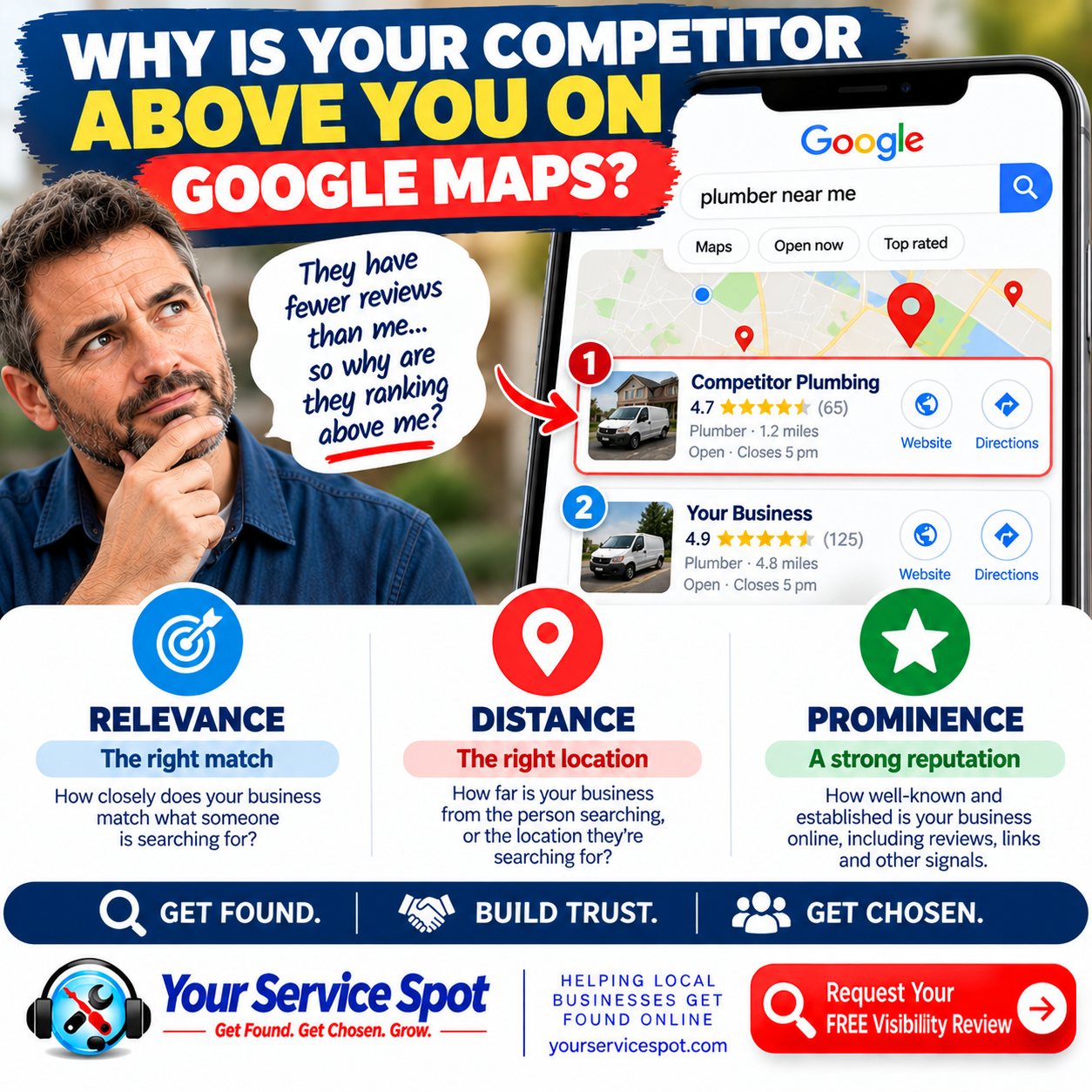
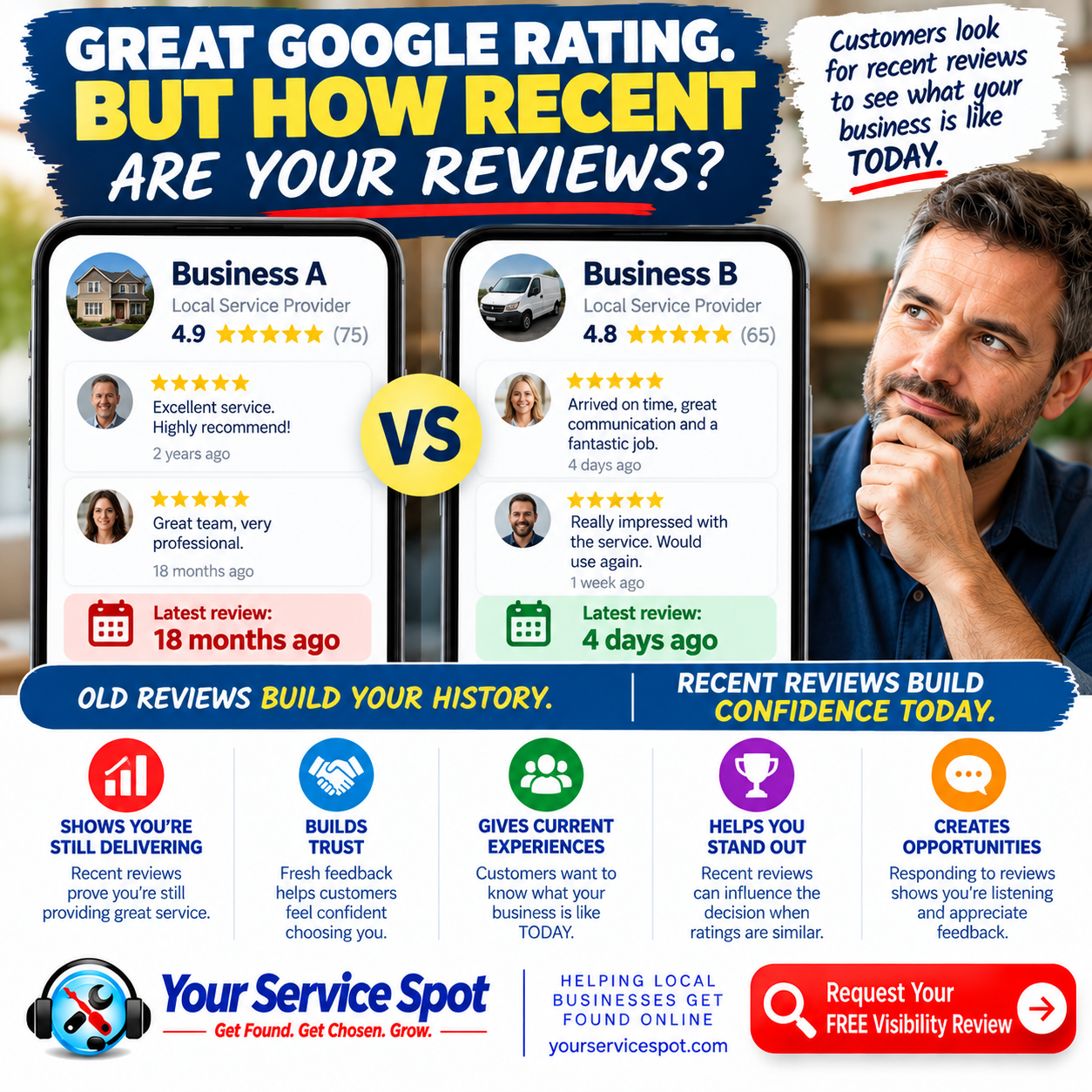
Remember that reviews are primarily about real customer experiences, not manipulating AI-generated recommendations. Read our guide on why recent Google reviews matter.
-
Answer Real Customer Questions
Think about the questions customers ask before purchasing:
- How much does your service cost?
- Which areas do you cover?
- How long does the work take?
- What qualifications or experience do you have?
- What should customers expect?
Answer those questions clearly on relevant service pages or in helpful articles.
This improves the usefulness of your website and provides more information that AI-powered search systems may be able to retrieve.
-
Keep Your Business Information Accurate
Check that your business name, contact details, services and location information are accurate wherever they appear.
Correct outdated listings and maintain your website.
Inconsistent or incorrect information can confuse customers and may contribute to inaccurate descriptions when information is gathered from multiple sources.
-
Make Sure Your Website Can Be Accessed
A technically sound website is important.
Check that your key pages load properly, work on mobile devices and don’t accidentally block search engines or relevant AI search crawlers.
Some AI services publish information about their crawlers and website access controls.
You don’t need to understand every technical detail, but it’s worth ensuring your website isn’t unintentionally preventing useful content from being discovered.
Read our article about website SEO problems that affect visibility.
-
Can You Guarantee That ChatGPT Will Recommend Your Business?
No.
And this is an important point.
No marketing agency can legitimately guarantee that ChatGPT, Gemini or Perplexity will recommend a particular business for every relevant question:
- AI-generated answers can vary.
- Platforms use different systems and sources.
- And their recommendations are influenced by the context of each question.
- Even businesses with strong websites and excellent reputations may not appear in every answer.
Be cautious of anyone promising guaranteed inclusion or permanent first-place positioning in AI-generated recommendations.
A credible AI visibility strategy focuses on improving discoverability, information quality and the ability to measure results — not promising control over independent AI platforms.
-
How Do You Measure AI Search Visibility?
AI visibility measurement is still developing.
Unlike traditional website analytics, there isn’t one universal dashboard showing every time an AI platform mentions your business.
However, you can track useful indicators.
Business Mentions
How often does your business appear across a consistent set of relevant questions?
Accuracy
When your business appears, are the services, location and other details correct?
Website Citations
Do AI platforms link to your website as a supporting source?
Competitor Comparisons
Which competitors appear for the same questions?
Are there recurring differences worth investigating?
Website Traffic and Enquiries
Where your analytics provide reliable information, look for visits and enquiries associated with AI platforms.
Be aware that not all AI-influenced customer journeys will be identifiable through website analytics.
Changes Over Time
Repeat a consistent set of tests periodically.
Look for meaningful patterns rather than reacting to every individual response.
A sensible assessment should distinguish between what has been directly observed and what remains uncertain.
-
Common AI Visibility Mistakes Small Businesses Should Avoid
As interest in AI search grows, it’s easy to become distracted by promises of shortcuts.
Here are several mistakes worth avoiding.
Assuming a Google ranking guarantees AI visibility
Traditional search rankings and AI-generated recommendations aren’t identical.
Checking one question and drawing a conclusion
A single response is only a snapshot.
Publishing large amounts of low-quality AI-generated content
Content should be accurate, helpful and relevant to customers.
Ignoring your existing website and Google Business Profile
AI visibility should complement established digital marketing foundations.
Treating AI mentions as guaranteed sales opportunities
Being mentioned doesn’t mean a customer will visit your website or make an enquiry.
Believing you can force AI systems to recommend you
No business controls every platform’s independent answers.
Forgetting the customer experience
Being discovered is valuable, but customers still need convincing reasons to choose you.
-
AI Visibility and Google Visibility Should Work Together
For most small businesses, the sensible strategy isn’t to abandon Google SEO and concentrate entirely on AI.
It’s to develop a consistent online presence across the places customers use to research businesses.
That means:
- A complete and accurate Google Business Profile
- A clear, useful website
- Relevant service and location information
- Genuine customer reviews
- Helpful answers to common customer questions
- Accurate business information across reputable sources
- Regular checks of AI-generated answers
These activities reinforce the same fundamental objective.
Make your business easier to discover, easier to understand and easier to trust.
At Your Service Spot, we believe visibility should lead somewhere.
GET FOUND → BUILD TRUST → GET CHOSEN → GENERATE ENQUIRIES
That principle applies whether someone discovers your business through Google Maps, a traditional search result or an AI-generated answer.
See our guide on how to turn website visitors into enquiries.
-
The First Step: Find Out Where You Stand
You don’t need to redesign your entire website or invest in complicated technology to begin investigating AI search visibility.
Start by asking a few simple questions.
When customers ask AI platforms for businesses offering your services:
Does your business appear?
If it appears, is the information accurate?
If it doesn’t, which competitors are being mentioned?
And what information might help customers and AI-powered systems understand your business better?
Those questions can reveal useful opportunities.
The key is to start with evidence rather than assumptions.
Is Your Business Being Found and Recommended by AI?
Your potential customers may already be using ChatGPT, Gemini and Perplexity to research businesses like yours.
But do you know what those platforms say about your company?
Or whether they mention it at all?
At Your Service Spot, we help small businesses understand their visibility across Google and AI-powered search platforms.
We identify opportunities to improve business information, website content, local search visibility and customer trust.
Request Your FREE Visibility Review
Discover where your business may be missing opportunities to get found online — and what you could do to improve.
Get Found. Get Chosen. Grow.
Frequently Asked Questions About AI Search Visibility
What is AI search visibility?
AI search visibility describes how easily a business can be discovered, mentioned and accurately represented in answers generated by AI-powered platforms such as ChatGPT, Gemini and Perplexity.
How can I check whether my business appears in ChatGPT?
Ask ChatGPT questions that potential customers might use when looking for your services. Where available, use current web search. Test several relevant questions and check whether your business appears, how accurately it’s described and whether supporting sources are provided.
Can I get my business recommended by ChatGPT?
You can improve the clarity, accessibility and quality of information about your business, which may improve opportunities for discovery. However, there’s no guaranteed method of making ChatGPT recommend a particular company.
Does your Google Business Profile help AI visibility?
A complete Google Business Profile is valuable for Google Search and Maps and helps maintain accurate business information online. However, it doesn’t guarantee that your business will appear in AI-generated recommendations, and different AI platforms may use different information sources.
Is AI SEO different from traditional SEO?
AI search visibility introduces additional considerations, such as how a business is described or cited in AI-generated answers. However, many established SEO practices — clear content, accurate information, accessible websites and a credible online presence — remain relevant.
Do I need a website to appear in AI search?
Not necessarily. AI platforms may find information about businesses through various public sources. However, a website gives you a valuable opportunity to publish accurate, detailed information about your services, locations and expertise.
Which AI search platform is most important for small businesses?
That depends on your customers and how they research services. ChatGPT, Gemini and Perplexity are useful platforms to investigate, alongside Google’s AI-powered search experiences. Avoid assuming that performance on one platform represents your visibility everywhere.
How do AI platforms decide which businesses to recommend?
There is no single ranking formula shared by all AI platforms. Depending on the platform, responses may involve language models, retrieved web information, location context and other signals. The exact processes and source-selection methods differ.
How long does it take to improve AI search visibility?
There’s no guaranteed timeframe. Improvements to website content and business information may take time to become accessible or reflected in AI-powered systems. Results can vary between platforms and individual questions.
Can AI platforms provide incorrect information about my business?
Yes. AI-generated answers can contain errors, outdated information or unsupported claims. That’s one reason to check how your business is described and maintain accurate information across your online presence.
Are customer reviews important for AI visibility?
Reviews can help customers evaluate businesses and contribute to their online reputations. Some AI systems may access or reference review-related information, but this varies by platform. There is no universal guarantee that collecting more reviews will increase AI recommendations.
How do I measure AI visibility?
Start by tracking mentions, accuracy, citations and competitor appearances across a consistent set of relevant questions. Where available, combine those findings with website analytics and enquiry data. Interpret results as indicators rather than exact measures of every AI-assisted customer journey.
Can an agency guarantee first place in AI recommendations?
No reputable agency should promise guaranteed first-place recommendations across independent AI platforms. A credible service should focus on evidence-based improvements, clear reporting and realistic expectations.