Is Mobile SEO Worth It for Small Businesses? Real Costs, Results & ROI Explained
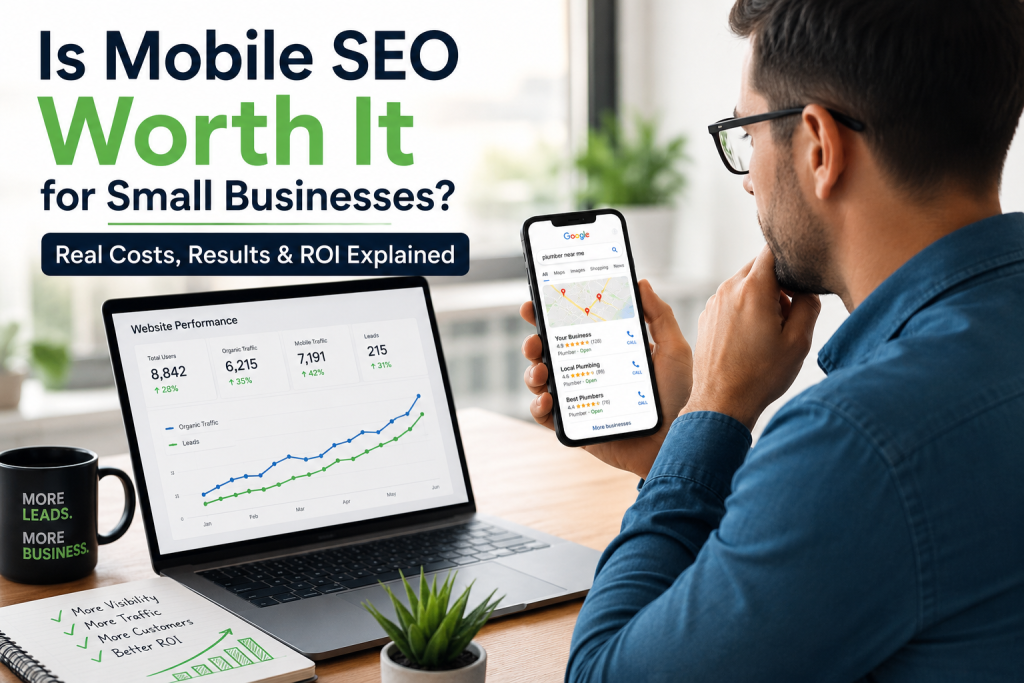
If you’ve been researching ways to get more customers online, you’ve probably come across Mobile SEO.
You’ve also probably seen plenty of marketing agencies claiming it can transform your business, increase traffic, and generate more leads.
Naturally, you’re wondering whether Mobile SEO is actually worth the investment.
It’s a fair question.
Many small business owners have spent money on websites, advertising, SEO, social media, and other marketing services only to see little return. Before investing in Mobile SEO, you want proof that it can work for your business.
The good news is that Mobile SEO can deliver excellent results when it’s implemented correctly. The key is understanding what it does, what it costs, how long it takes, and how to measure success.
In this guide, we’ll explain the real costs, expected results, potential return on investment, and whether Mobile SEO makes sense for your business.
What Is Mobile SEO?
Mobile SEO is the process of optimising your website so it performs well on smartphones and tablets.
This includes:
- Faster page loading times
- Mobile-friendly website design
- Responsive layouts
- Improved navigation
- Easy-to-read content
- Click-to-call functionality
- Better user experience
- Strong mobile search rankings
Google now uses mobile-first indexing. This means Google primarily evaluates the mobile version of your website when determining search rankings.
If your website performs poorly on mobile devices, your rankings, traffic, and lead generation can all suffer.
Why Mobile SEO Matters More Than Ever
Take a moment to think about how people search for local businesses today.
Someone needs an emergency plumber.
A homeowner wants a pool cleaning company.
A patient is looking for a chiropractor.
A dog owner needs a trainer.
What do they do?
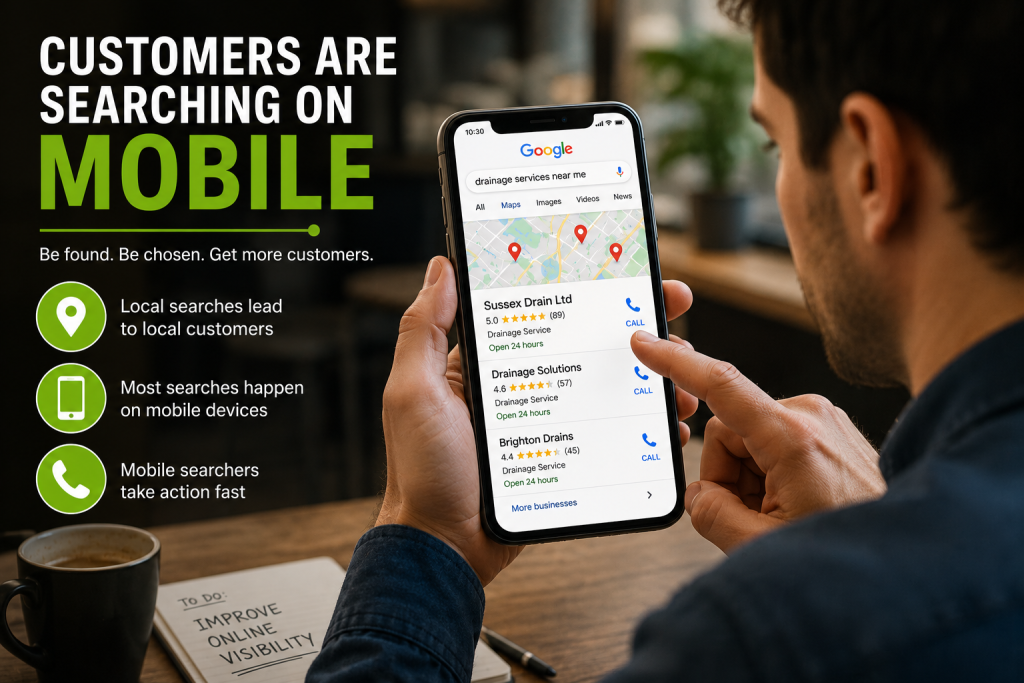
They pull out their phone and search.
They aren’t waiting until they get home to sit at a desktop computer.
According to industry studies, most local searches now happen on mobile devices. If your website loads slowly, displays incorrectly, or is difficult to use, potential customers often leave and contact a competitor.
That’s not speculation. We see it regularly during visibility audits conducted for local businesses.
At Your Service Spot, we’ve reviewed websites across multiple industries including dentists, chiropractors, osteopaths, pet services, pool companies, and tour operators. One of the most common issues we find is poor mobile usability that directly impacts lead generation.
In many cases, business owners don’t realise they’re losing customers because everything looks fine on their own desktop computer.
How Google Evaluates Mobile Websites
Google looks at several factors when assessing mobile performance:
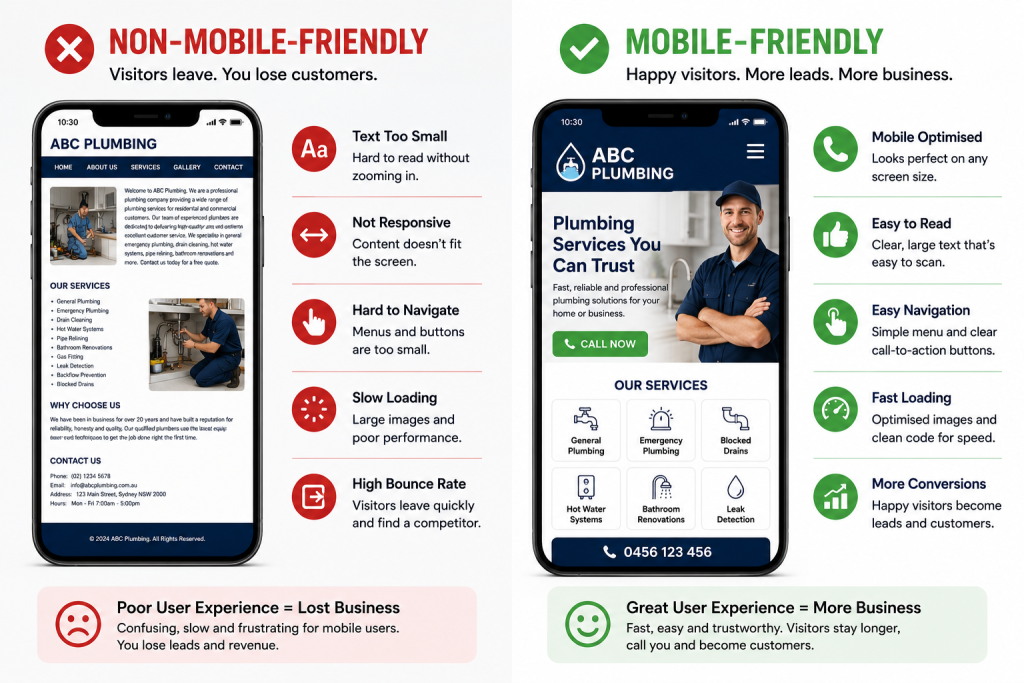
Mobile Friendliness
Your website should display properly on all screen sizes.
Users should not need to zoom in, scroll horizontally, or struggle to click buttons.
Page Speed
Fast websites create better user experiences.
Slow websites increase bounce rates and reduce conversions.
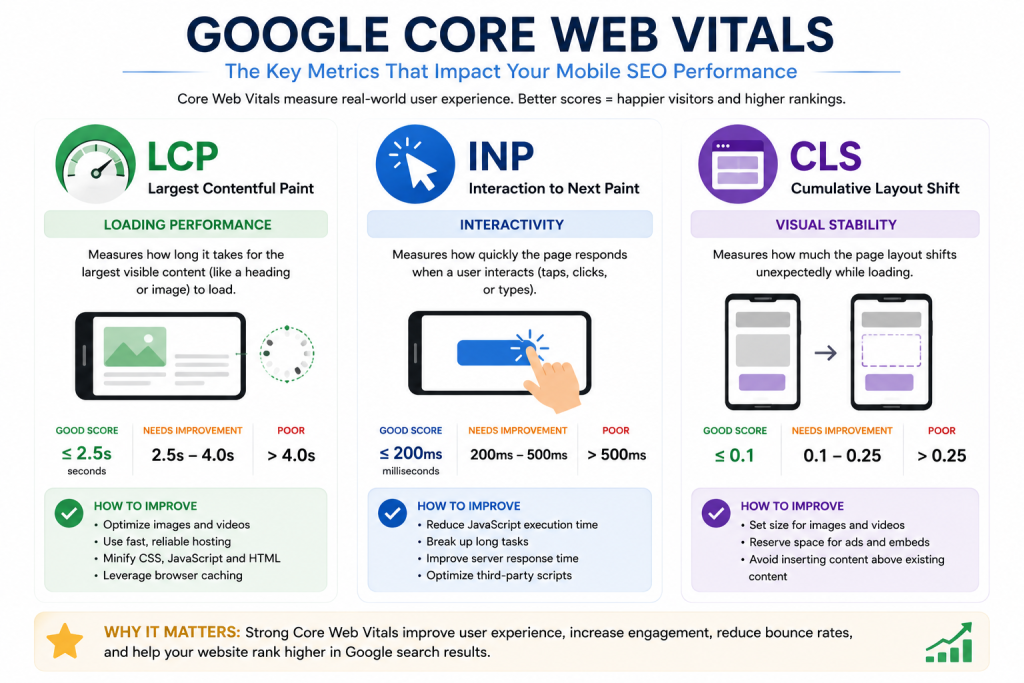
Core Web Vitals
Google measures:
- Loading performance
- Visual stability
- Interactivity
These metrics help Google determine whether visitors are having a positive experience.
User Experience
Google wants visitors to find information quickly and easily.
A confusing mobile experience can negatively affect rankings and conversions.
Content Accessibility
Content should be readable and usable on smaller screens.
Large blocks of text and poor formatting can hurt engagement.
How Much Does Mobile SEO Cost?
Costs vary depending on your website, competition, and goals.
Typical UK pricing often falls into these ranges:
DIY Improvements
£0 – £300
Suitable for business owners willing to learn and implement improvements themselves.
One-Time Optimisation
£300 – £2,500+
Suitable for businesses with specific technical or mobile usability issues.
Ongoing SEO Campaigns
£500 – £3,000+ per month
Suitable for businesses seeking long-term growth and ongoing lead generation.
The cheapest option isn’t always the most cost-effective.
A business losing several enquiries every month due to poor mobile performance could be sacrificing far more revenue than the cost of fixing the problem.
How Long Does Mobile SEO Take To Work?
This is one of the most common questions we receive.
The honest answer is that Mobile SEO isn’t a quick fix.
Results typically follow this timeline:
30-60 Days
- Technical issues corrected
- Faster page speeds
- Improved user experience
- Better mobile usability
60-90 Days
- Ranking improvements may begin
- Increased visibility in search results
- More website engagement
3-6 Months
- Stronger traffic growth
- More enquiries
- Increased lead generation
- Better overall ROI
The timeline depends on factors such as competition, website quality, local market conditions, and existing SEO performance.
What Results Can Small Businesses Expect?
The real purpose of Mobile SEO isn’t rankings.
It’s generating more customers.
A properly optimised mobile website can help improve:
- Phone calls
- Contact form enquiries
- Quote requests
- Appointment bookings
- Google Business Profile interactions
- Direction requests
- Website engagement
- Conversion rates
Many business owners focus entirely on traffic.
Traffic matters.
However, conversion rates matter more.
If 100 visitors arrive on your website and nobody contacts you, the traffic has little value.
If 50 visitors arrive and several become customers, the website is performing effectively.
A Simple ROI Example
Let’s look at a realistic example.
Suppose you’re a local service business.
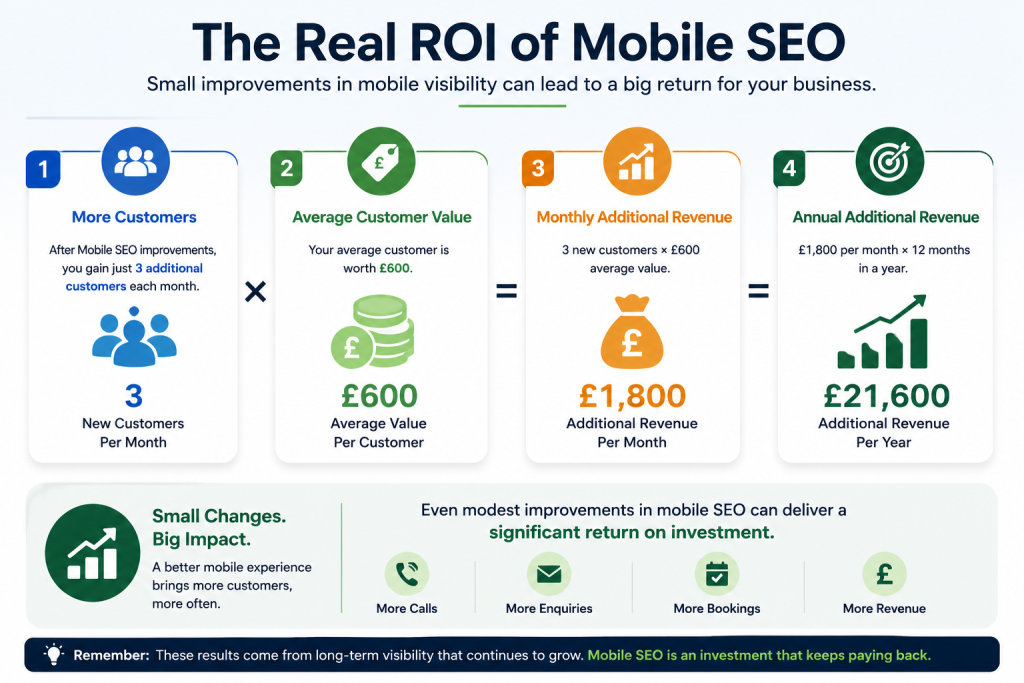
Your average customer is worth £600.
After improving your mobile website, you generate just three additional customers per month.
3 customers × £600 = £1,800 additional monthly revenue
Over 12 months:
£1,800 × 12 = £21,600 additional annual revenue
Even modest improvements can produce significant returns when customer values are relatively high.
This is why Mobile SEO should be viewed as an investment rather than an expense.
Mobile SEO vs Google Ads
Many business owners compare SEO with Google Ads.
Both have advantages.
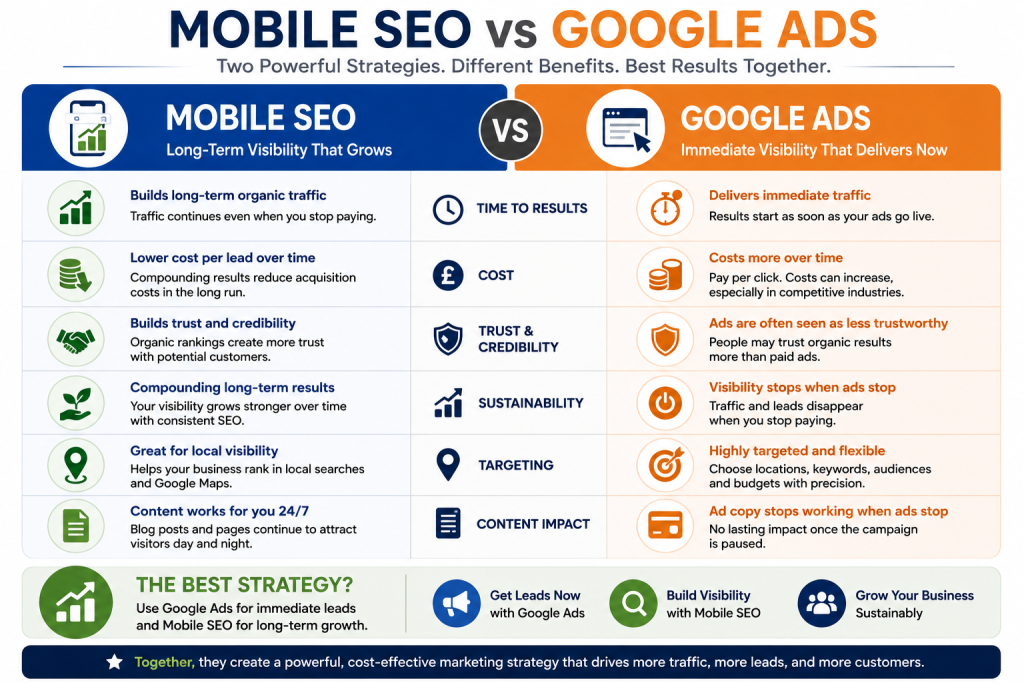
Google Ads
Benefits:
- Immediate visibility
- Fast traffic
- Predictable targeting
Drawbacks:
- Traffic stops when spending stops
- Cost per click continues to increase
- Can become expensive over time
Mobile SEO
Benefits:
- Long-term visibility
- Compounding results
- Lower cost per lead over time
- Improved user experience
- Increased trust and credibility
Drawbacks:
- Takes longer to see results
- Requires ongoing optimisation
The strongest businesses often use both strategies together.
Google Ads generates immediate leads while Mobile SEO builds long-term visibility and authority.
Common Reasons Mobile SEO Fails
It’s important to be honest.
Mobile SEO doesn’t always work.
The businesses that struggle usually make one or more of these mistakes:
Focusing Only On Rankings
Higher rankings don’t automatically create customers.
Lead generation should always be the primary objective.
Ignoring Website Conversions
A website that ranks well but fails to convert visitors will still underperform.
Choosing Cheap SEO Services
Low-cost SEO often focuses on shortcuts rather than sustainable growth.
Neglecting Local SEO
Many local businesses need both Mobile SEO and Local SEO to maximise visibility.
Expecting Instant Results
SEO is a long-term strategy.
Businesses expecting overnight success often become disappointed too quickly.
When Mobile SEO Is Worth It
Mobile SEO is usually worthwhile if:
- You rely on local customers
- You want more enquiries
- Your competitors rank above you
- Your website receives mobile traffic
- Your website loads slowly
- Your mobile experience needs improvement
- You want sustainable lead generation
For most local businesses, the answer is yes.
When Mobile SEO May Not Be The Best First Step
Mobile SEO may not be your highest priority if:
- You don’t yet have a website
- Your business is not actively seeking growth
- Your website already performs exceptionally well
- You have major sales or service delivery issues that need solving first
In these situations, other improvements may generate faster results.
Why Your Service Spot Recommends Starting With A Visibility Audit
One of the biggest mistakes business owners make is paying for services before understanding what’s actually wrong.
At Your Service Spot, we recommend starting with a Visibility Audit.
This allows us to identify:
- Mobile usability issues
- Website performance problems
- Local SEO opportunities
- Google Business Profile weaknesses
- Lead generation bottlenecks
- Competitor advantages
Once you understand where opportunities exist, you can make informed decisions based on evidence rather than guesswork.
Frequently Asked Questions
Does Mobile SEO Really Work?
Yes. Mobile SEO can improve user experience, search visibility, and lead generation when implemented correctly.
Is Mobile SEO Worth It For Small Businesses?
In most cases, yes. Businesses that rely on local customers often benefit significantly from better mobile visibility and usability.
How Much Does Mobile SEO Cost?
Costs range from a few hundred pounds for basic improvements to several thousand pounds for comprehensive campaigns.
How Long Does Mobile SEO Take?
Most businesses begin seeing improvements within 30-90 days, with stronger results developing over several months.
Can Mobile SEO Increase Leads?
Yes. Better mobile experiences often increase calls, enquiries, bookings, and conversions.
Is Mobile SEO Better Than Google Ads?
They’re different strategies. Google Ads generates immediate traffic, while Mobile SEO creates long-term visibility and lower acquisition costs over time.
What Is Mobile-First Indexing?
Mobile-first indexing means Google primarily uses the mobile version of your website when determining rankings.
How Can I Check My Website’s Mobile Performance?
Tools such as Google PageSpeed Insights can provide valuable information about speed, usability, and performance.
Final Verdict
So, is Mobile SEO worth it for small businesses?
For most businesses, absolutely.
Your customers are searching on mobile devices every day. If your website isn’t providing a fast, user-friendly experience, you’re likely losing enquiries to competitors who are.
Mobile SEO isn’t magic.
It won’t fix every marketing problem overnight.
However, when combined with strong local SEO, clear messaging, and effective conversion optimisation, it can become one of the most valuable long-term investments a business makes.
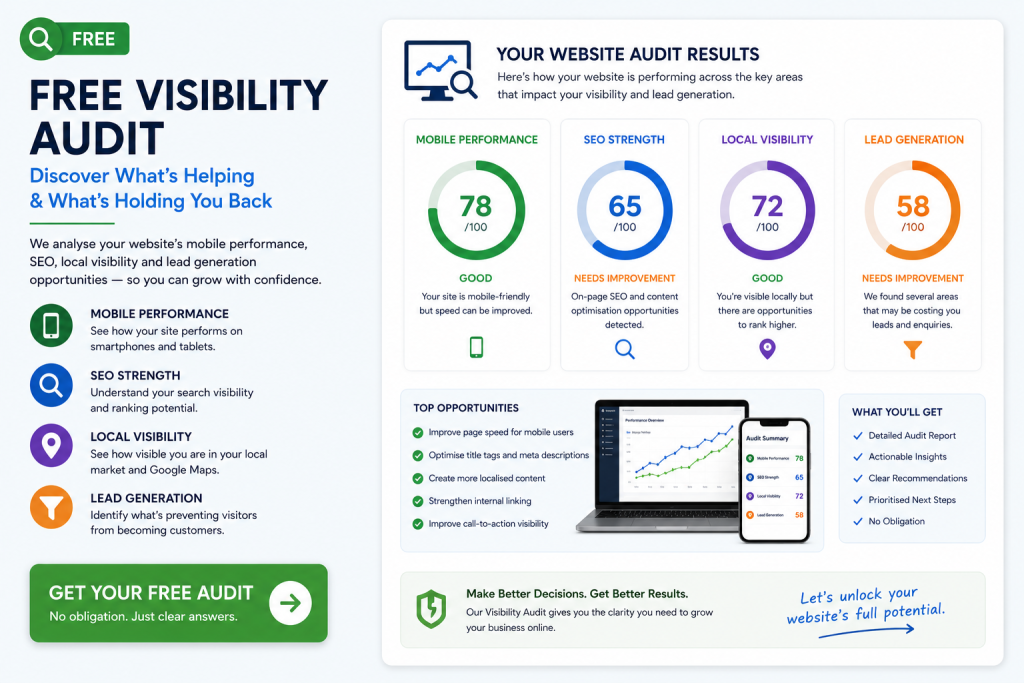
Get Your Free Visibility Audit
Wondering whether your website is helping or hurting your ability to attract customers?
Your Service Spot can review your website, mobile performance, local visibility, and lead generation opportunities.
Request your free Visibility Audit today and discover what could be holding your business back.